
The quick version:
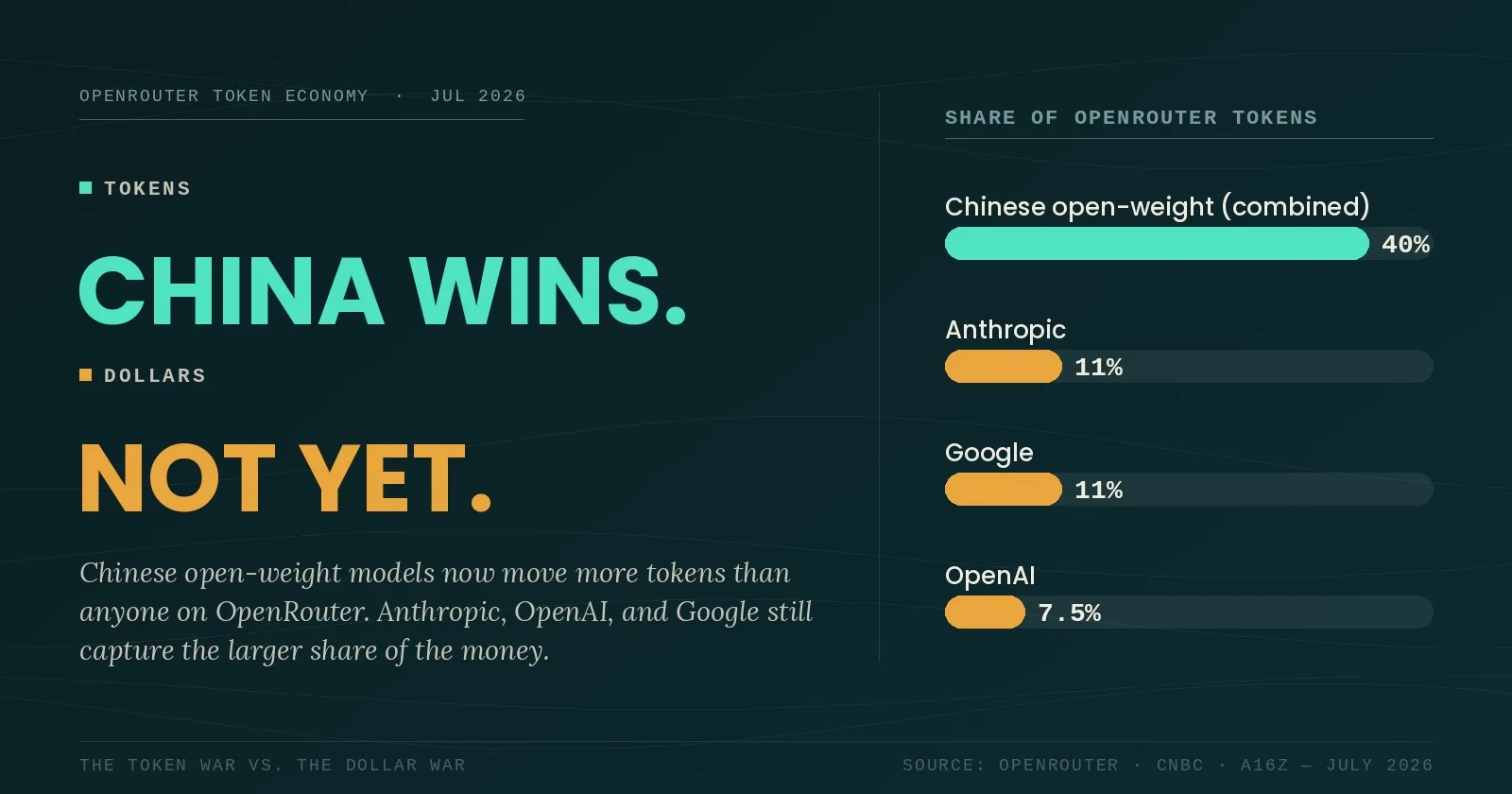
Chinese open-weight models (DeepSeek, GLM, Kimi, Qwen, MiMo, and others) now account for somewhere between 30% and 61% of OpenRouter's traffic, depending on exactly what you measure.
The most rigorous number — sustained weekly share of US company traffic — has held above 30% every week since February 8, 2026, peaking at 46%. A year ago it averaged 11%.
They're winning on tokens. Anthropic, OpenAI, and Google still win on dollars, because their models are priced as a premium product, not a commodity one.
Coinbase, Lindy, and (quietly) Cursor have already shipped production systems built on these models. This isn't a developer-forum curiosity anymore — it's a line item in real budgets.
Here's the full picture.
If you've seen the line "Chinese open-weight models now serve 45% of all OpenRouter traffic," you've seen a real number. You've also seen a number attached to a screenshot from roughly April 2026, quietly reposted unchanged ever since.
It isn't wrong. It also isn't the most current or most precise version of what's happening. The gap between the headline and the underlying data tells you more about this market than the stat itself does.
Days before this was written, CNBC reported something more current and more conservative: Chinese-origin models have held more than 30% of the tokens US companies route through OpenRouter every single week since February 8, 2026, peaking as high as 46%. A year earlier, that average was 11%. In the first half of 2025, it was 4.5%.
Justin Summerville, who works on data and analytics at OpenRouter, gave CNBC a blunt explanation: leading Chinese open models run 60% to 90% cheaper than comparable Anthropic and OpenAI offerings. Teams are routing anything that doesn't need the absolute best model to whichever one is cheapest and good enough. Harpreet Arora, who heads agentic infrastructure at Vercel, put it more bluntly still to CNBC: price is doing the work here, and the recent wave of Chinese models is winning that trade.
So is it 45%, 46%, or 61%? All three — depending on what exactly you're measuring. That distinction is worth walking through in full, because "China is winning" is not, on its own, an engineering decision.
Four numbers, four different questions
OpenRouter's public rankings, and the reporting built on top of them, have produced at least four distinct figures over the past year. They get conflated constantly.
What was measured | Window | Chinese-model share | Source |
|---|---|---|---|
Full-year weekly average, all models | Nov 2024 – Nov 2025 | ~13% average, ~30% at peak weeks | OpenRouter × a16z, 100-trillion-token study |
All-model snapshot | April 2026 | 45%+ | OpenRouter rankings roundups |
Top-10 models only, single week | Week of Feb 24, 2026 | ~61% | CNBC / OpenRouter |
US company traffic, sustained weekly | Feb 8, 2026 – present | 30%–46% | CNBC, reported July 7, 2026 |
None of these is "the" number. Each is a legitimate way to slice the data.
The 61% figure only holds if you throw out everything outside the top 10 models. That concentrates Chinese share, because those slots are dominated by coding and agentic workloads — exactly where the cost gap matters most.
The 45% figure is an all-model, all-traffic snapshot from one specific week, repeated in dozens of posts since without a fresh pull.
The 30–46% range is the most rigorously sourced of the four. It covers a sustained five-month run rather than a single peak week, scoped specifically to US company traffic — the number that should matter most if you're a US-based team deciding where to route your own calls.
Bottom line: on any reasonable measure, Chinese open-weight models now account for somewhere between a third and a majority of OpenRouter's token volume. The trend line has only gone one direction since late 2024.
How fast this actually happened
The trajectory is the part that's easy to undersell.
OpenRouter and Andreessen Horowitz jointly analyzed 100 trillion tokens of platform traffic and found Chinese-developed models sitting at a weekly share as low as 1.2% in late 2024. From there:
DeepSeek V3's release in December 2024, then R1 in early 2025, started the climb.
By some weeks in 2025, the figure touched nearly 30%.
Kimi K2 and MiniMax's mid-2025 releases pushed the trend further.
By February 2026, sustained weekly share crossed 30% and hasn't dropped back since.
That's a move from roughly one in a hundred tokens to something like one in three, in about fourteen months — on a platform that itself exploded over the same period. OpenRouter disclosed weekly traffic of 25 trillion tokens around its $113 million Series B in late May 2026, up 5x from just six months earlier. The company now serves more than 8 million developers across 400+ models.
The Chinese-model share didn't just grow as a percentage. It grew as a percentage of a much bigger number.
Who's actually taking the share
No single Chinese lab is responsible for this — and the story of how the current leader announced itself is a good illustration of how fast this market moves.
In March 2026, an anonymous model calling itself "Hunter Alpha" quietly appeared on OpenRouter and started topping the daily usage charts, completely free, against developers who assumed it must be an unreleased DeepSeek build. A week later, Xiaomi revealed Hunter Alpha was an early test build of its own MiMo-V2-Pro — a trillion-parameter model from a company best known for phones. By early April, Xiaomi held 21.1% of all weekly OpenRouter tokens, roughly three times OpenAI's 7.5% share that same week.
A broader snapshot from that period broke the rest of the field down like this:
Xiaomi (MiMo family): ~21% of weekly tokens
Alibaba (Qwen family): ~14%
MiniMax, Zhipu (Z.ai), DeepSeek, and StepFun combined: roughly a quarter of traffic
Anthropic and Google: each holding low double digits
The exact ranking shuffles week to week as new releases land, and different snapshots taken just weeks apart put the same providers at noticeably different shares — which is itself the whole point of this piece. But the direction is unambiguous.
Z.ai's GLM 5.2 went further still. According to Vercel's own platform tracking, it was the fastest-adopted model the company measured in 2026, with daily token volume up roughly 27x and customer count up roughly 80x in its first full week after launch. DeepSeek V4 Flash, meanwhile, became the first open-weight model teams routinely dropped into production agentic pipelines as a genuine substitute for a frontier closed model.
The names worth knowing right now, if you're choosing where to route:
DeepSeek (V4 Flash and V4 Pro)
Zhipu / Z.ai (GLM 5.2)
Moonshot AI (Kimi K2.6 and K2.7 Code)
MiniMax (M3)
Alibaba (Qwen3.x)
Xiaomi (MiMo)
All are open-weight. Most ship an MIT or MIT-adjacent license.
The split nobody puts in the headline
Here's the part that actually changes how you should think about this: token share is not dollar share, and the gap between the two is the real story.
Anthropic's share of tokens on OpenRouter sits somewhere around 11–12% depending on the week measured — a fraction of the Chinese open-weight bloc's combined share. But Anthropic's share of dollars spent is far higher, because its models are priced as a premium product rather than a commodity one.
One widely cited comparison from CNBC's reporting put the cost of running the Artificial Analysis Intelligence Index benchmark suite at roughly $4,811 on Claude and $3,357 on ChatGPT, versus $544 on Zhipu's GLM for the same workload.
The pricing gap at the model level is just as stark:
Model | Input ($/M tokens) | Output ($/M tokens) |
|---|---|---|
DeepSeek V4 Flash (first-party, post-discount) | $0.14 | $0.28 |
MiniMax M3 (OpenRouter weighted avg.) | ~$0.10 | ~$1.21 |
Z.ai GLM 5.2 (OpenRouter weighted avg.) | ~$0.45 | ~$3.31 |
Claude Opus-class | ~$5 | ~$25 |
DeepSeek made its 75% price cut permanent in May 2026; with prompt caching layered on top, realized input cost drops closer to $0.03 per million tokens. The 60-to-90% discount Summerville described to CNBC stops sounding like marketing and starts looking like arithmetic once you line those numbers up.
What this means in practice: OpenRouter now effectively routes two different markets through the same pipes. A commodity lane, dominated by Chinese open-weight models, wins on pure token volume — agentic and coding workloads call a model thousands of times per session, so per-call cost compounds fast. A premium lane, still led by Anthropic, OpenAI, and Google, retains disproportionate dollar share, because some workloads are still worth paying for the extra few points of reliability. Both lanes are growing. They're just growing differently.
This has already left the "interesting benchmark" phase
The clearest signal that this isn't a developer-forum curiosity is who has already switched in production — and a couple of these stories are more dramatic than a one-line mention suggests.
Coinbase cut internal AI spending by almost 50% in late June by routing engineers through a gateway that defaults to Zhipu’s GLM 5.2 and Moonshot’s Kimi K2.7, even as token use kept climbing. CEO Brian Armstrong said engineers can still request frontier models for truly complex tasks, but 91% never hit their former usage caps. The main driver was boosting the cache‑hit rate from 5% to 60%; cheaper defaults and more efficient routing made up the rest. The cost drop stemmed from low‑cost defaults and infrastructure improvements, not usage limits.
Lindy, a 25-person AI agent startup, went further: it moved 100% of its traffic off Anthropic's Claude models onto DeepSeek V4, hosted through a US-based provider. CEO Flo Crivello said the move would save the company millions and that inference cost had grown larger than payroll — "a matter of survival for the business," in his words to CNBC. He's also been candid that the migration was far more work than expected, and that he'd consider switching back if Anthropic's pricing changed.
Cursor’s story matters because its Composer 2 model, marketed as an in‑house, frontier system, actually builds on Moonshot AI’s Kimi K2.5. API analysis identified Kimi signatures, and Moonshot confirmed that Kimi K2.5 is the underlying base, with Cursor adding extensive pre‑training and reinforcement learning through a licensed partnership. A co‑founder acknowledged the failure to disclose this foundation, turning the incident into a case study on what firms owe users when “proprietary” products are merely fine‑tuned open‑weight models—yet Cursor repeats the approach with Composer 2.5.
Microsoft, meanwhile, has confirmed it's evaluating a fine-tuned, Azure-hosted version of DeepSeek V4 as a cheaper backend option for Copilot Cowork, alongside its existing Anthropic and OpenAI models — any such option would be optional for customers and fully hosted on Microsoft's own infrastructure.
And at the investor level: a16z general partner Martin Casado has said that when startups pitch the firm today, there's roughly an 80% chance they're already running a Chinese open-source model somewhere in their stack.
None of this reads as experimentation. It reads as line items in real budgets.
The gap that hasn't closed — and the one that has
None of the above means open-weight has caught up everywhere. Pretending otherwise would undercut the whole point of measuring this carefully.
On Artificial Analysis's Intelligence Index (v4.1), the top open-weight model as of late June 2026, Z.ai's GLM 5.2, scored 51. Nvidia's Nemotron 3 Ultra followed at 48, then MiniMax M3 and DeepSeek V4 Pro tied at 44, and Kimi K2.6 at 43. Claude Fable 5 topped the reasoning-model leaderboard at 60 — a gap of roughly five to nine points between the best open-weight model and the frontier.
Kyle Chan, a fellow at the Brookings Institution's John L. Thornton China Center, put the practical gap at six to nine months behind the US frontier — a figure that's held roughly steady even as both sides keep shipping. A separate CAISI (Center for AI Standards and Innovation) evaluation using held-out benchmarks put DeepSeek V4 Pro specifically at closer to eight months behind, while calling it the most capable Chinese model it had tested.
Coding is the exception, and a meaningful one. DeepSeek V4 Pro scores around 80.6% on SWE-bench Verified — competitive with, and by some measures tied with, top closed models on that benchmark. On the harder, less contamination-prone SWE-bench Pro variant, Kimi K2.6 and GLM 5.2 have both posted scores at or above GPT-5.5's reported number on the same test. For the specific workload that dominates OpenRouter's top-line token counts — agentic coding — the open-weight frontier isn't trailing by much anymore, if at all.
The real-world numbers back this up in a way benchmarks alone can't. Snowflake CEO Sridhar Ramaswamy ran his own head-to-head: on 103 real coding tasks, GLM 5.2 solved 66% and Claude Opus 4.7 solved 67% — a gap that's arguably not worth 5-7x the price. GLM was less consistent on individual tasks (it occasionally chased the wrong approach for dozens of calls before failing), but on the aggregate, the difference is thin enough that "good enough for a fraction of the price" is a defensible engineering call, not a compromise.
There's also a risk dimension that pure benchmark comparisons skip past, worth stating plainly rather than folding into a footnote.
Chinese AI companies operate under China's National Intelligence Law, which requires cooperation with government intelligence requests regardless of where servers are physically located or what a privacy policy says. DeepSeek's first-party API explicitly retains and trains on submitted data. No-train Western hosting options exist through providers like Fireworks, Together, and DeepInfra, typically at roughly double the first-party price — which is exactly the workaround Lindy used. Government devices in the US, Taiwan, South Korea, Italy, and Australia are barred from running DeepSeek specifically.
That's a genuinely different calculus for a marketing-copy generator than for a codebase containing customer financial data. OpenRouter's own model pages expose provider country of origin and data-policy controls precisely so you can make that call per workload rather than per vendor.
Worth noting for context: the US Commerce Department briefly imposed export controls in June 2026 that forced Anthropic to suspend access to its own Fable 5 and Mythos 5 models, before restoring it on July 1. That kind of availability risk, on any vendor, is part of why some teams are deliberately diversifying away from single-vendor dependence — regardless of country of origin. Anthropic's own account of that episode is posted at anthropic.com/news/fable-mythos-access.
What this actually means for how you build
If you're still routing every call to a single frontier provider out of habit rather than evaluation, that habit is now measurably expensive. The market data says so more convincingly than any vendor's pricing page.
The practical shift underway among the teams above isn't "switch everything to a Chinese model." It's task-based routing:
Send planning, architecture decisions, and anything genuinely hard to the model worth the premium.
Send high-volume execution work — code review, summarization, repetitive agent steps — to whichever open-weight model clears your own bar at the lowest price.
Building that bar yourself matters more than trusting anyone's leaderboard, including this one. A workable version of the eval a few of the teams above have described:
Pull twenty real issues from your own repositories.
Mix in tests, migrations, ambiguous bugs, and a few "do not touch this file" constraints.
Run each candidate model against the set.
Measure compile rate, test-pass rate, diff quality, and token cost per resolved issue.
The benchmark tables tell you where to start looking. Your own repo tells you where to actually route.
Checking the numbers yourself
OpenRouter's public rankings page updates continuously and is the closest thing to ground truth here, broken down by model, provider, and category.
If you want raw daily token totals for the top 50 models programmatically, OpenRouter's rankings API endpoint does exactly that — per-day token totals by model, plus an aggregated row for everything outside the top 50, which is exactly what you need to compute a top-N-versus-total share yourself instead of trusting someone else's snapshot. It requires a standard OpenRouter API key and is rate-limited to 30 requests a minute.
Bottom line
The 45% number isn't fake. It's a single frame from a video that's still playing, and the frame keeps changing week to week. What's real, and what the frame doesn't capture: Chinese open-weight models won the token war some time in the last year, decisively enough that Coinbase, Lindy, and a growing list of others have made it a board-level talking point. Whether they've won your dollar war is a question your own eval set should answer — not a screenshot from April.
Pull your own numbers before you make a routing decision based on somebody else's.
Quick FAQ
Is the "45% of OpenRouter traffic" stat real? Yes, but it's a snapshot from one week in April 2026, not a current or sustained figure. The more current, more rigorously sourced number is 30–46% of US company traffic, sustained weekly since February 8, 2026.
Should I switch everything to a Chinese open-weight model? No — the teams actually doing this aren't switching everything. They're routing routine, high-volume work to cheaper open-weight models and reserving premium models for the hardest planning and reasoning tasks.
What's the actual capability gap right now? Roughly six to nine months behind the closed frontier on general benchmarks, according to Brookings' Kyle Chan — but at or near parity on agentic coding specifically, where DeepSeek, GLM, and Kimi have posted competitive or leading scores.
What's the biggest risk with Chinese-hosted models? Data governance. Chinese AI companies operate under laws requiring cooperation with government intelligence requests. Western no-train hosting (Fireworks, Together, DeepInfra) mitigates this at roughly double the first-party price.
Sources
CNBC, "Chinese AI models are gaining ground with U.S. companies as OpenAI, Anthropic costs surge," July 7, 2026
CNBC, "OpenAI and Anthropic face new AI reality as users shift from 'tokenmaxxing' to efficiency," June 26, 2026
CNBC, "China's Zhipu is closing in on top U.S. AI models with Anthropic and OpenAI held back," June 26, 2026
OpenRouter × a16z, "State of AI 2025: 100T Token LLM Usage Study"
OpenRouter, live rankings
OpenRouter Blog, "The Open Weight Models that Matter: June 2026"
OpenRouter, "$113M Series B" announcement, May 28, 2026
OpenRouter, rankings API documentation
Artificial Analysis, Intelligence Index (v4.1) and model comparison pages
The New Stack, "This AI agent startup ditched Anthropic for DeepSeek — and says it's saving millions"
TechTimes, "Coinbase Cuts AI Spend 50% on Chinese Models," June 28, 2026
The Decoder, "Cursor quietly built its new coding model on top of Chinese open-source Kimi K2.5," March 2026
The New Stack, "Cursor bets on cheaper coding with Composer 2.5 and Kimi K2.5"
Axios, "Microsoft explores DeepSeek for Copilot Cowork," June 16, 2026
ChainCatcher, on Snowflake's GLM-5.2 vs. Claude Opus 4.7 internal benchmark
36Kr, on Martin Casado (a16z) and Chinese open-source model adoption among startups
Tech Times, "Chinese AI Models Lead OpenRouter Traffic: Coding Gains Come With China Data Risk," May 29, 2026
Anthropic, statement on Fable/Mythos access
Comments(0)
Join the discussion by logging into your account.
No comments yet. Be the first to comment!