
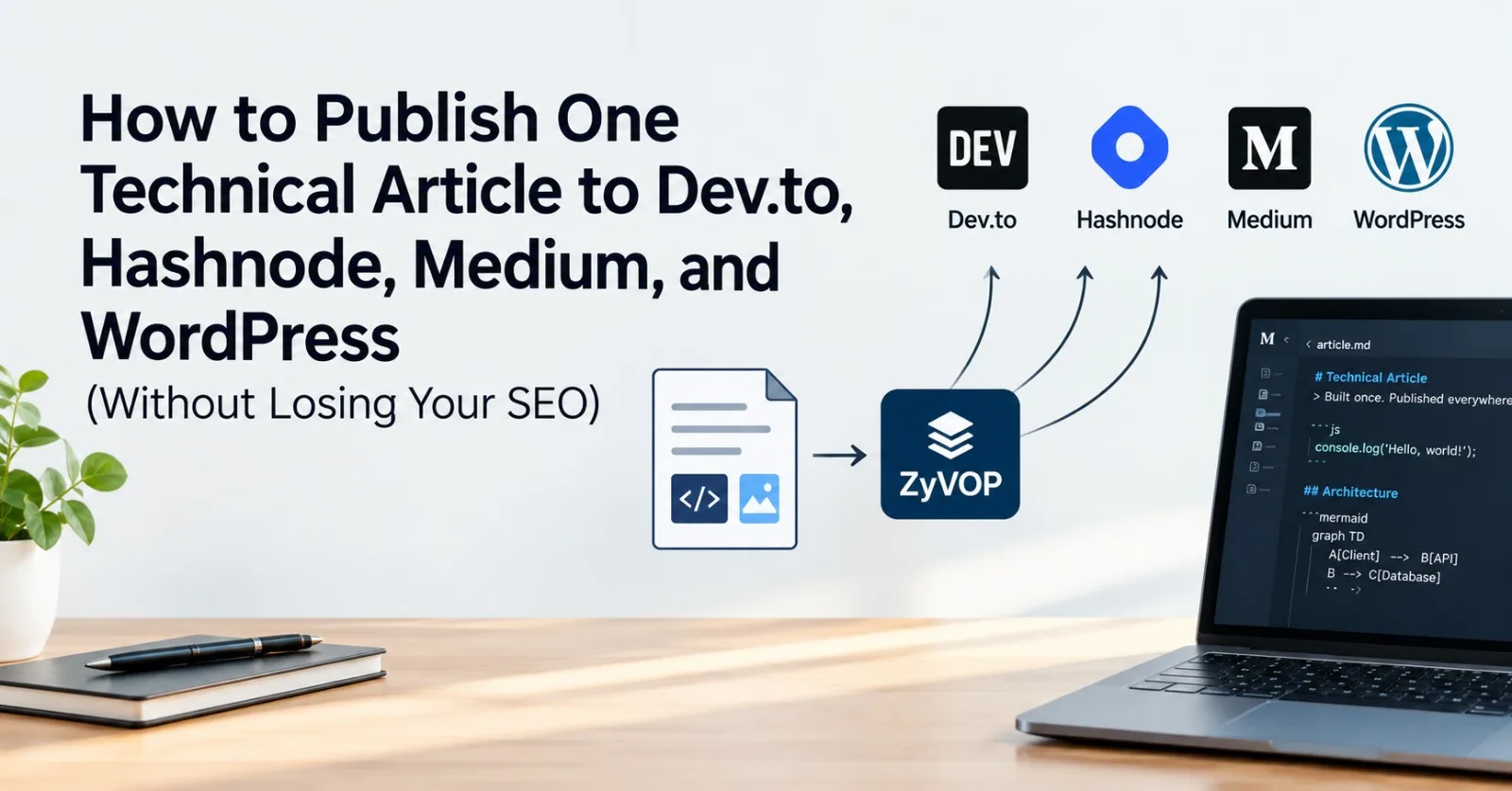
TL;DR: Publishing across Dev.to, Hashnode, Medium, and WordPress maximizes developer discovery, but manual cross-posting introduces search engine cannibalization, mangled Markdown, stripped Mermaid diagrams, and tedious maintenance. Here is how to automate the entire syndication pipeline—via Web UI or headless GitOps (
npx zyvop)—while anchoring full canonical SEO authority to your sovereign domain.
The 2-Hour Copy-Paste Tax
You just spent 15 hours on a technical deep dive. You benchmarked memory leaks under high concurrency, profiled heap allocations, built detailed architectural diagrams, and verified code snippets against the latest runtime release.
Your draft is crisp, authoritative, and finally finished in Markdown.
Now comes the part every engineer dreads: the distribution grind.
If you publish solely to your personal blog (Next.js, Astro, or Hugo), you hit the cold-start wall: near-zero discoverability without years of domain authority. But if you publish exclusively on walled platforms like Medium or Dev.to, you surrender your audience, brand equity, and content sovereignty.
The industry-standard solution is multi-platform syndication: publish on your primary home, then syndicate to Dev.to, Hashnode, Medium, and WordPress.
Yet in practice, doing this manually costs at least two hours per article:
Opening four browser dashboards and copy-pasting Markdown or HTML.
Fixing broken code fences and stripped syntax highlighting tags.
Manually re-uploading architecture diagrams because Medium and WordPress don't support Mermaid.
Digging through four distinct settings panels to set canonical links.
Praying you don't discover a typo ten minutes later, requiring you to repeat the cycle across all four platforms.
There is a much better way. Let’s break down the technical pitfalls of multi-platform publishing and explore how to automate the entire flow cleanly with ZyVOP.
The Four Mechanical Failure Points of Manual Syndication
Before looking at the solution, let’s diagnose why manual syndication breaks:
flowchart TD
    Article["Single Technical Article<br/>(Markdown + Diagrams + Code)"] --> D1["Dev.to<br/>(Forem REST API)"]
    Article --> D2["Hashnode<br/>(GraphQL Schema)"]
    Article --> D3["Medium<br/>(REST API v1)"]
    Article --> D4["WordPress<br/>(WP-JSON REST)"]

    D1 -. "rel=canonical in Frontmatter" .-> Canon["Sovereign Canonical URL<br/>(Your Personal Domain or ZyVOP Hub)"]
    D2 -. "originalArticleURL in GraphQL" .-> Canon
    D3 -. "canonicalUrl parameter" .-> Canon
    D4 -. "Attribution Link + Head Meta" .-> Canon
1. SEO Cannibalization & Canonical Disasters
Search engine algorithms penalize or consolidate duplicate content. If Google discovers your article on Dev.to or Medium before your personal blog, their domain authority (DA 80+) will outrank your site unless an explicit rel="canonical" tag tells Google: "Credit the original author URL as the definitive source."
Every platform implements this differently:
Dev.to: Requires
canonical_urlin YAML frontmatter or thearticleREST payload.Hashnode: Requires
originalArticleURLinside its GraphQLPublishPostInputmutation.Medium: Accepts
canonicalUrlonly upon initial article creation (Medium's API does not permit updating published posts).WordPress: Lacks a native canonical REST field out of the box, requiring either third-party plugin meta mapping (Yoast/RankMath) or structured HTML attribution.
2. AST Transformation & Code Fence Collisions
Markdown is not a single standard; it is a family of dialects. If your technical post includes Markdown code snippets with three backticks inside a fenced block, parsers like Dev.to's Forem misinterpret the fences, inject orphaned Liquid tags, and crash with Unknown tag 'endraw'.
3. Broken Architecture Diagrams (The Mermaid Problem)
Dev.to and Hashnode render code fences, but Medium and WordPress have zero native Mermaid or LaTeX support. When you copy-paste raw Mermaid syntax into Medium, it displays as an unreadable block of raw plaintext. High-grade syndication must automatically compile diagram code into vector SVGs or standalone high-resolution images.
4. The Maintenance Dilemma (Idempotency)
When an author patches a bug in a code example, manual syndication means hunting down URLs and editing four different CMS forms. If you automate via naive scripts, network retries risk spawning duplicate posts across your feeds.
The Sovereign Publishing Model with ZyVOP
ZyVOP was engineered from the ground up as a Developer Publishing Hub. It enforces a single guiding philosophy:
Own your canonical source of truth; treat third-party networks purely as distribution edges.
sequenceDiagram
    autonumber
    actor Author as Technical Author
    participant CLI as ZyVOP CLI / UI
    participant Core as ZyVOP Engine (NestJS)
    participant Redis as Redis / BullMQ Queue
    participant DevTo as Dev.to API
    participant HN as Hashnode GraphQL
    participant Med as Medium API
    participant WP as WordPress REST API

    Author->>CLI: Publish post (Markdown / AST)
    CLI->>Core: Ingest post + resolve canonical URL
    Core->>Core: Convert Mermaid to SVG & adjust code fences
    Core->>Redis: Dispatch syndication jobs
    par Asynchronous Fan-Out
        Redis->>DevTo: POST /api/articles (canonical_url)
        Redis->>HN: publishPost(originalArticleURL)
        Redis->>Med: POST /users/{id}/posts (canonicalUrl, HTML)
        Redis->>WP: POST /wp-json/wp/v2/posts (Attribution backlink)
    end
    Core-->>Author: Unified publication URLs & live telemetry
ZyVOP automates the entire conversion and publishing lifecycle:
Canonical Anchoring: Points all syndicated destinations back to your primary article on your custom domain (
https://yourdomain.com/blog/slug) or your ZyVOP profile.Dynamic Backtick Scaling: Detects nested backticks and scales fences (
````) so Dev.to and Forem never break.Stateless Vector Diagram Compilation: Compiles
mermaidcode blocks into high-contrast diagram image URLs readable across light and dark themes.Automated UTM Attribution: Tags backlinks with structured parameters (
?utm_source=devto&utm_medium=crosspost) to track readership funnels.Idempotent Updates: Recognizes existing articles by slug, updating live copies instead of duplicating them.
Method 1: The GitOps & CLI Workflow (npx zyvop)
For developers who live inside Neovim, VS Code, or Obsidian, leaving your terminal to open multiple browser tabs breaks flow. ZyVOP provides a headless CLI that publishes Markdown files directly.
Step 1: Install or Run Directly via npx
No global installation required:
npx zyvop --helpOr install globally:
npm install -g zyvopStep 2: Configure YAML Frontmatter
Add syndication targets and metadata to your Markdown document:
---
title: "Zero-Trust Architecture in Distributed Systems"
subtitle: "A deep dive into mTLS, ephemeral tokens, and SPIFFE/SPIRE"
slug: "zero-trust-architecture-distributed-systems"
canonical_url: "https://alex.dev/blog/zero-trust-architecture"
tags: [security, devops, distributed-systems, architecture]
category: backend
generate_toc: true
cross_post:
  devto: true
  hashnode: true
  medium: true
  wordpress: true
---

## 1. Threat Modeling in Modern Microservices

Here is an architectural overview of mutual TLS handshake verification:

```mermaid
sequenceDiagram
    Client->>Gateway: Initial TLS Client Hello
    Gateway->>Client: Server Certificate + CA Challenge
    Client->>Gateway: Client Certificate Verification
    Gateway-->>Client: Encrypted mTLS Session Established
When implementing cryptographic handshakes...
#### Step 3: Preview with a Dry Run
Verify how ZyVOP parses your frontmatter, resolves relative images, and structures platform payloads without authenticating:

```bash
zyvop publish ./zero-trust.md --dry-run
Step 4: Authenticate and Publish
Authenticate once with your developer token:
export ZYVOP_TOKEN="zv_live_98a7f..."
zyvop publish ./zero-trust.md
Zero-Trust Local Mode (--local)
For security-conscious engineers or strict enterprise environments where third-party API credentials cannot be stored on external servers, ZyVOP offers a --local mode. Credentials are read from your local environment or CI secret manager, sent directly to providers, and never uploaded to ZyVOP:
export ZYVOP_DEVTO_API_KEY="dev_..."
export ZYVOP_HASHNODE_API_KEY="hn_..."
export ZYVOP_MEDIUM_API_TOKEN="med_..."
export ZYVOP_WORDPRESS_URL="https://wp.alex.dev"
export ZYVOP_WORDPRESS_USERNAME="alex"
export ZYVOP_WORDPRESS_APP_PASSWORD="xxxx xxxx xxxx xxxx"

zyvop publish ./zero-trust.md --local
Automating with GitHub Actions
You can trigger multi-platform distribution on every git push to main:
name: Publish Technical Articles
on:
  push:
    branches: [main]
    paths: ['posts/**.md']

jobs:
  syndicate:
    runs-on: ubuntu-latest
    steps:
      - uses: actions/checkout@v4
      - uses: actions/setup-node@v4
        with:
          node-version: 22
      - name: Publish to ZyVOP, Dev.to, Hashnode, Medium & WordPress
        env:
          ZYVOP_TOKEN: ${{ secrets.ZYVOP_TOKEN }}
        run: |
          npx zyvop publish ./posts/zero-trust.md
Method 2: The Web Studio & One-Click Publisher
If you prefer a rich visual authoring experience, ZyVOP’s Web Studio provides an author-first interface:
Connect Integrations Once: Navigate to Settings → Integrations and connect Dev.to, Hashnode, Medium, and WordPress with your API tokens or Application Passwords.
Distraction-Free Authoring: Write in a hybrid Tiptap editor that seamlessly blends Markdown shortcuts, syntax-highlighted code blocks, live KaTeX formulas, and real-time Mermaid previewing.
Syndication Drawer: Click Publish, select which platforms should receive the post, review canonical preview URLs, and hit confirm.
Real-Time Job Telemetry: Monitor queued workers, inspect external platform post URLs, or trigger retries if a third-party platform API encounters a rate limit.
Platform Syndication Matrix
Platform | Protocol | Canonical Mechanism | Diagram Handling | Idempotent Updates |
|---|---|---|---|---|
Dev.to | REST API |
| Auto-converts to high-res SVG embed | Full |
Hashnode | GraphQL |
| Auto-converts to high-res SVG embed | Full |
Medium | REST API v1 |
| Auto-converts to high-res SVG embed | Initial creation only (API constraint) |
WordPress | WP REST API | Head meta + structured HTML backlink | Auto-converts to high-res SVG embed | Full |
The Result: Sovereign Reach Without the Friction
Technical writing is one of the highest-leverage investments in a software engineer's career. It sharpens your architectural thinking, opens doors to leadership roles, and establishes authority in your domain.
You should never have to sacrifice distribution to maintain ownership, nor should you spend two hours fighting copy-paste formatting bugs every time you publish.
By combining canonical SEO protection, automatic AST transformations, and GitOps workflows, ZyVOP gives you the best of both worlds:
Your content lives on your domain, building your personal search authority.
Your articles reach tens of thousands of developers across Dev.to, Hashnode, Medium, and WordPress on day one.
Your publishing pipeline is version-controlled, automated, and painless.
Write once. Own your canonical home. Syndicate everywhere.
Ready to streamline your technical writing workflow? Get started with ZyVOP or run npx zyvop publish --help in your terminal today.
Comments(0)
Join the discussion by logging into your account.
No comments yet. Be the first to comment!