
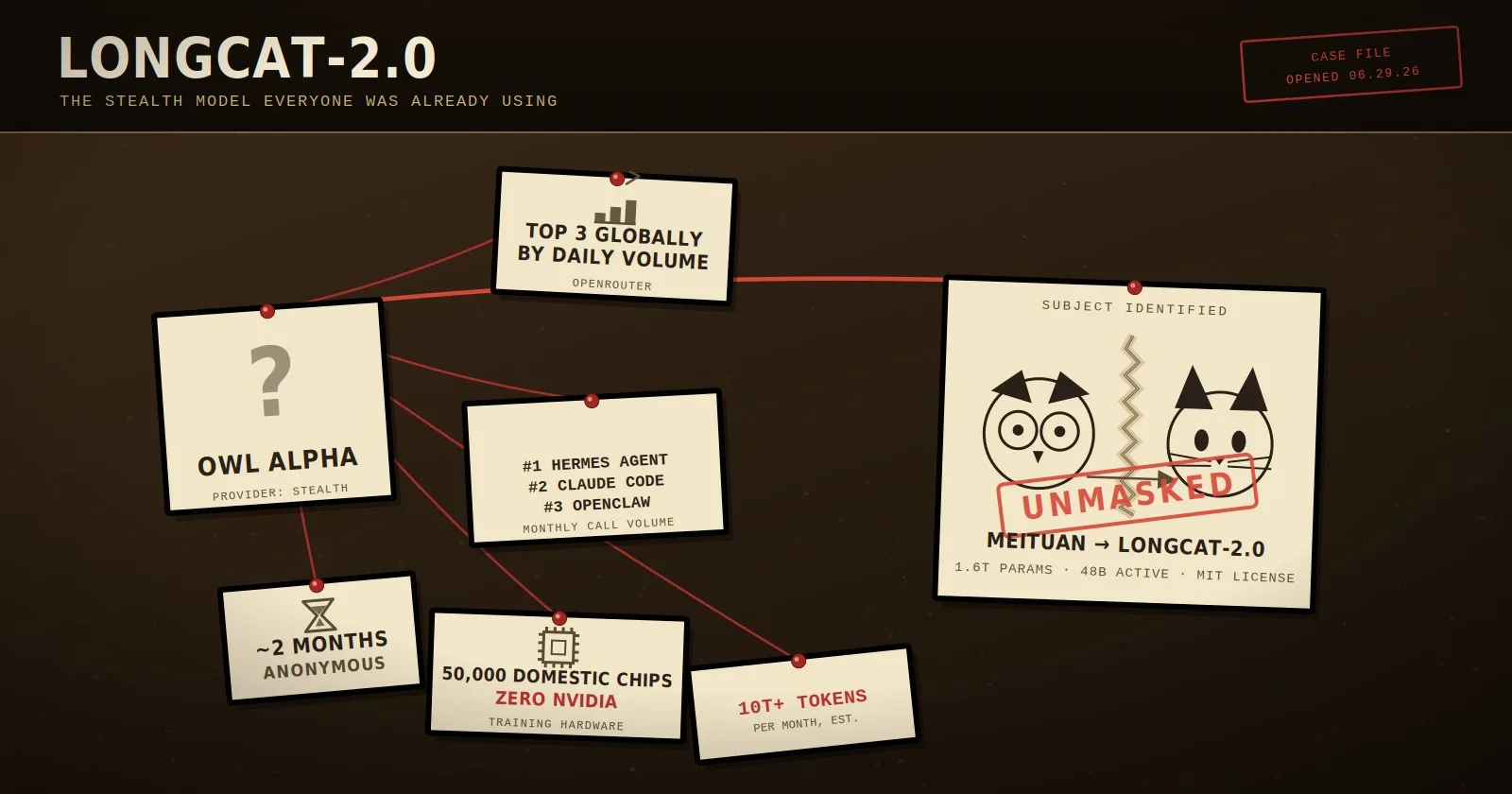
For two months, a model called "Owl Alpha" quietly out-hustled GPT-5.5 and Claude on OpenRouter. Nobody knew it was Meituan — yes, the food-delivery app — running a 1.6-trillion-parameter model trained entirely on Chinese chips.
The short version:
Meituan — China's Uber Eats-meets-everything super-app — spent two months running a model called Owl Alpha anonymously on OpenRouter. Real developers used it in real coding agents, with zero idea who built it.
On June 29, Meituan outed itself. On June 30, it launched the model publicly as LongCat-2.0: 1.6 trillion parameters, MIT-licensed, trained entirely on Chinese-made chips — no Nvidia anywhere in the pipeline.
It undercuts GPT-5.5 on price by roughly 6–7x and edges past it on one coding benchmark by less than a point — a claim worth double-checking, not taking on faith.
The actual downloadable weights didn't show up until July 4, five days after the "open source" announcement.
If you ran a coding agent through Hermes Agent, Claude Code, or OpenClaw sometime between late April and late June 2026, you probably already have an opinion about LongCat-2.0. You just knew it by a different name.
The Reveal
Meituan didn't do a keynote. It didn't do a demo video with swelling music. It posted a tweet.
On June 29, the official Meituan LongCat account wrote: "Some of you guessed right. 👀 Owl Alpha on @OpenRouter — that's us." The thread added that Owl Alpha had hit the global top three by daily volume on OpenRouter, and — by monthly volume — ranked #1 on the Hermes Agent workspace, #2 on Claude Code-compatible deployments, and #3 across OpenClaw. The next day, the LongCat-2.0 GitHub repo and Hugging Face model card went live, MIT license attached.
That's the whole trick, and it's a good one: don't launch a model and hope people adopt it. Let them adopt it first, then tell them whose it was.
Meet Owl Alpha
Before June 29, here's everything OpenRouter's public listing told you about Owl Alpha: a "high-performance foundation model designed for agentic workloads," hosted by a provider labeled simply "Stealth." No parameter count. No company. Just a note that your prompts might get logged to improve the model — standard fine print for anything running incognito.
That vagueness didn't stop it from putting up real numbers. One independent tracker following OpenRouter's public usage charts estimated Owl Alpha was processing north of 10 trillion tokens a month by the time of the reveal, growing over 200% month-over-month, and — within the Hermes Agent ecosystem specifically — out-consuming its next four competitors combined. Take the precise figures with a grain of salt; they're estimates from public dashboards, not audited numbers. But the direction isn't in dispute: developers with zero brand loyalty kept picking this thing for real work.
The Detective Work
Naturally, people tried to unmask it. That's half the fun of a stealth model — the community turns into an amateur forensics team.
The strongest tell was behavioral: users on Reddit and elsewhere noticed Owl Alpha would affirm that Taiwan is part of China and steer hard away from questions about Taiwanese independence — the kind of reflex you don't get from a Western lab's model. That pointed toward a Chinese origin fast. Guesses circulated toward Tencent's Hunyuan team, MiniMax, Baidu, or some unannounced newcomer. A Hacker News thread speculated about the Huawei Ascend chips underneath it well before Meituan confirmed anything. A handful of users even reported the model referring to itself as being "from the Zoo company" in casual chat — nobody could explain that one until the reveal.
Almost nobody guessed a food-delivery app.
This Playbook Isn't New. The Patience Is.
If this feels familiar, it should. Running a flagship model incognito before the official launch has become standard practice at frontier labs. OpenAI has done it more than once — Horizon Alpha is widely believed to have been an early GPT-5 checkpoint, and Polaris Alpha, which showed up on OpenRouter with unusually generous rate limits, turned out to be an early build of GPT-5.1. xAI does this constantly, cycling code names like Sonic, Sherlock, and Sonoma before they resolve into named Grok releases. Cursor's "Cheetah" turned out to be its own Composer model. Even Anthropic has quietly run checkpoints under names like Bobcat and Code-Supernova. There's a decent field guide to spotting these if you want to go down that rabbit hole yourself.
What's different about Owl Alpha isn't the tactic — it's the patience. Most stealth models get made and claimed within days, maybe a couple of weeks. Owl Alpha ran anonymously for roughly two months, long enough to rack up genuine production usage across three separate agent ecosystems before Meituan said a word. Leaderboard screenshots are easy to game. Two months of developers voluntarily choosing your model with no idea who made it is a lot harder to fake.
It's also not like Meituan appeared from nowhere. Its LongCat team had already shipped LongCat-Flash, a 560-billion-parameter model, back in September 2025, followed by the multimodal LongCat-Next in March 2026 — public papers, model cards, GitHub repos, the whole open-source routine. What Meituan had never done before was let a model build a reputation before attaching its name to it. Coming from the company most people outside China associate with fried chicken delivery, that combination was enough to catch the industry flat-footed.
What's Actually Inside It
Cut the backstory and LongCat-2.0 is a Mixture-of-Experts (MoE) model: a huge pool of specialized sub-networks where only a small slice fires for any given token, instead of the whole network lighting up every time. The headline is 1.6 trillion total parameters. The number that actually determines your bill is closer to 48 billion active parameters per token, sliding between roughly 33 billion and 56 billion depending on how hard the request is. Autocompleting a variable name barely taxes it; a gnarly multi-step reasoning problem pulls in more of the network.
A few specific design choices carry the weight, per Meituan's own technical writeup:
LongCat Sparse Attention (LSA) — standard attention gets brutally expensive as context grows, because every token has to weigh every other token. LSA instead indexes and selects only the most relevant chunks of a long conversation, which is the trick behind sustaining a full 1-million-token context window without the cost exploding.
N-gram Embedding — a 135-billion-parameter layer, borrowed from an earlier LongCat model, that sits alongside the MoE experts rather than inside them. Instead of only recognizing individual words, it can treat common multi-word phrases as single units — "New York City" as one concept instead of three disconnected tokens. Meituan claims roughly 100x richer representations from this without meaningfully increasing model size.
Multi-Token Prediction (MTP) — a lightweight head that drafts several tokens ahead in one pass, which the main model then verifies. Reported acceptance rate above 90%, which is what gets inference speeds above 100 tokens/second through the API.
Multi-Teacher On-Policy Distillation (MOPD) — a post-training step fusing three specialist skill sets (tool use and self-correction, multi-step and STEM reasoning, instruction-following and hallucination suppression) into one model.
Pretraining ran on more than 30 trillion tokens of code, English, Chinese, and multilingual data. License is MIT — commercial use, fine-tuning, redistribution, all explicitly fair game.
The Benchmarks — Read the Fine Print
Here's what Meituan is claiming:
Benchmark | LongCat-2.0 | For comparison |
|---|---|---|
SWE-bench Pro (real GitHub issue resolution) | 59.5 | GPT-5.5: 58.6 · Gemini 3.1 Pro: 54.2 · Claude Opus 4.7: 64.3 |
FORTE (office-task agent benchmark) | 73.2 | Claude Opus 4.6: 73.2 (tied) · GPT-5.5: 77.8 |
Terminal-Bench 2.1 | 70.8 | outperforms Gemini 3.1 Pro |
SWE-Bench Multilingual | 77.3 | — |
Here's the part most coverage buried: these are Meituan's own numbers, run mostly on Meituan's own testing harness. Someone actually filed a pull request trying to add these scores to Hugging Face's public evaluation database and hit a wall — Terminal-Bench 2.1, SWE-Bench Multilingual, and FORTE didn't have registered independent evaluations to check against. That's not proof the numbers are inflated. It's just a reminder that "beats GPT-5.5 by eight-tenths of a point on one benchmark" is a claim to file under competitive, not confirmed until outside labs run their own passes. One outlet that actually built something with it found the output capable but noticeably behind Claude's top tier — closer to a mid-range Claude model than the headline number suggests.
The Price Is the Actual Headline
Whatever you think of the benchmark gap, the pricing is not up for debate. Standard API access runs $0.75 per million input tokens and $2.95 per million output, dropping to a launch-promo rate of $0.30 / $1.20 — with cached context reads billed at zero.
Model | Input ($/M tokens) | Output ($/M tokens) |
|---|---|---|
LongCat-2.0 (promo) | $0.30 | $1.20 |
LongCat-2.0 (standard) | $0.75 | $2.95 |
DeepSeek V4-Pro | $0.435 | $0.87 |
Claude Sonnet 5 (intro rate) | $2.00 | $10.00 |
GPT-5.5 | $5.00 | $30.00 |
Claude Opus 4.7 | ~$15.00 | ~$75.00 |
For teams burning through millions of tokens re-reading the same repo on every agent loop, free cache reads alone change the math. Meituan is also running flash-sale token packs — roughly a billion tokens for $60 — released four times a day on a Beijing schedule.
The Chip Story Nobody Should Skip
Here's the part that actually rattled policy people, and it has nothing to do with coding benchmarks. Meituan says LongCat-2.0 was trained from scratch and served entirely on a cluster of roughly 50,000 domestic Chinese AI accelerators, coordinated with Huawei's HCCL library — the domestic answer to Nvidia's NCCL — with zero Nvidia hardware anywhere in the pipeline.
That distinction is bigger than it sounds. Other Chinese models, including DeepSeek's V4-Pro, have reportedly used domestic chips for inference while still training on non-domestic hardware. Meituan's claim is that LongCat-2.0 is the first trillion-parameter-class model to do the harder part — training — entirely on Chinese silicon, at frontier scale, with no catastrophic loss spikes along the way. Caixin Global and Digitimes both framed it as a real stress test of China's chip stack, not just a press release.
Analysts treated it that way too. One noted it should put to rest doubts about whether Huawei's Atlas-950 clusters could actually scale; a Lehigh University researcher called it the first model trained to near-frontier performance entirely on domestic accelerators. The read that stuck: export controls on the newest Nvidia chips don't stop capable models from getting built — they just push the timeline toward domestic alternatives faster than the policy assumed.
That doesn't settle the argument. Controls still raise costs and slow things down — Meituan's own writeup admits real pain from hardware faults, memory pressure, and numerical instability at 50,000-chip scale. But the assumption that Chinese labs simply couldn't train frontier-adjacent systems without the latest Nvidia stack took a real hit.
There's a business subplot worth one line: Meituan's core delivery business has had a brutal year — stock down more than 30% year-to-date, market cap under HK$400 billion — and CEO Wang Xing has publicly taken responsibility for it. A trillion-parameter model quietly beating Western pricing on homegrown chips is, among other things, a pretty loud answer to shareholders asking what else the company's been doing.
What's Still Soft
Be honest about the gaps before you bet a production stack on this:
The benchmarks are self-reported, and several don't have independent verification yet.
"Open weights" and "MIT license" didn't mean downloadable until July 4 — the GitHub and Hugging Face pages sat on "coming soon" for five days after the big announcement. An Unsloth GitHub issue tracking community support for the model captures that gap in real time.
Self-hosting isn't realistic for most people. Estimates put a full deployment around sixteen high-end GPUs — "open source" here mostly means someone can run it, not you, unless you've got serious hardware.
One hands-on test — building something end-to-end rather than running a benchmark — found the actual output quality trailing top-tier closed models by more than the score table implies.
Bottom Line
Strip away the theater and two things are solidly true: real developers adopted this model in volume with zero idea who built it, and the pricing advantage over GPT-5.5 and Claude's intro rates is real and large, especially for high-volume agentic coding. The domestic-chip training claim, if the SWE-bench-level scrutiny holds up, is a legitimately significant data point about where Chinese AI infrastructure actually stands — independent of how you feel about the export-control debate.
What's still an open question is whether it's actually as good as the benchmark table says, and the honest answer right now is: probably close, not quite there, and worth testing yourself rather than taking Meituan's word for it.
The bigger story isn't a half-point benchmark edge over GPT-5.5. It's that a two-month blind trial, run without anyone's permission to be impressed, ended up more convincing than a launch event — and the company running it wasn't one anyone in the AI industry was watching closely enough.
Go deeper:
Comments(0)
Join the discussion by logging into your account.
No comments yet. Be the first to comment!