
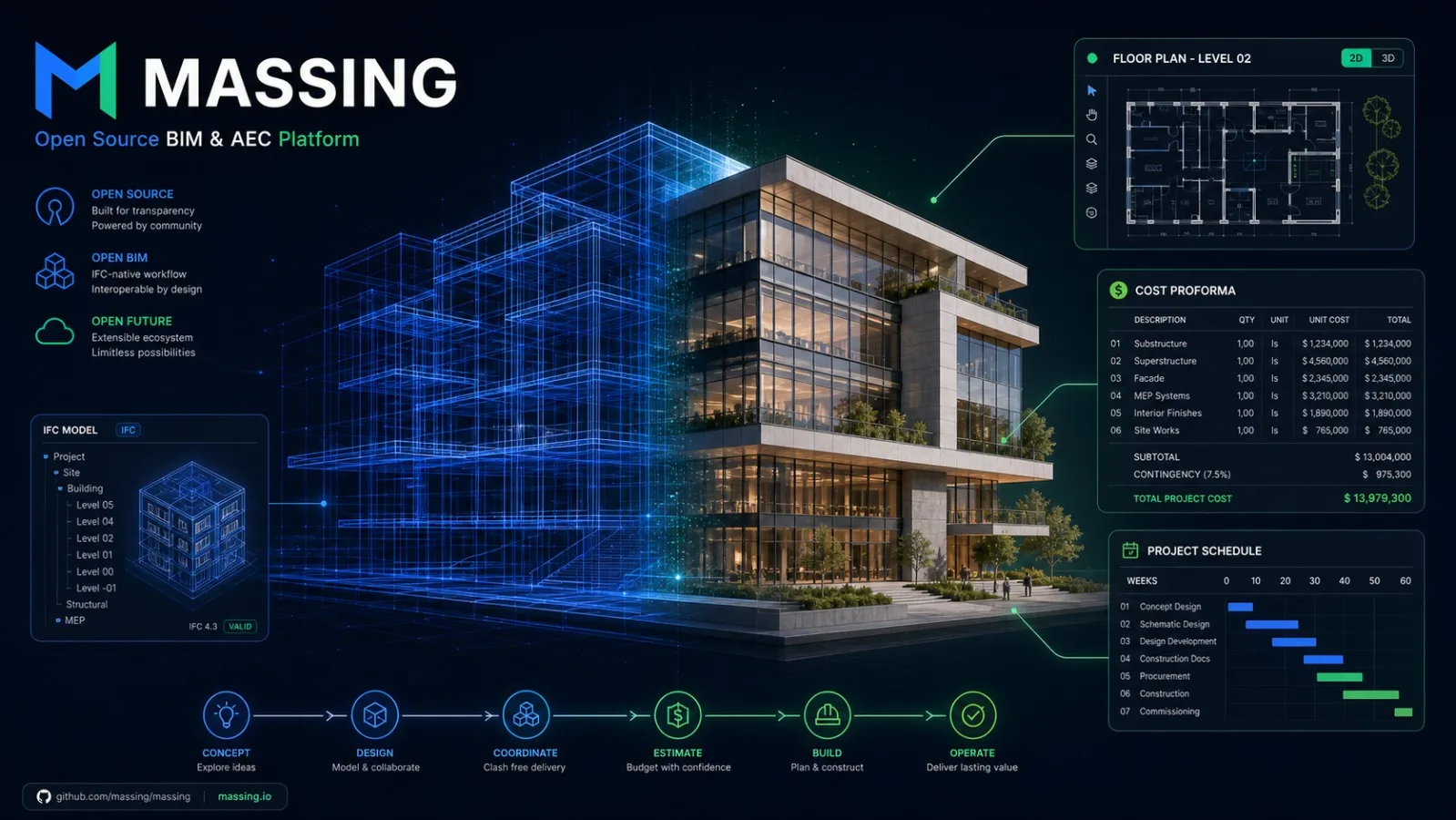
For most of the industry's history, AEC software has worked in silos — one tool for feasibility, another for BIM modeling, yet another for construction management. Massing (github.com/ibuilder/massing) is a direct challenge to that fragmentation. It's a fully open-source, self-hosted, IFC-native platform that spans the complete project lifecycle — from land acquisition to building operations — on a single model.
What Is Massing?
Massing is described simply as "in-browser BIM authoring · construction docs · GC portal · proforma." But those four words undersell it. At its core, Massing is an attempt to unify seven major workstreams — Deal · Design · Planning · Schedule · Cost · Work · Operate — under one IFC-keyed model, accessible through any modern browser or a downloadable desktop app on Windows, macOS, or Linux.
It's built on an open stack: That Open (Fragments + web-ifc), IfcOpenShell, Three.js, FastAPI, and Tauri for the desktop shell. IFC is the source of truth — no proprietary formats, no per-seat licensing. The desktop app is free.
Three Pillars, One Model
Massing's architecture rests on three core pillars that are tightly integrated through shared IFC GlobalIds.
1. In-Browser BIM Authoring
This isn't a viewer with light editing bolted on. Massing provides a genuine authoring environment where you can model from scratch — walls (including sloped-top parapet, shed, and gable profiles), slabs, columns, beams, curtain wall systems, structural steel connections, rebar cages, and MEP fittings with port-to-port connectivity. Every edit is a server-side IfcOpenShell recipe, GUID-stable, so RFI pins and clash topics survive model edits.
Standout authoring features include:
CAD command line — AutoCAD-style syntax (
WALL 0,0 5,0 3,COLUMN 2,2) with history and spacebar-repeatAI command bar — plain English instructions ("a 5×4 m room at 0,0") resolved through a deterministic keyword baseline or an optional Claude multi-step planner
Authoring guardrails —
guards.py::precheckrejects broken edits (zero-length walls, non-finite coordinates) before they touch the modelScan-to-BIM deviation — compare as-built point clouds against the model surface with a tolerance heatmap
2. Construction Document Set
From the authored geometry, Massing generates a permit-ready document set — no geometry kernel required, just extruded-profile footprints. Output includes:
Dimensioned floor plans with class-styled poché, keynote bubbles, and NCS-style detail callouts
Auto-centered sections and projected N/S/E/W elevations
Door, window, and room schedules
Issuable ARCH-D (36×24") sheets with titleblocks, exported to SVG, PDF, and DXF
A 3-part MasterFormat project manual organized into CSI divisions in SectionFormat shape
The platform also includes edition-aware IBC code intelligence — occupancy load and egress pre-checks that account for which IBC cycle a jurisdiction has adopted (e.g., Business at 100 gross ft²/occ in IBC 2012/2015 vs. 150 ft²/occ in 2018+), and an approvability pre-flight that scores permit readiness before submission.
3. GC Portal + Development Proforma
The GC portal is a config-driven module engine with 133 modules across 30 sections — RFIs, submittals, change orders, pay apps (AIA G702/G703), CPM/Gantt schedules, safety/TRIR, and closeout (COBie). Every module is defined by a module.json with no per-module code required. A full change-order chain runs PCO → NOC → Directive → Proposal → COR → eTicket, audit-logged with AIA-style PAdES digital e-sign.
The development proforma workspace covers the full deal stack: sources & uses, S-curve draws, XIRR/NPV/equity multiple, a JV waterfall with pref + promote tiers, debt sizing (LTC/LTV/DSCR/debt yield), Monte Carlo risk, and auto-generated investment memos — all seeded directly from the IFC model geometry and quantities.
Generative Design: Zoning Envelope to IFC Building
One of Massing's most compelling capabilities is its generative design engine. Feed it a zoning envelope — lot area, FAR, setbacks, height limit, floor-to-floor height — and it computes the buildable program and generates a real IFC4 model in a single API call. The generated building can include a concrete structural frame on a bay grid, per-apartment unit layouts on a double-loaded corridor, a facade envelope with ribbon windows feeding an energy model, and a service core with elevators, stairs, and MEP risers.
Because the output is openBIM, the generated building flows directly into the viewer, CD set, energy analysis, quantity takeoff, assembly-based estimate, and acquisition proforma — one chain from lot to deal to turnover.
Architecture and Integration
Elements are referenced by IFC GlobalId throughout — never by a viewer-assigned ID. This means a pin placed on an RFI, a clash topic in BCF, and a pay application all point to the same physical element in the model. IFC is pre-converted to Fragments server-side and never parsed in the browser at runtime, keeping the viewer fast on large models.
The platform also ships an MCP server so external agents (including Claude Desktop) can drive the project — reading status, running schedule-risk and carbon checks, authoring model elements, and querying permit readiness — all through the same gated engines the UI uses.
text IFC (source of truth)
author ▲ │ convert + tile
│ ▼
services/data (Python) services/converter (Node)
│ │
└──► services/api (FastAPI) ◄──► apps/web (Vite + TS / Three.js)
Getting Started
Self-hosting the full stack is a single Docker Compose command:
bashgit clone https://github.com/ibuilder/massing.git && cd massing
cp .env.example .env
docker compose --profile full up --build
# web → http://localhost:8080 · api → http://localhost:8000
An optional seed container fills a demo project across every module and relation chain. The stack requires Node 24 and Python 3.12. For those who prefer not to manage a stack, signed desktop app installers for Windows, macOS, and Linux are available at the latest release — free, auto-updating, single-project.
Why It Matters
The AEC industry spends billions each year on software that doesn't talk to itself. A project team might use one tool for BIM coordination, a separate platform for construction management, a spreadsheet for the proforma, and a third system for operations — with manual handoffs between each. Massing bets that IFC as a neutral, open carrier can eliminate those seams.
It won't replace specialized enterprise tools overnight, and Massing itself notes that 47% of contractors cite getting people to use new technology as their single biggest challenge — ahead of cost or integration. Its design response to that is "defer, never delete": route each user to the ten modules they use daily, keep the rest a keystroke away.
For teams evaluating open-source BIM infrastructure — whether for internal tooling, a product foundation, or an alternative to proprietary platforms — Massing is the most comprehensive single-repo AEC platform currently available under an MIT license. The live demo is at massing.build/app.





Comments(1)
Join the discussion by logging into your account.
ZyVOP
Hi Matthew, Welcome to ZyVOP 😀