
The puzzle
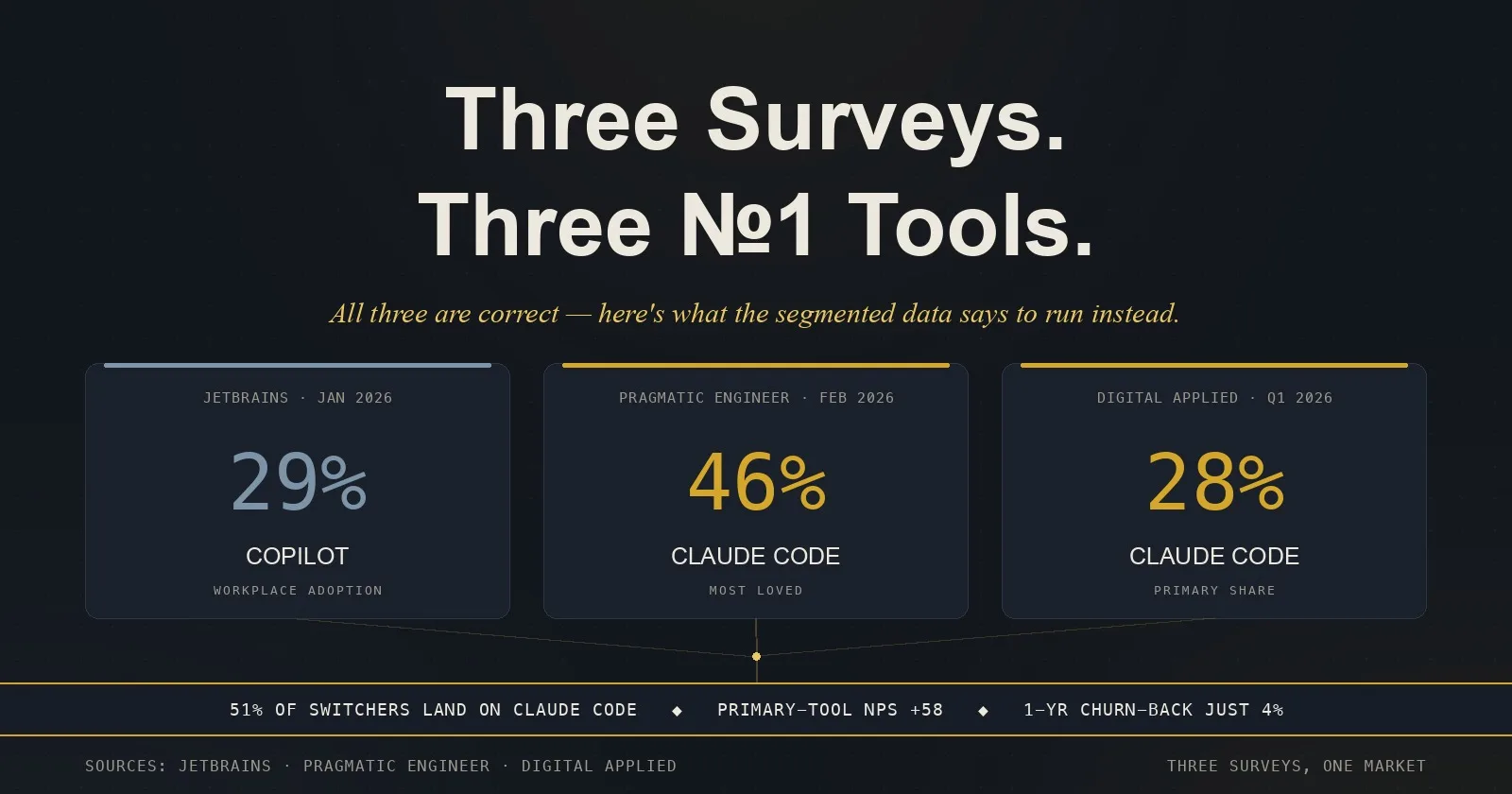
Here's a small puzzle. Three separate developer surveys, all run in the first few months of 2026, all with real sample sizes and disclosed methodology, asked some version of one question: which AI coding tool do you actually use? They came back with three different leaders.
None of these three organizations got it wrong. They surveyed different people, asked a slightly different question, and got answers that are all true at once. That's actually the whole story — "which tool is best" stopped having one answer, and the surveys are just the first place it becomes visible.
Three surveys, side by side
Survey | Population | #1 by their measure | Runner-up |
|---|---|---|---|
JetBrains AI Pulse, Jan 2026 | 10,000+ developers, global | Copilot — 29% adoption | Cursor & Claude Code tied, 18% |
The Pragmatic Engineer, Feb 2026 | ~900 newsletter readers, senior-skewing | Claude Code — 46% "most loved" | Cursor, 19% |
Digital Applied, Q1 2026 | 2,847 devs, 320 agencies + in-house teams | Claude Code — 28% primary share | Cursor, 24% |
xychart-beta
    title "Same Tools, Three Different Leaderboards"
    x-axis ["Copilot", "Cursor", "Claude Code"]
    y-axis "Share (%)" 0 --> 50
    bar [29, 18, 18]
    bar [9, 19, 46]
    bar [17, 24, 28]
Series left→right within each bar group: JetBrains (adoption) → Pragmatic Engineer (most-loved) → Digital Applied (primary share).
Look closely at the wording in that middle column and the contradiction mostly dissolves. "Adoption" isn't "most loved" isn't "primary tool." A tool can be the thing 29% of all developers have installed and still lose to a different tool on the much narrower question of what people reach for first, every day, for the hard problems.
Why the same market produces three different winners
Pull the thread further and the surveys themselves explain the split — most of them break results down by company size and role, and that's where the real signal is.
1. Company size is the clearest divider
The Pragmatic Engineer survey found the smallest companies favor Claude Code at 75%, with Cursor second at 42%, while companies with 10,000+ employees flip the order entirely and default to GitHub Copilot.
That's not really a taste difference. It's procurement. Copilot ships bundled through existing GitHub and Microsoft enterprise agreements. A five-person startup doesn't have a procurement department standing between an engineer and a terminal.
2. Role is the second divider
The Digital Applied survey found Claude Code dominant among backend developers (34% primary share) and full-stack developers (29%), while data and ML engineers favored Google's Gemini Code Assist at 18% primary share — specifically because of its native Vertex AI and BigQuery integration.
Mobile developers were the most fragmented segment measured: Cursor led at just 27%, and no tool cleared 30% of primary share.
3. Task type is the third divider
This is the one most "which tool is best" content misses entirely. The same Q1 2026 survey found that reviewing AI-generated code now consumes more developer time than writing it does: 11.4 hours a week reviewing versus 9.8 hours writing — a reversal from their own Q4 2024 survey, when writing still held a four-hour lead.
A tool optimized for fast first-draft generation and a tool optimized for catching what a first draft got wrong are solving different problems. A lot of teams are already running separate tools for each without necessarily framing it that way.
Loyalty tells you more than the leaderboard does
Adoption numbers show you what people are trying. Migration data shows you what actually sticks — and this is where Claude Code's lead stops looking like a survey artifact.
Digital Applied tracked which tools developers switched from and to over a six-month window. GitHub Copilot was the single largest source of outbound migration: 42% of everyone who switched primary tools started at Copilot. Claude Code was the single largest destination: 51% of everyone who switched ended up there.
sankey-beta

Copilot,Claude Code,24
Cursor,Claude Code,18
Other Tools,Claude Code,9
Six-month migration window, Digital Applied — the three flows sum to Claude Code's full 51% destination share.
The biggest individual flow was Copilot → Claude Code, 24% of all migrations, with "multi-file and agentic capability" as the top cited reason. Cursor → Claude Code accounted for another 18%, driven by reasoning depth on long tasks.
Here's the number that actually matters, though: of the developers who migrated to Claude Code, only 4% migrated away again within the following year. Cursor's reverse-migration rate was 11%. Copilot's was 14%. Once people land on Claude Code, they mostly stay.
The satisfaction numbers back this up — Digital Applied's primary-tool NPS (Net Promoter Score, promoters minus detractors, among people who picked each tool as their main driver):
xychart-beta
    title "Primary-Tool NPS (Digital Applied)"
    x-axis ["Copilot", "Cursor", "Claude Code"]
    y-axis "NPS Score" 0 --> 70
    bar [14, 51, 58]
GitHub Copilot's score is a real drag that survey authors attributed to thin promoter enthusiasm and detractor comments citing stagnant improvement versus newer tools.
The stack nobody designed on purpose
Zoom out from any single survey and a pattern shows up that none of them set out to measure: developers aren't consolidating onto one tool. They're layering several, the same way nobody runs a single observability tool — Prometheus for metrics, Grafana for dashboards, PagerDuty for alerts. Each does one job well, and the value comes from how they compose.
AI coding tools assembled into a similar three-layer shape over the first half of 2026, largely by accident. In the same week in early April, two vendors shipped moves that only make sense together:
timeline
    title The Stack Nobody Designed On Purpose (Apr – Jun 2026)
    3 days pre-launch : OpenAI ships a Codex plugin inside Claude Code
    Early April 2026 : Cursor ships v3 "Glass" with an Agents Window and /best-of-n
    Same week, no coordination : Google's Antigravity splits into Editor View + Manager Surface
    June 2026 : Claude Code, Cursor, Codex & Antigravity converge on one blueprint : xAI's Grok Build joins on the same layout
OpenAI published a plugin that installs directly inside Anthropic's Claude Code, a direct competitor's product. It ships six slash commands, including
/codex:reviewfor a standard pass,/codex:adversarial-reviewfor pressure-testing decisions around auth and race conditions, and an optional review-gate that has Codex check Claude's work before it's allowed to finalize.Cursor released version 3 ("Glass"), replacing its old Composer pane with a dedicated Agents Window built for running multiple parallel agents across local machines, worktrees, and cloud sandboxes from one sidebar. A new
/best-of-ncommand sends the same task to several different models at once, in isolated worktrees. Cursor forked VS Code in 2023 to get distribution; with Glass, it's building away from VS Code entirely.Google's Antigravity, which grew out of a $2.4 billion licensing deal with Windsurf, splits into an Editor View for hands-on work and a Manager Surface for spawning and watching multiple agents at once — reaching the same three-way split independently.
By June 2026, reporting on the space described Claude Code, Cursor, Codex, and Antigravity as having converged on a broadly similar blueprint, with xAI's Grok Build arriving to compete on the same layout rather than propose a different one.
Orchestration, execution, and review are becoming separate jobs, done by separate tools. When four or five competing vendors independently converge on the same shape, that shape probably isn't a coincidence. It's what the underlying workflow actually needs.
The number that refuses to move
Here's the caveat that belongs in any honest version of this story: adoption exploded, but trust did not follow at the same rate, and that gap has held remarkably steady even as everything else about this market kept shifting.
xychart-beta
    title "Usage Exploded. Trust Didn't Follow."
    x-axis ["Daily/Current AI Tool Usage", "Trust AI Code w/o Human Review"]
    y-axis "Percent of Developers" 0 --> 100
    bar [84, 29]
Stack Overflow's 2025 survey put daily or current AI tool usage at roughly 84%, up from 76% the year before. The share of developers who trust AI-generated code in production without a human review has sat around 29% across multiple surveys and multiple quarters. Usage nearly doubled in some populations. Trust barely twitched.
The pain-point data explains why, and it flipped in a way that's easy to miss. Model reliability was the single biggest complaint developers had about AI coding tools in 2024. By Q1 2026, it had fallen 7 points to fourth place.
The new top two:
Token cost volatility — 42% (up 11 points in a single quarter, as more teams hit usage-based billing and watched their bills swing 2 to 3x quarter over quarter)
Prompt injection risk — 31% (up 9 points, as agent workflows that read external content — issues, PR comments, web results — started exposing a bigger attack surface than plain autocomplete ever had)
In other words, the tools got good enough that "does it work" stopped being the main worry. "What does it cost, and can it be tricked" took its place. That's a sign of a maturing category, not a failing one — but it's also exactly why nobody's ready to remove the human from the loop yet.
So what should you actually run
Given all that, the honest answer to "which AI coding tool should my team use" isn't a name. It's a shape, and the shape depends on your actual profile:
Solo developer or small team (under 10): the data says you'll likely gravitate to Claude Code as a primary driver, per its dominant share and retention at this segment size, with Cursor as a secondary in-editor layer.
Mid-size product team doing full-stack or backend work: the segmented data supports a Cursor-plus-Claude-Code pairing — Cursor for in-editor completion and semantic codebase search, Claude Code for the harder multi-file, multi-step agentic work.
Data or ML-heavy team: don't default to whatever your backend engineers use. Gemini Code Assist's Vertex AI and BigQuery integration is winning this segment specifically because it fits the existing workflow, not because it benchmarks higher.
Enterprise team (10,000+ employees): Copilot's procurement advantage is real and probably isn't going away soon, but the NPS and migration data both say it's increasingly a baseline rather than the whole stack; pair it with a second tool for the agentic, multi-file work Copilot alone tends to underserve.
Anyone shipping AI-generated code to production: whatever tool combination you land on, budget real review time for it, ideally from a second model or a second person who didn't write the first draft. The 29% trust number is the market telling you, collectively, not to skip that step yet.
The old advice — pick the best tool and standardize on it — assumed there was a single best tool to find. The 2026 data says that assumption was the mistake, not any particular survey's methodology.
Sources
JetBrains — "Which AI Coding Tools Do Developers Actually Use at Work?"
The Pragmatic Engineer — "AI Tooling for Software Engineers in 2026"
Digital Applied — "AI Coding Tool Adoption 2026: Developer Survey Results"
The New Stack — "Cursor, Claude Code, and Codex are merging into one AI coding stack nobody planned"
The New Stack — "Claude Code vs. Cursor vs. Codex vs. Antigravity, six months in"
Comments(0)
Join the discussion by logging into your account.
No comments yet. Be the first to comment!