
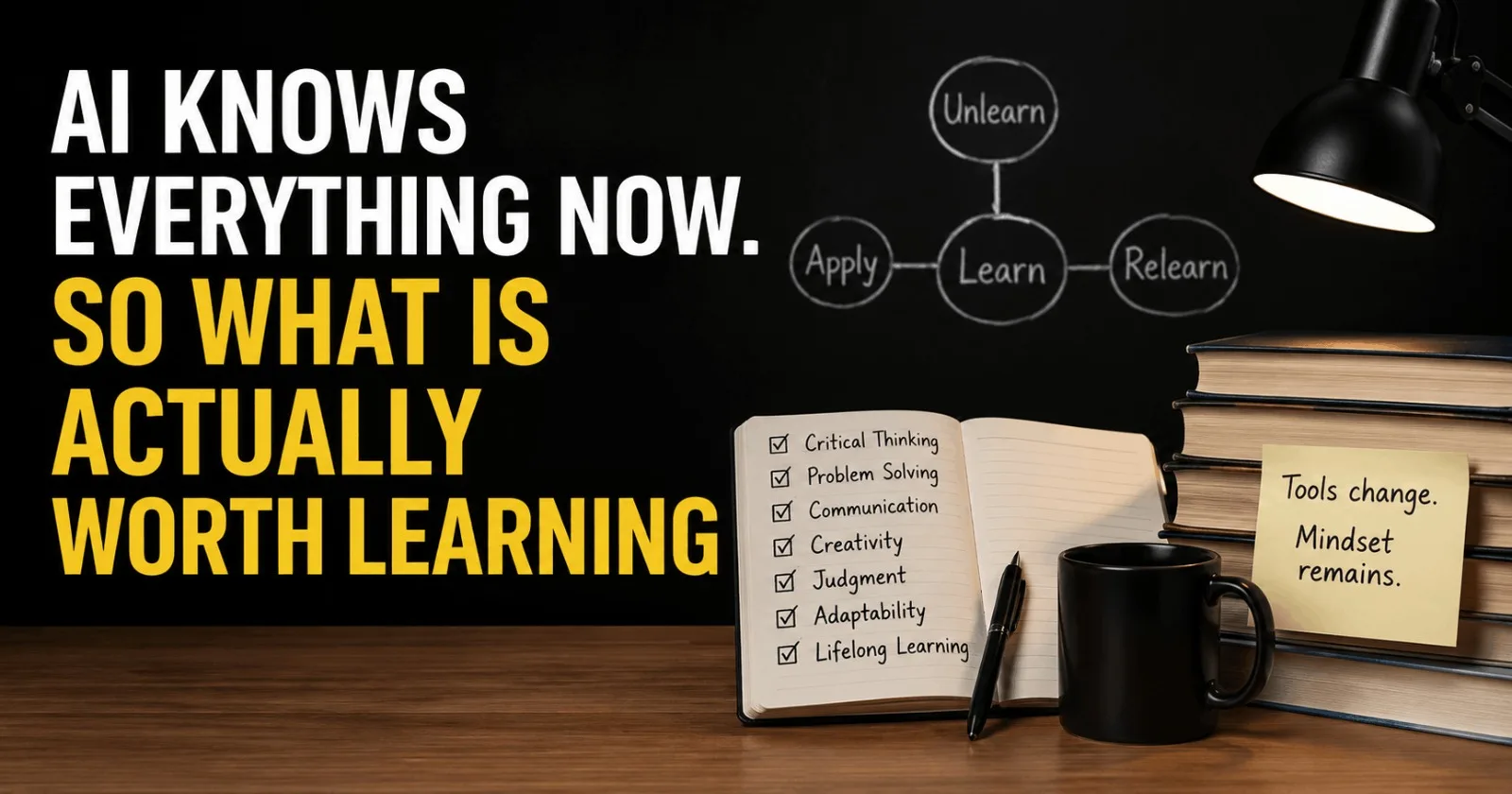
The question nobody can dodge anymore
Type a question into any current AI model and three seconds later you have a confident, well-organized, mostly correct answer. General relativity. A bug in your code. A first draft of your contract. A 400-page report, summarized before your coffee cools.
So why learn anything the hard way anymore?
That question used to be a thought experiment. Now it is showing up in classrooms, boardrooms, and yes, TEDx stages, including a recent talk at TEDxUniversity of Tartu by Kristina Kallas, Estonia's Minister of Education and Research, who framed the dilemma in one sharp line: when AI knows everything, what should humans learn. This piece does not retrace her talk. It is an independent dig into what the research, the labor-market data, and one country's live experiment actually say about the answer.
Here is the short version, and it will probably annoy anyone hoping for a simple answer: the old advice was to learn more facts. The new advice is close to the opposite. What is becoming valuable is not what you know, it is how well you think, judge, and verify, especially now that the easy answer is one prompt away.
The numbers, up front:
MIT lab study: 78% of AI-assisted writers still could not quote their own unaided essay, minutes after finishing it
Medical AI study: unaided detection of precancerous colon polyps fell from 28% to 22% after routine AI use
OECD global survey: only 47% of 15-year-olds regularly ask a question when they are confused
World Economic Forum: 70% of employers rank analytical thinking as the single most essential skill for the years ahead
The quiet cost of being helped
In 2025, MIT Media Lab researchers ran a four-month study that put a hard number on something people had only sensed anecdotally. Fifty-four participants were split into three groups writing essays: one using ChatGPT, one using a search engine, one using neither. The study, published as "Your Brain on ChatGPT," tracked brain activity with EEG the entire time.
The results were not subtle. The AI-assisted group showed weaker neural connectivity, reported the lowest sense of ownership over their own essays, and produced writing that was more homogeneous across participants than either other group. Different students, same AI, suspiciously similar essays. The researchers coined a term for what they were watching happen in real time: cognitive debt, the accumulation of long-term costs from short-term convenience.
Here is the number that should make you sit up. In their very first session, 83 percent of the ChatGPT group struggled to quote a line from the essay they had just finished writing, minutes earlier, in their own supposed words. By the fourth session, when researchers took the tool away entirely and had the same participants write unaided, 78 percent still could not quote their own essay right after finishing it. The habit of not really owning your own writing had outlasted the tool that caused it.
Before anyone reaches for the panic button: this is not a story about AI making people permanently dumber. The same study found that participants who started tool-free and only added AI in the final session showed increased neural engagement and more sophisticated prompting behavior, not less. The pattern is not "AI is bad for your brain." It is that outsourcing the effortful part of a task, every single time, quietly erodes the skill that the effort was building.
We have been here before, and it has a name
Cognitive debt is a new label for an old, well-documented pattern: deskilling. Aviation ran this experiment first, decades ago. Medicine is running it right now.
[IMAGE: Commercial airplane cockpit at cruising altitude, instrument panel lit up]
In 1997, American Airlines training captain Warren Vanderburgh stood in front of a room of pilots and told them something they did not want to hear: a whole generation was growing up trusting the flight computer's course line more than their own hands. He gave that generation a name that stuck: children of the magenta line, after the colored path the autopilot draws on the display.
Twelve years later, the warning stopped being theoretical. In 2009, the autopilot on Air France Flight 447 disconnected over the Atlantic after ice crystals blocked its airspeed sensors. The crew had so little recent manual flying practice that they could not recover the aircraft from a stall.
The official inquiry pointed directly at eroded manual skill as a contributing factor. Human-factors researchers have a name for this pattern: the automation paradox. The better the automation, the less practiced the human backup becomes, and the more damage occurs the moment the automation quits.
Medicine just produced its own version of that finding, with a control group and a number attached this time. Researchers publishing in The Lancet Gastroenterology and Hepatology tracked colonoscopies at four endoscopy centers in Poland before and after AI-assisted polyp detection tools were introduced. They isolated the exams where AI was switched off entirely, so the doctor was working alone, and compared performance before versus after routine exposure to the tool.
Before the AI arrived, unassisted adenoma (precancerous polyp) detection ran at about 28 percent. Three months after the doctors had gotten used to AI assistance, their unassisted detection rate, on the exact same task, had dropped to about 22 percent. Nobody told the endoscopists their eye had gotten worse. They performed the procedure exactly the way they always had. They had simply stopped noticing things they used to notice, because a machine had been noticing for them.
The lesson from a cockpit over the Atlantic and a colonoscopy room in Poland is the same one MIT's lab just confirmed on a smaller scale: automation does not just help you skip a task. Skip it enough times unaided, and the underlying skill quietly leaves with it, no warning light included.
What gets more valuable, not less
If some skills atrophy under AI assistance, the useful question flips: which skills get more valuable precisely because AI has gotten so capable?
The World Economic Forum's Future of Jobs Report 2025, drawing on responses from more than 1,000 employers representing over 14 million workers, has an answer. For the third survey in a row, one skill sits at the top.
Core skill employers call essential | Share of employers |
|---|---|
Analytical thinking | 70% |
Resilience, flexibility, agility | 67% |
Rounding out the top five, in that order, are leadership and social influence, creative thinking, and motivation and self-awareness. Two things stand out beyond the ranking itself. First, AI and big data is the single fastest-growing skill category employers expect to need through 2030. Second, and this is the counterintuitive part, analytical thinking and creative thinking are rising in importance right alongside it, not getting displaced by it. Employers do not want fewer people who can reason and judge just because a model can generate options. They want more of them, because someone still has to decide which option is right.
That same logic shows up well beyond HR surveys too, in what a wave of 2026 commentary has started calling the taste economy. When generation is nearly free, the argument goes, the scarce resource shifts upstream, from making things to choosing what is worth making.
Record producer Rick Rubin, who has openly said he cannot operate a mixing board, is the favorite example of this. Asked on 60 Minutes what artists actually pay him for, his answer boiled down to one thing: confidence in his own judgment about what is good.
AI can now generate a hundred song drafts, a hundred logo options, a hundred article angles, in the time it takes you to read this sentence. It still cannot tell you which one is worth keeping. That call remains stubbornly, expensively, human.
A country running the experiment live
Kristina Kallas's TEDx talk did not happen in a vacuum. As Estonia's Minister of Education, she has spent the last year and a half overseeing a genuinely unusual policy bet on this exact question, one that predates and outlasts any single talk.
In 2025, Estonia launched AI Leap, a national program giving every 10th and 11th grade student and their teachers free access to AI tools, starting with roughly 20,000 students and 4,700 teachers. It is among the first countries to attempt this at a full national scale, in partnership with OpenAI and Anthropic.
Here is what makes it interesting: not the access, the design. Before the program existed, 64 to 90 percent of Estonian students were already using commercial AI tools on their own, mostly to finish homework faster. Ivo Visak, the program's CEO, has been blunt about the underlying worry: for the vast majority of students, AI was already the default first move, and schools risked losing track of how much actual thinking students were still doing on their own.
So the student-facing tool Estonia built is deliberately not a fast-answer machine. It is tuned, in Visak's phrase, as a Socratic model: instead of handing over a finished answer, it questions the student, prompts them to plan their own approach, and pushes them toward their own conclusion.
The explicit goal, stated by the program itself, is not to maximize how much AI students use. It is to make sure the use that happens still builds a mind instead of replacing one. Researchers at the University of Tartu, the same university that hosted Kallas's talk, are running a multi-year study with Stanford to track the program's cognitive and academic effects.
Estonia's bet, in other words, is a real-world test of the exact split this article has been building toward: let AI handle retrieval and drafting, and deliberately protect the thinking that retrieval and drafting used to require of you.
So what should you actually go learn
Put the research side by side, aviation and medicine's deskilling data, MIT's cognitive debt findings, the labor market's skills data, Estonia's live experiment, and a fairly concrete list falls out. None of it is about avoiding AI. All of it is about what to protect while you use it.
Practice some things unaided, on purpose. Pilots keep manual flying hours specifically so a working autopilot does not become the only thing standing between them and a crisis. Do the same with your core professional skill: write the first draft yourself sometimes, solve the problem before you check the model's answer, do the mental math before the calculator.
Get better at asking, not just receiving. The OECD's 2022 PISA survey found that only 47 percent of 15-year-olds regularly asked questions when they did not understand the material, one of the strongest predictors of whether a student actually masters it. A precise question is a form of thinking. Staying quiet and letting the answer arrive just outsources the thinking to whatever supplies it.
Build a point of view before you consult the model. Form your own rough opinion first, then use AI to pressure-test, extend, or challenge it. That order matters more than it sounds like it should. It is the difference between AI sharpening your judgment and AI quietly replacing it.
Verify like it is your job, because it is. Treat every AI output the way a good editor treats a junior reporter's draft: plausible until checked. Every deskilling case above shares this same habit in reverse. The professionals who stayed sharp were the ones who kept actively evaluating output instead of just accepting it.
Do not skip the boring reps. Foundational, repetitive practice is what builds the pattern recognition that later lets you spot when an AI answer is subtly wrong. Skipping straight to the shortcut is exactly how the MIT study's low-ownership, low-connectivity group got that way.
This is not a threat to learning. It is a redirection of it
None of this is an argument to fear or avoid AI. Estonia is not banning ChatGPT, it is redesigning what students do with the time it frees up. MIT's own researchers were careful to say their finding was not that AI makes people "dumb," only that unexamined reliance has a cost, and examined use does not carry the same one.
Here is the honest way to read all of this evidence together: the value of raw knowledge is falling, fast, because a model can supply it instantly and nearly free. The value of judgment, verification, original synthesis, and the discipline to think before you ask is rising just as fast, for exactly the same reason. That is not a smaller list of things worth learning. It is a sharper one.
Comments (0)
Join the discussion by logging into your account.