
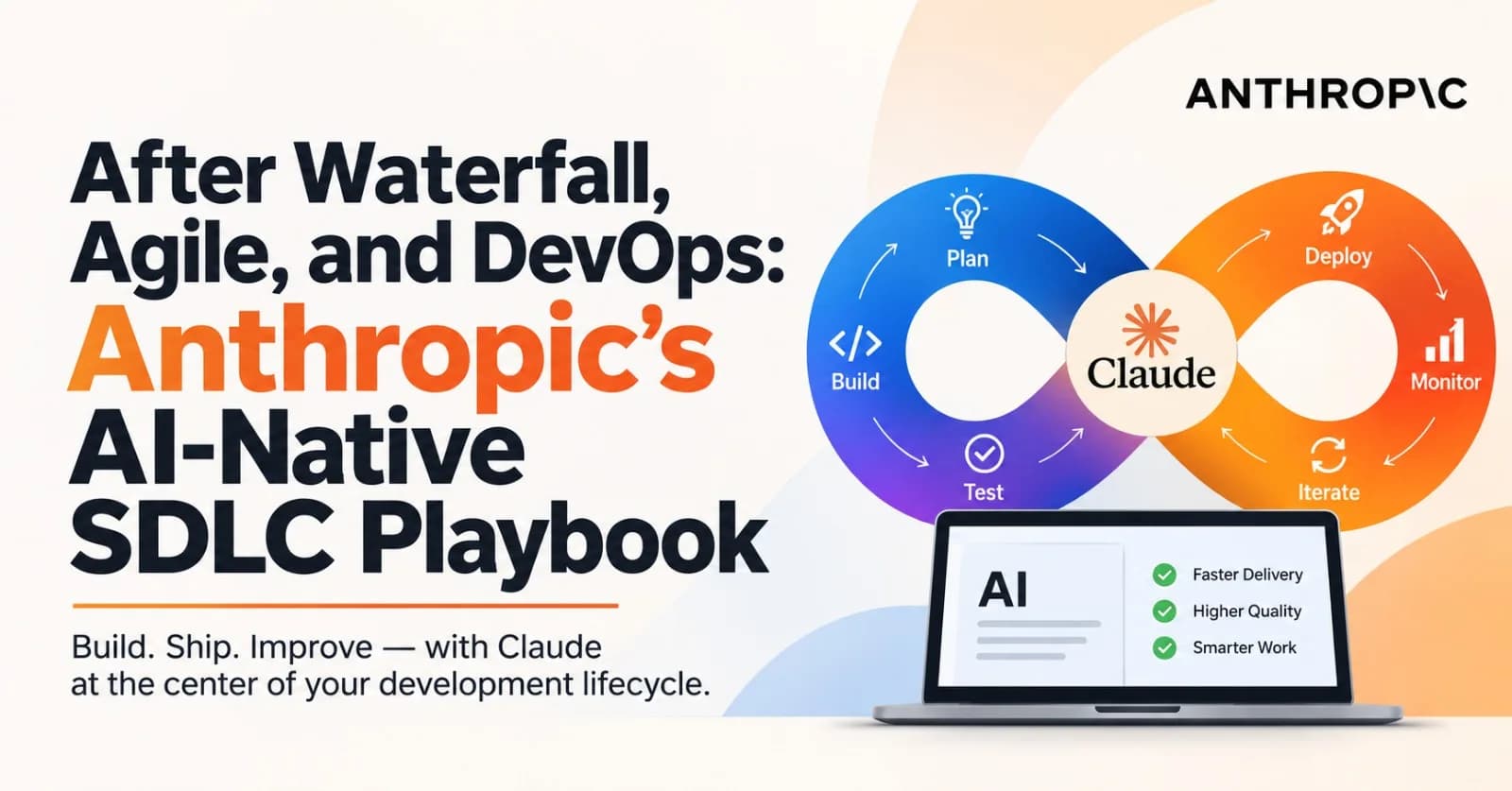
Each big shift in how software gets built started with a bottleneck. Waterfall dealt with the cost of coordinating large teams, so it leaned on documents and sign-offs. Agile shortened the feedback loop for requirements that kept changing. DevOps closed the gap between writing code and running it.
In August 2026, Anthropic’s Applied AI team published a 40-minute playbook (author: Louis Claxton) arguing the bottleneck has moved again. The playbook never uses the words waterfall or Agile, so that framing is mine. The rest of this post sticks to what the document says, plus one outside critique.
The premise
Code is no longer the slow part. Anthropic says that has three consequences:
The bottleneck moves to the stages on either side of build: planning, review and testing, and deployment. Those still run at human speed.
Controls stop matching reality. Reading every line made sense when a person wrote it. It doesn’t scale when agents write most of the diff.
Governance gets expensive, because exceptions still go through committees that meet weekly or monthly.
Security is the example they use. Security teams are sized for human output. When agents multiply that output, either the review queue grows or code ships under-reviewed.
Here is the idea in one picture. The bar lengths are invented for illustration; the playbook gives no durations.
%%{init: {'theme':'base','themeVariables':{'taskBkgColor':'#94A3B8','taskBorderColor':'#64748B','critBkgColor':'#F87171','critBorderColor':'#DC2626','activeTaskBkgColor':'#FBBF24','activeTaskBorderColor':'#D97706','doneTaskBkgColor':'#4ADE80','doneTaskBorderColor':'#16A34A','taskTextColor':'#0F172A','taskTextDarkColor':'#0F172A','taskTextLightColor':'#0F172A','taskTextOutsideColor':'#64748B'}}}%%
gantt
    title Where the time goes (illustrative, not measured)
    dateFormat YYYY-MM-DD
    axisFormat %-d
    todayMarker off
    section Before agents
    Plan      :p1, 2026-03-01, 3d
    Design    :d1, after p1, 3d
    Build     :crit, b1, after d1, 10d
    Test      :t1, after b1, 3d
    Deploy    :y1, after t1, 2d
    Maintain  :m1, after y1, 2d
    section With agents
    Plan      :active, p2, 2026-03-01, 3d
    Design    :d2, after p2, 3d
    Build     :done, b2, after d2, 1d
    Test      :active, t2, after b2, 3d
    Deploy    :active, y2, after t2, 2d
    Maintain  :m2, after y2, 2d
Red is the slow stage in the old model and green is the same stage once agents do it. Amber marks the stages the playbook says still run at human speed: planning, review and testing, and deployment.
A loop instead of a line
The playbook keeps the usual six stages (plan, design, build, test, deploy, maintain) but arranges them as a loop. Each stage ends by committing a file to version control, and the next stage starts by reading it. Humans sit at the gates between stages, and the dotted line is how the loop restarts.
flowchart TB
    PL["<b>1 Plan</b><br/>intent.md"]
    DE["<b>2 Design</b><br/>spec.md"]
    BU["<b>3 Build</b><br/>plan.md, then code and tests"]
    TE["<b>4 Test</b><br/>checks and evals"]
    DP["<b>5 Deploy</b><br/>PR with review findings"]
    MA["<b>6 Maintain</b><br/>incident record"]

    PL -->|"product owner accepts"| DE
    DE -->|"product owner approves spec"| BU
    BU -->|"engineer approves plan, agent builds"| TE
    TE -->|"agent checks its own work"| DP
    DP -->|"code owner approves PR,<br/>release manager authorizes deploy"| MA
    MA -.->|"breach writes a new intent.md"| PL

    classDef plan fill:#DBEAFE,stroke:#2563EB,stroke-width:2px,color:#0F172A
    classDef design fill:#EDE9FE,stroke:#7C3AED,stroke-width:2px,color:#0F172A
    classDef build fill:#FFEDD5,stroke:#EA580C,stroke-width:2px,color:#0F172A
    classDef test fill:#DCFCE7,stroke:#16A34A,stroke-width:2px,color:#0F172A
    classDef deploy fill:#FEF9C3,stroke:#CA8A04,stroke-width:2px,color:#0F172A
    classDef maintain fill:#FCE7F3,stroke:#DB2777,stroke-width:2px,color:#0F172A

    class PL plan
    class DE design
    class BU build
    class TE test
    class DP deploy
    class MA maintain
Stage | Artifact | What changes |
|---|---|---|
Plan |
| Anyone describes a problem to Claude in their own words. The product owner corrects and approves it before it’s committed. |
Design |
| Requirements and design happen in one session, constrained by the organization’s skills for brand, security, compliance and UX. The owner reviews the spec instead of writing it. |
Build |
| The engineer works in plan mode and approves a written plan before any code is generated. |
Test | Tests and evals | The agent verifies its own work. Evals run in CI whenever |
Deploy | PR and review findings | AI review runs against a |
Maintain | Incident record, then a new | Monitoring detects a problem, Claude diagnoses it, and the finding re-enters the pipeline as the next intent. |
The commit chain doubles as the audit trail: who asked for what, what the agent produced, and who approved it.
Ideas worth borrowing
A short CLAUDE.md. A file at the repo root with build commands, conventions, architecture notes and the mistakes the agent keeps making. The rule: if it makes the same mistake twice, the fix goes in the file. Keep it under a page.
Skills advise, hooks enforce. A skill makes the agent likely to follow a policy, but nothing forces it. Anything that must always hold needs a hook behind it that blocks the action.
Let the agent check its own work. Give it tests, a build, or a screenshot to compare. For bug fixes, write the failing test first, then stop the agent from editing that test.
Act up to the gate, not past it. Agent output arrives as a PR through branch protection. A production deploy hook blocks until a named release manager authorizes it.
Keep detection deterministic. In the Maintain stage, a plain script watches a metric against a rolling baseline. At one standard deviation it logs. At two, Claude diagnoses read-only. At three, it can open a PR or trigger a pre-approved runbook. No model decides whether something is wrong.
How to adopt it
Start by running each step by hand. The loop, where an accepted artifact triggers the next stage on its own, comes later. The plays are modular, and a few (the intent.md capture and CLAUDE.md) have no prerequisites.
If you already track work in Jira or a requirements tool, the playbook suggests naming one source of truth per artifact, either the repo or the legacy system. At minimum, cross-link the two.
For measurement, the playbook lists DORA metrics as lagging indicators. That makes it closer to an extension of DevOps practice than a replacement.
Caveats
It’s a vendor document. The tooling named throughout is Claude Code, Claude Security and Claude Tag. Nielsen Norman Group points out that AI labs benefit when companies adopt this model. Google (May 2026) and OpenAI (November 2025) have published similar, less prescriptive versions, and the core ideas carry over: versioned context, enforced guardrails, evals.
UX has no seat. NN/G notes that the playbook gives UX no stage or approval gate and doesn’t mention user research. Monitoring watches technical health, so a feature that works but confuses users could pass every check.
Review concentrates, it doesn’t vanish. The playbook says the practical limit on parallel agent sessions is how many streams one person can review properly. If review capacity is what limits you, more agents won’t help.
The numbers are targets. Claims like intent capture dropping from weeks to hours are stated as expectations, not measured results.
Takeaway
Faster code generation doesn’t speed up delivery if everything around it still runs at human speed. Anthropic’s answer is to write intent and policy into versioned files, enforce the hard rules with code, and spend human judgment at a small number of gates. Teams can test that without adopting the whole loop. CLAUDE.md, one hook, and one eval suite are a reasonable first week.
Sources
Louis Claxton, The AI-native SDLC playbook, Anthropic, August 21, 2026
Tanner Kohler, The Role of UX in Agentic Software Factories, Nielsen Norman Group, October 30, 2026
Comments(0)
Join the discussion by logging into your account.
No comments yet. Be the first to comment!