
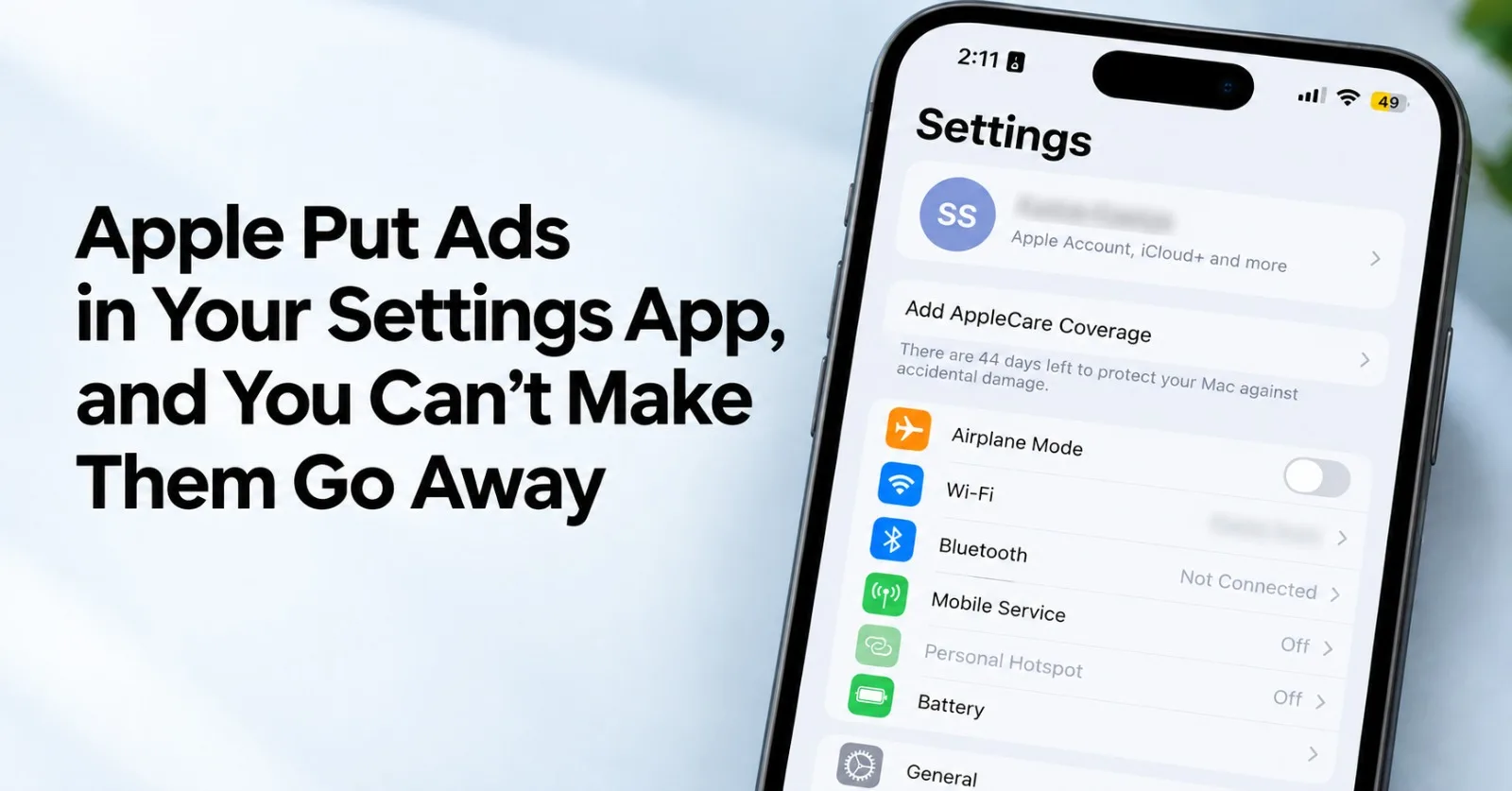
I want to tell you about the little red badge that's been sitting on top of my Settings app for two weeks now.
It's just a badge nagging me about more iCloud storage, or a free trial for Apple Music, or AppleCare+ being "right there" if I want it. I've tapped Not Now on it so many times I've lost count, and it just keeps coming back. Judging by the pile-up of complaints on social media and Reddit this week, I'm not the only one stuck in this loop.
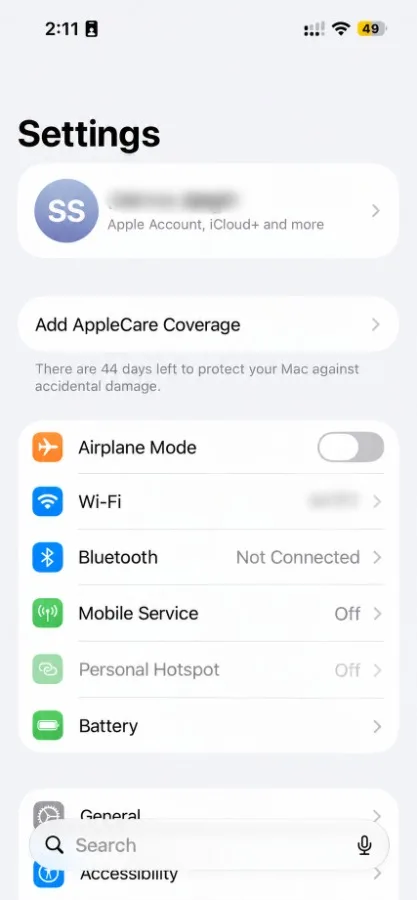
Mine, as of this week. Still there.
TechRadar broke the story, and the headline says it all: one fed-up user's comment, "I wish Apple would just stop that crap," became the actual title of the article. Which tells you something about the mood right now.
But there's more going on here than one annoying badge.
What's going on
The banners in question live near the top of the Settings app, right under your name and Apple ID. They rotate through promos for:
iCloud+ paid storage tiers
Free trials for Apple Music and Apple TV
AppleCare+ extended warranty coverage
What's making people angry is that there's often no clean way to dismiss these for good. You either wait for the promo to expire, which can take weeks or months while the badge just sits there, or you pay for whatever's being offered. Some banners do technically have a dismiss button. Doesn't always work, according to a bunch of users.
A chunk of these prompts show up right after you buy a new Apple device, which tracks with the timing. Apple just launched the iPhone Duo and the iPhone 18 Pro lineup, so there's a fresh wave of new owners getting greeted with pop-ups for services they never asked about. There's also a theory that some of this is a bug and not a deliberate choice: people who are already paying iCloud+ subscribers say they're still getting the storage upsell, which doesn't make much sense unless something's misfiring — or Apple just doesn't care and hasn't said so. Whether Apple fixes it or just lets it ride is going to tell us a lot.
There's a pattern here
What changed my mind from "mildly annoying bug" to "okay, this is clearly a strategy" was looking at the timeline. The Settings prompts are just the newest entry on a growing list.
When | Where | What happened |
|---|---|---|
2016 | App Store search | A single sponsored slot launches at the top of results |
2022 | App Store search | That ad program gets meaningfully expanded |
Ongoing | Apple News & Stocks | Ads become a standard part of the feed |
Feb 2026 | Apple News | Apple partners with ad-tech firm Taboola; users and writers call the resulting ads low-quality and "scammy"-looking |
March 2026 | App Store search | Multiple new ad positions per search (UK and Japan first, then everywhere else) |
Aug 2026 | Apple Maps | Ads land in "Suggested Places" and search results for US/Canada users, no opt-out even for paying iCloud+ subscribers |
Sept 2026 | Settings app | Persistent, hard-to-dismiss promos for iCloud+, Music, and AppleCare+ |
iOS 27 (released Sept 14) | Visual Intelligence | Sponsored-results code found in a pre-release build hints at ads when you point your camera at something to shop for it, but Apple hasn't confirmed it's live |
Look at that list and the picture gets pretty clear. Apple's spent the last two years quietly wiring advertising into almost every corner of iOS that gets real eyeballs. Maps was the one that got people talking back in August. Reddit's Apple Maps community wasn't shy about it, with one widely shared comment basically saying there's no reason left to use the app over Google Maps. Paying for iCloud+ or Apple One doesn't get you out of any of it, either. You can be a paying customer and still see the ad.
Visual Intelligence is the one I'm personally watching. iOS 27 itself is out now, Apple shipped it on September 14, but the sponsored-results code MacRumors found was just sitting in a pre-release build, and Apple hasn't confirmed it's actually switched on for anyone. If it does go live, the camera tool you point at a product to identify it could start surfacing sponsored listings from search partners next to the real results. A feature that already leans heavily on shopping would basically become a paid placement engine.
Follow the money
None of this is happening by accident, and Apple isn't even hiding why. Services is the fastest-growing, highest-margin part of the business, and the company keeps saying so out loud.
In its most recent quarter, Apple's Services division (which bundles in advertising, the App Store, iCloud, Apple Music, AppleCare, and more) pulled in $30.7 billion, up about 12 percent year-over-year, at something like a 75.6 percent gross margin. Compare that to Products, i.e. hardware, which ran closer to 40 percent. Services is now over a quarter of Apple's total revenue and a much bigger slice of its profit. CFO Kevan Parekh even called out advertising by name as one of the categories that hit a quarterly record.
Analysts have been tracking the ramp for a while. eMarketer's most recent forecast puts Apple's US ad revenue at $8.53 billion for 2026, climbing another 11 percent to $9.47 billion in 2027. Still small next to Google or Meta — but not a rounding error anymore either. And unlike Google or Meta, Apple gets to build the ad inventory straight into the operating system, so there's basically zero risk of losing the placement to a competing app.
So the next ad slot that turns up in some other app isn't a fluke. It's the plan playing out.
The Microsoft comparison people keep making
A lot of the social media reaction to the Settings ads has drawn a direct line to Microsoft, and honestly, it's a fair comparison. Windows 11 has been sliding ads into its Start menu's "Recommended" section for a couple of years now, promoting apps from the Microsoft Store whether you asked for them or not. It became such a punchline that a third-party Start menu replacement called Start11 started marketing itself specifically as the "no ads" option, and people bought it just for that.
For now, the difference is that Microsoft's Start menu ads have a toggle to switch them off in Settings. Apple's mostly don't. That's a real distinction, and it's probably why the "on par with Microsoft" comparisons stung as hard as they did. Being lumped in with Windows bloatware is not where Apple wants to be in this conversation.
The part I can't get past
Apple has spent a decade building its whole premium identity around not being the company that monetizes your attention. Privacy is basically a headline feature at every keynote. The pitch for paying more for an iPhone, more for iCloud+, more for Apple One, has always boiled down to some version of "you're the customer here, not the product."
To be fair, Apple's ad targeting really is more private than Google's or Meta's. It's not building a cross-app behavioral profile on you the same way, and that's a real difference. But "we won't profile you" and "you'll see unavoidable ads even after paying us" are two separate promises, and Apple's only kept one of them.
An AppleCare+ promo obviously isn't in the same category as a surveillance-based ad network. But when it shows up on hardware you paid over a thousand dollars for, in an app you didn't choose to open, and won't go away no matter how many times you dismiss it, it starts to feel less like a premium product and more like an appliance nagging you to register the warranty. That's basically where all this frustration is coming from, I think.
What happens next
If the pattern holds, and every data point above says it will, I'd expect this to keep expanding instead of reversing. Visual Intelligence is the obvious next stop, given the code that's already surfaced. Wouldn't be shocked to see more Settings-style prompts tied to other Apple services down the line either, especially around device upgrade windows, when Apple already knows you're primed to spend.
The one lever users technically have is making noise. Whether that changes anything is a fair question, though. Apple hasn't walked back the App Store ads, the News ads, or the Maps ads despite plenty of backlash each time it added one, and Microsoft rolled its own Start menu ads out to everyone "despite backlash," as one report literally put it. So if that persistent Settings badge is bugging you, complaining is probably still worth doing. Just don't expect it to work.
In the meantime, I'll be here, tapping "Not Now" on the same iCloud+ banner for what feels like the tenth time this month.
Sources:
MacRumors — Apple considering ads inside Visual Intelligence
Gigazine/9to5Mac — Apple dinged over low-quality, scammy-looking ads on Apple News
eMarketer — Apple's earnings show record iPhone sales and potential for growing its ad ecosystem
TechSpot — Microsoft is rolling out new Start menu ads to all Windows 11 users despite backlash
Windows Central — Here's how to never see ads again in the Windows 11 Start menu
Comments (0)
Join the discussion by logging into your account.
No comments yet. Be the first to comment!