
Quick status check: AWS's Bahrain region and the mec1-az2 zone in the UAE remain unavailable. Every other zone in the region, including the rest of the UAE and AWS's separate Israel sites, is running normally.
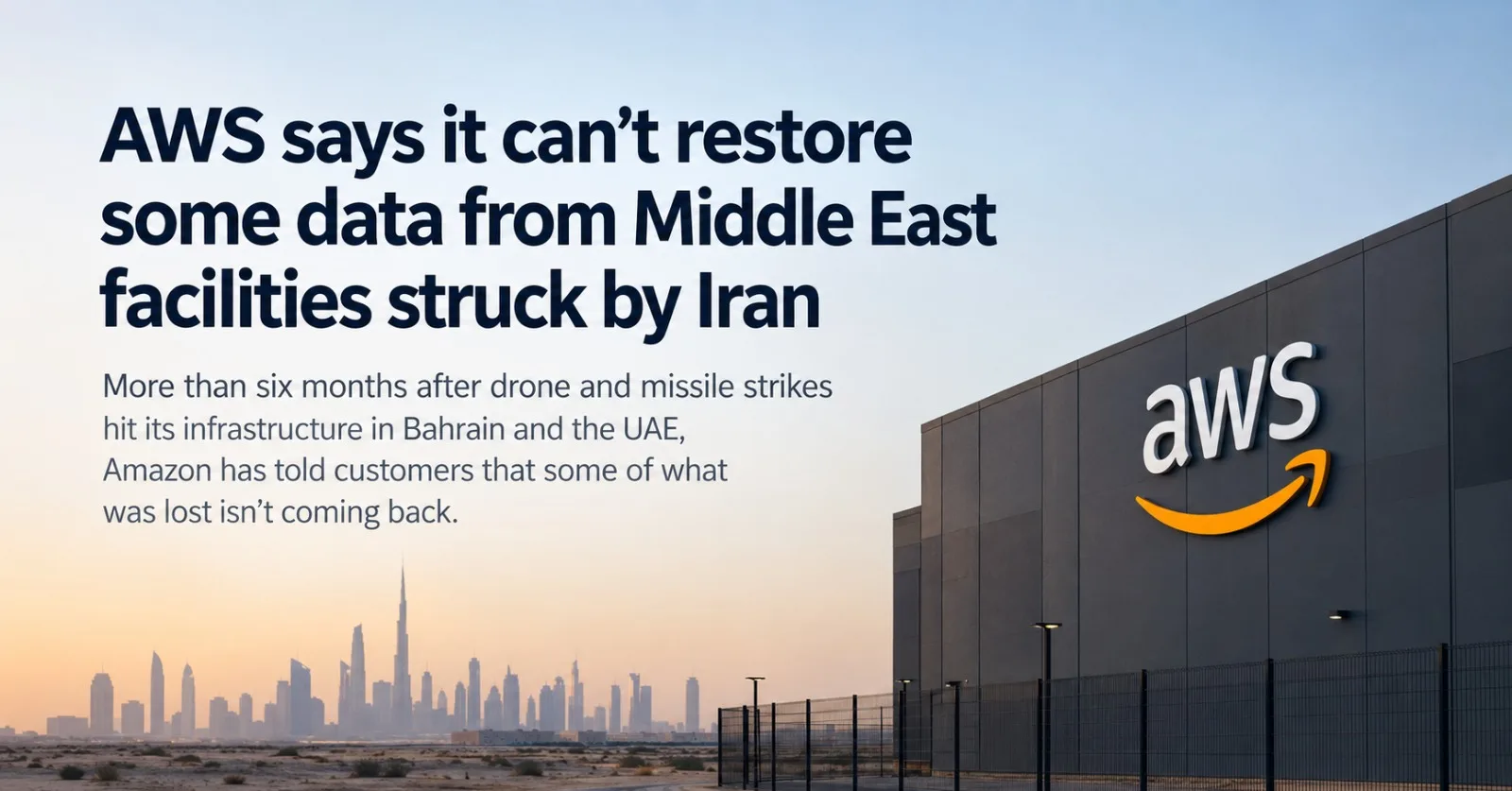
Amazon Web Services confirmed this week that it can't restore access to some of the cloud infrastructure it lost in the Middle East during this year's Iran war. In an update posted to its service health dashboard, first reported by Reuters, AWS said it won't bring back its Bahrain region or one of the three availability zones in its UAE cloud region, the zone known internally as mec1-az2.
It's the company's first detailed public accounting of the damage since spring, and it confirms what customers had suspected for months: parts of AWS's Gulf footprint are gone for good.
How it got here
The damage traces back to the wider Iran war that broke out earlier this year. After the US and Israel struck Iranian targets in February, Tehran retaliated with missile and drone strikes on Israel and Gulf states hosting American military assets, and AWS's regional infrastructure ended up in the blast radius.
timeline
    title AWS Middle East facilities: strikes to "unrecoverable"
    Feb 2026 : US and Israel strike Iran
    Mar 2026 : Two UAE data centers hit by drones (mec1-az2) : Bahrain facility damaged by nearby strike
    Apr 2026 : Bahrain hit again, later called "destroyed" by Iranian state media
    Sep 2026 : AWS confirms Bahrain region and mec1-az2 unrecoverable
    Early 2027 : Next AWS update expected, Bahrain only
Why AWS says it can't fix it
AWS designs its regions around multiple, physically separate availability zones so that damage to one doesn't take out the whole region. In Bahrain, the company said, that redundancy wasn't enough: the damage "exceeded what our regional and multi-AZ services are designed to withstand."
The UAE region held up better, since only one of its three zones was affected. AWS said it has already helped most customers in both countries move their workloads elsewhere, restoring what it could from backups and, where that wasn't possible, helping them work around data that's now permanently out of reach.
Who says they did it
Iran's Islamic Revolutionary Guard Corps, through the state-run Fars News Agency, has claimed the strikes on the Bahrain and UAE facilities were deliberate, alleging that AWS's infrastructure supported US military and intelligence activity in the region. Those claims haven't been independently verified.
For its part, AWS has been more circumspect, describing the UAE incident at the time only as damage caused by unspecified "objects" that struck the facility. Iran's Guard Corps separately claimed responsibility that same spring for hitting a Dubai data center it linked to Oracle, and reportedly warned other US tech companies operating in the Gulf that they could be targeted next.
The bigger stakes for Gulf cloud computing
The outages land at an awkward moment for the region's cloud and AI ambitions. The UAE has been positioning itself as a global data-center hub, and in 2025 it lined up OpenAI, Nvidia, Oracle, and Cisco as partners on the sprawling "Stargate" campus project.
Reporting since the strikes suggests the UAE is now rethinking how it builds, weighing options like spreading facilities out geographically and building underground, blast-resistant data centers instead of the conventional above-ground designs that were hit this year.
For now, AWS's message to customers in the affected zones is simple: don't wait around for those specific facilities to come back. Everything else in the region, including two other UAE zones and AWS's separate Israel sites, continues to operate normally.
Set the geopolitics aside for a second, and there's a plainer lesson here about what "resilient cloud infrastructure" actually means in practice. The pitch has always been that spreading load across availability zones protects you from exactly this kind of disaster.
In the UAE, that promise mostly held: one zone went down, the other two kept running. In Bahrain, it didn't, because the whole region turned out to be small enough, geographically, that one bad stretch of weeks could reach every zone in it.
If your workloads live entirely inside a single small country's cloud region, this is a reasonable prompt to check where your backups actually sit, war zone or not.
Further reading
CNBC: AWS says it can't restore service to Bahrain, UAE facilities six months after Iran strikes
The Times of Israel (Reuters): Amazon's AWS unable to restore access at some Mideast data centers after Iran war damage
The National: Amazon Web Services unable to restore Bahrain data network knocked out by Iran
Techzine Global: AWS can't recover all data from data centers hit in Middle East
Tom's Hardware: AWS tells clients to abandon Middle East data centers six months after Iranian drone strikes
TechRadar: Iran state media claims strikes on AWS data centers were deliberate, due to its support for US
Yahoo News (Reuters): Amazon's cloud unit reports fire after objects hit UAE data center
Comments (0)
Join the discussion by logging into your account.