
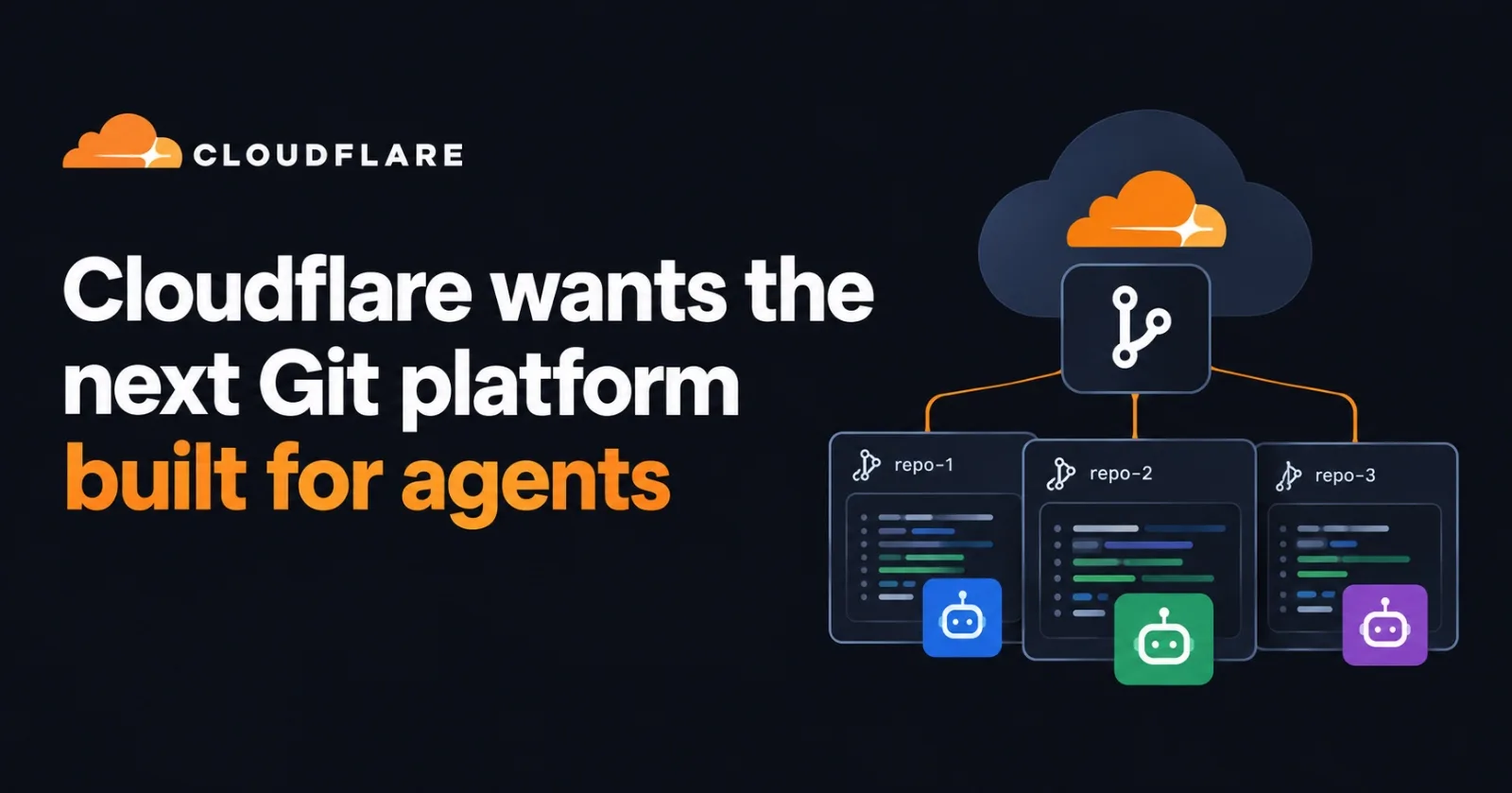
GitHub assumes a person is at the keyboard. People write the code, group it into repos, and talk about it through branches, commits, issues, and pull requests.
Cloudflare's argument is that this model strains when the developers are agents. It has put Artifacts, its Git-compatible filesystem, into open beta and started a competition to see what developers build on it. The post, by Dina Kozlov, Dillon Mulroy, and Zebulon Piasecki, went up on October 1.
Where the human model strains
Agents already fix bugs, write tests, review changes, and update dependencies. Put hundreds or thousands of them on one codebase and the basics get hard.
They need a way to see what the others are working on. Conflicting changes need somewhere to go. Reviewing that much output is a job in itself. And someone has to record why a change happened, not only what changed.
What Artifacts gives you
Artifacts launched earlier this year as a versioned filesystem that speaks Git. Cloudflare says it can scale to millions of repositories, and the aim was to make it practical to create a repo for every agent, session, task, or user.
Cloudflare says vibe-coding platforms use it to store their users' projects, and other developers use it to keep the code and context from agent sessions. Others give several agents isolated repos from the same starting point, then compare or merge the results later.
Since launch, Cloudflare has added three things that matter most for agent workflows. A Worker can now create and fork repos, read files and commits, and issue repo-scoped Git tokens.
Artifacts publishes an event whenever a repo is created, imported, forked, deleted, pushed to, cloned, or fetched.
And a repo can be connected to a Worker through Workers Builds, so a push to the production branch deploys the Worker while other branches get a Workers Preview.
There are two smaller additions. You can set a U.S. or EU jurisdiction when you create a namespace, and every repo in it follows that setting. The dashboard also shows operations, pulls, pushes, errors, and error rate for each repo.
Artifacts is in open beta on the Workers Paid plan. Billing, based on repository operations and stored data, starts October 15, 2026.
How the pieces could fit together
Cloudflare doesn't hand you a design, but the parts line up into a workflow.
A task arrives, and a Worker forks the project so the agent gets its own repo. The agent pushes its work, and the push event starts a review agent.
If the repo holds a Worker, work on a non-production branch gets a preview. After approval, a push to the production branch deploys.
That should be possible with what Cloudflare describes. It's also a fairly conventional shape, and the contest is asking you to go past it.
The more interesting questions sit on top. What should review look like when ten agents solve the same task ten different ways? Where does the reasoning behind a change live? How do you pick which of several competing changes ships?
The competition
Cloudflare wants entrants to build their vision of the Git platform for the agentic era, using Workers and Artifacts. The minimum bar is multiple agents working on changes at the same time.
Past that, it's open. Cloudflare says it isn't looking for today's GitHub with agents added on top. It suggests rethinking repositories, branches, pull requests, worktrees, code review, and merge conflicts, or finding better ways to preserve agent context.
To enter, you send:
A 5 to 10 minute video showing what you built, what it lets agents and developers do, and how it works.
A link to the source code, under a permissive open source license (MIT, Apache, or BSD).
Instructions for running or trying the project.
Entries are due October 14, 2026.
Cloudflare will pick the top three projects and fly up to two people from each team to San Francisco to show them at Cloudflare Connect. The first-place team also gets $25,000 in Cloudflare credits and invitations to the VIP speaker dinner on the Monday night of Connect.
If you have an idea, the competition page is where to submit it, and the Artifacts docs are the place to start.
Comments (0)
Join the discussion by logging into your account.
No comments yet. Be the first to comment!