
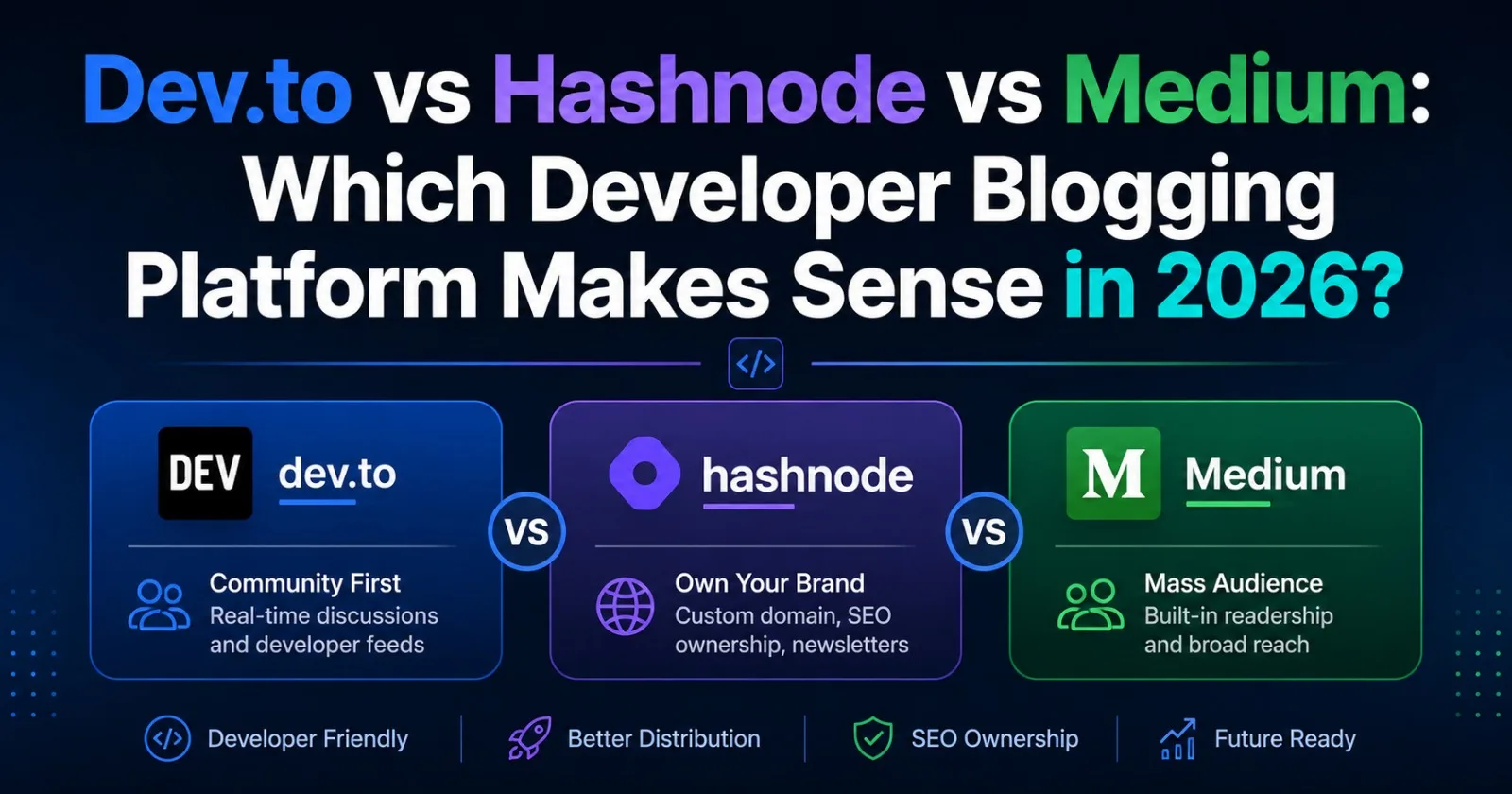
Disclosure: I'm building ZyVOP, an open developer publishing platform with native multi-platform cross-posting. This comparison evaluates dev.to, Hashnode, and Medium strictly on their technical features and documented platform mechanics before discussing how ZyVOP approaches the distribution problem.
Deciding where to publish technical tutorials, architectural breakdowns, and engineering guides usually comes down to three established platforms: dev.to, Hashnode, and Medium.
Each platform operates on fundamentally different business models, SEO architectures, and content discovery mechanics. Choosing where to invest your writing time depends on what you value most: immediate community feedback, long-term domain authority, or broader non-technical reach.
Here is a comprehensive, feature-by-feature comparison of how all three platforms stack up in 2026.
Platform Summary
Dimension | Dev.to | Hashnode | Medium |
|---|---|---|---|
Core Model | Centralized community feed | Independent custom-domain blogs | Generalist publication network |
Pricing | 100% Free | Freemium ($50/yr Pro for AI/APIs/Scheduling) | Free to publish, reader paywall ($5/mo) |
Primary Domain SEO | Owned by | Owned by your custom domain | Owned by |
Code Highlighting | Native (Markdown) | Native (Markdown) | Basic / Gist embeds |
Diagrams & Math | Basic Math (KaTeX), no native Mermaid | Native Mermaid & LaTeX | ❌ None |
Interactive Playgrounds | Liquid tags (CodePen, Glitch) | Embed widgets | ❌ None |
API & Automation | Free Forem REST API | Pro-only GraphQL API ($50/yr) | Limited / Deprecated |
Post Scheduling | Free & Native | Pro-only ($50/yr) | ❌ None |
Email Newsletters | ❌ None | Native publication newsletter | Platform digest only |
Outbound Syndication | ❌ None (RSS import only) | ❌ None (Pro ZIP import only) | ❌ None |
1. Dev.to — The Community Town Square
Dev.to (powered by the open-source Forem engine) is built around a centralized social feed where discovery is driven by tags, recency, and community reactions.
Strengths
Immediate Community Reach: Because dev.to operates as a shared timeline rather than isolated blogs, newly published articles get surfaced in topic feeds immediately.
Frictionless Onboarding: Standard Markdown editor with zero configuration or domain setup required.
Free Developer API: Full programmatic access via the Forem REST API with personal API keys at zero cost.
Active Technical Discussions: Built-in multi-reaction system and comment threads foster collaborative technical discussions.
Tradeoffs
No Domain SEO Ownership: Your articles live at
dev.to/username/slug. Backlinks and search ranking build domain authority fordev.to, not an asset you control.No Direct Audience Ownership (Newsletter): Dev.to does not provide an author-specific email newsletter mechanism. You cannot collect subscriber emails to reach readers directly.
No Native Diagram Rendering: Mermaid diagrams must be pre-rendered into static images before insertion.
Single-Platform Walled Garden: There is no native outbound syndication engine to distribute posts to other networks automatically.
2. Hashnode — The Custom-Domain Blog Engine
Hashnode positions itself as a blogging platform for developers who want the benefits of a personal blog (custom domains) combined with a developer-centric markdown editing environment.
Strengths
Custom Domain Mapping: Map your personal domain (e.g.,
blog.yourdomain.com) so all search indexing and domain authority accrue directly to your property.Rich Technical Markdown: First-class native support for LaTeX mathematical equations and Mermaid v11 flowcharts/diagrams.
Built-in Publication Newsletter: Allows readers to subscribe directly to your publication to receive email notifications upon new releases.
Headless CMS Capabilities: Option to use Hashnode as a headless content store backed by GraphQL queries.
Tradeoffs
Feature Gating via Hashnode Pro ($50/year): Core developer workflow features are locked behind the paid Pro tier:
Advanced AI writing and cover generation tools
Scheduled post publishing
Programmatic API mutations (publishing/updating via GraphQL)
Advanced export and backup tools
Smaller Organic Discovery Feed: Because Hashnode prioritizes individual custom domains, organic feed-based discovery is generally lower than dev.to's centralized stream.
No Multi-Platform Outbound Syndication: Articles published to Hashnode must be manually cross-posted and canonicalized to other platforms.
3. Medium — The Generalist Publication Network
Medium is not a developer-specific platform, but its massive global audience makes it an attractive target for technical writers seeking reach outside pure engineering circles.
Strengths
Broad Demographic Reach: Reaches product managers, executives, startup founders, and non-technical decision makers who do not browse dev.to or Hashnode.
Clean Reading Experience: Minimalist typography and distraction-free article presentation.
Monetization Option: The Medium Partner Program allows eligible writers to earn income based on member reading time.
Tradeoffs
Aggressive Reader Metered Paywall: Non-paying readers frequently encounter paywalls after viewing a small number of free articles per month, blocking tutorial access.
Poor Technical Tooling: Lack of robust syntax highlighting, no native Mermaid diagramming, no LaTeX support, and no embedded runnable code sandboxes.
Deprecated / Restricted API: Programmatic posting to Medium has limited native support compared to modern REST/GraphQL workflows.
The Syndication Dilemma: Why Choose Just One?
The central challenge technical writers face is audience fragmentation. Developers who browse dev.to for quick debugging tips rarely scour personal Hashnode domains, while leaders browsing Medium miss both.
Historically, reaching all three platforms required:
Writing the markdown once.
Manually copying and pasting into each editor.
Reformatting broken code blocks or embed tags.
Manually configuring
canonical_urlmetadata on each platform to avoid duplicate content search penalties.
How We Approached This at ZyVOP
We built ZyVOP around the principle that developers should write once in clean Markdown and syndicate everywhere automatically.
1-Click Multi-Platform Cross-Posting: Publish natively on ZyVOP and automatically broadcast to dev.to, Hashnode, Medium, WordPress, and Bluesky.
Automated Canonical URL Protection: Every syndicated post automatically injects the primary ZyVOP post URL as its canonical source, ensuring Google attributes all domain authority correctly.
Official CLI & REST API: Publish directly from your terminal or CI/CD pipelines via
npx zyvop publish ./post.mdwith full frontmatter support.Free Developer Tooling: Groq-powered AI writing copilot, post scheduling, double opt-in email newsletters, and interactive playground embeds (CodePen, StackBlitz, CodeSandbox, OneCompiler) without paid feature gates.
If you are evaluating where to start your developer blog in 2026, you don't necessarily have to pick a single walled garden.
Comments (3)
Join the discussion by logging into your account.
Igor Ganapolsky
Useful comparison. The practical decision rule I'd add: pick where the canonical lives first, then treat the rest as distribution. Own-domain canonical + syndicated copies with rel=canonical back to it is the only setup that doesn't strand your SEO if a platform changes its rules. Two gotchas worth checking before committing: Medium's importer will happily set canonical but you lose it if you later move a post behind the paywall/publication, and Dev.to's API caps you on rapid publishes, so bulk backfills need throttling. Also export early — do a test export on each platform on day one, not on the day you want to leave, since the difference between "Markdown export" and "HTML dump with inline styles" is a weekend of cleanup.