
A Decade in the Making
F-Droid shipped version 2.0 on September 24, 2026, calling it the largest update to the app in a decade. The release follows more than a year of development, 14 public test builds, and an independent security audit.
For over ten years, F-Droid has helped people find and install free and open source Android apps without trackers or proprietary dependencies. Version 2.0 rebuilds the interface, navigation, and core code in Kotlin and Jetpack Compose, while keeping the interactions longtime users already rely on.
The rollout is gradual. F-Droid is pushing 2.0 out to users over the coming weeks, so it may take a while to reach your device.
Navigation and Layout
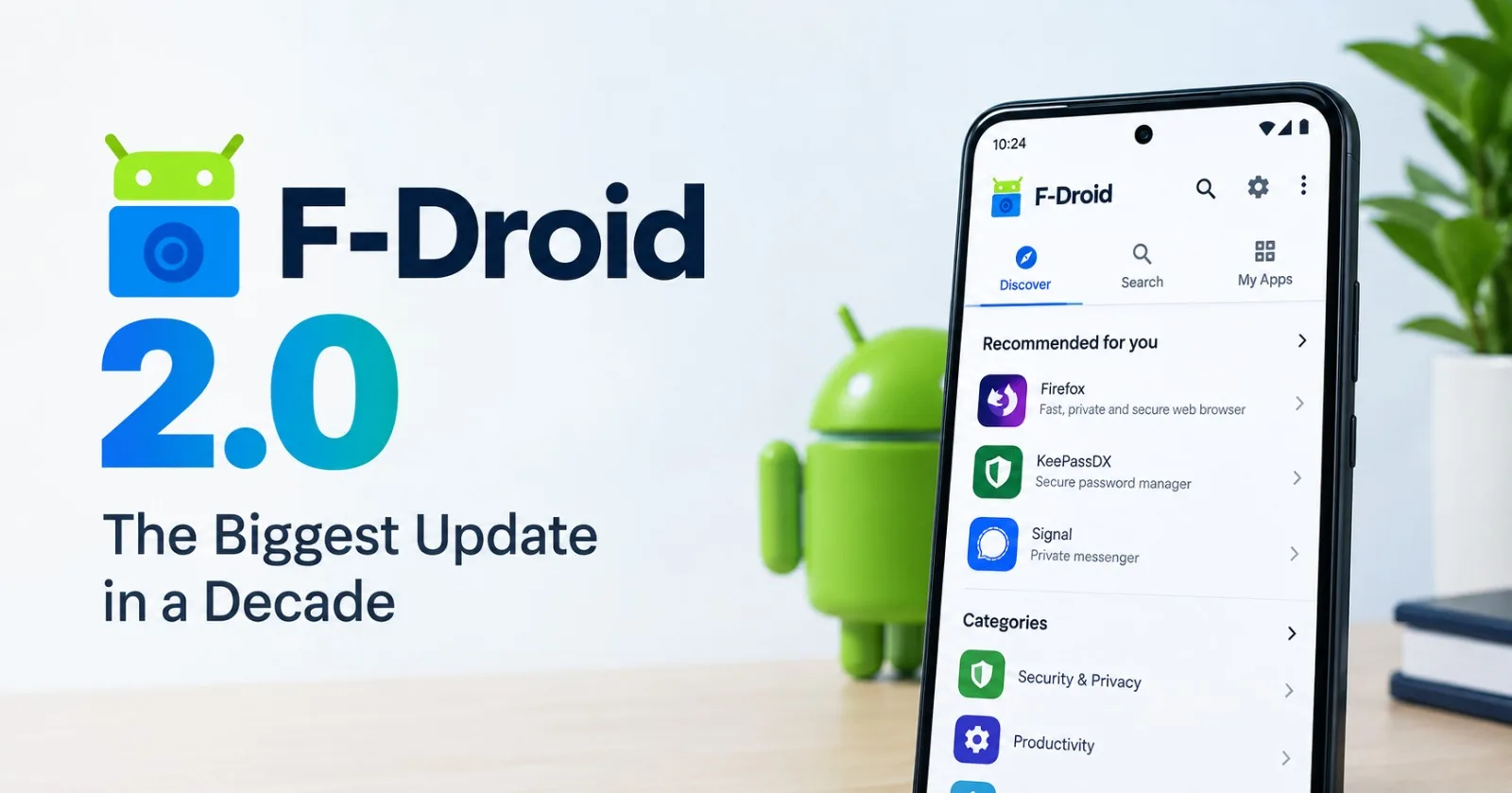
The redesign fits current Android patterns, including Material Design, while keeping the F-Droid interactions people already know.
Main navigation is now split into three areas:
Discover: browse categories and see what's new
Search: find a specific app
My Apps: manage installed apps, updates, and issues in one place
Settings and Nearby Swap have moved to the top bar. They're still one tap away, but no longer compete for space with the main navigation.
Finding the Right App Among Thousands
With the F-Droid catalog now running to thousands of apps, discovery was a major priority. The new Discover screen surfaces newly added apps, recently updated apps, and the most-downloaded apps in the repository, without tracking what you look at.
Categories were overhauled in three ways. Many more specialized categories replace the old, small set of broad ones, covering things like VPNs, firewalls, password managers, launchers, and navigation tools.
New higher-level "meta" categories group related categories together on the Discover screen, giving newcomers an easier entry point. Category names and descriptions now actively help guide search and discovery throughout the app.
Games got special attention: instead of one big lump, F-Droid 2.0 splits games into 17 distinct genres, making it easier to find the kind of game you're after.
A new filtering system lets you combine criteria such as category, device compatibility, and anti-features, so you could view only action games that work on your device while excluding anything that depends on non-free network services. Onboarding screens introduce these features contextually instead of burying them in settings.
Search
Search no longer only matches app names. It now checks descriptions, categories, and translated content too, so you can find an app by what it does rather than what it's called.
The biggest gains land in Chinese, Japanese, and Korean, where the new search engine gives much more reliable support for CJK writing systems. Search also remembers recent queries, so you can return to an earlier search without retyping it.
Installing and Updating
Installing and updating apps has historically been a second-rate experience outside Google Play. Pressure from the EU's Digital Markets Act and antitrust actions elsewhere has pushed Android to open up smoother, more automatic install and update APIs to all app stores, and F-Droid 2.0 takes advantage of that.
The app now uses one unified installer for every F-Droid install, whether it came from the OS or was sideloaded. On supported devices, the new pre-approval API lets you confirm an install right after you tap it, instead of waiting for the download to finish first.
Updates now download and install automatically in the background by default, while still respecting whatever preferences you already had set. Because of this, pull-to-refresh no longer triggers a manual check; that gesture is reserved for scrolling now.
A manual "check for updates" option still lives in the three-dot menu on the My Apps screen, and the data-usage settings that control background downloads have been reorganized to be easier to adjust.
What Changed, Moved, or Disappeared
A rebuild this size meant hard calls about what to carry forward.
Tor settings are simplified. Automatic Tor detection, which had grown unreliable as Android's Tor landscape expanded (TorVPN, Orbot, TorServices, and more), has been removed. An existing "Use Tor" setting migrates to the general Proxy Settings, and Tor VPN is now the recommended path for easy Tor support.
The panic app-hiding feature is more honest about its limits. F-Droid was among the first apps to let users disguise it, originally as a fake calculator.
F-Droid 2.0 adopts the design now common across apps like Orbot, TorVPN, and Signal: the disguise changes only the app's icon and name. The app still appears in Android's Apps settings and remains detectable under forensic inspection, so users understand exactly what protection they're getting.
App-wiping on panic trigger is on hold. The ability to wipe apps automatically in response to a panic-trigger app like Ripple hasn't carried over to 2.0.
The F-Droid team says maintaining it is highly specialized work for a small user base, and it wants feedback from people who relied on it before deciding how to move forward. If you depend on this today, it's worth holding off on updating.
The Privileged Extension (FPE) isn't supported yet. F-Droid 2.0 won't use FPE even if it's installed. Instead, it leans on Android's built-in session installer, which can run background updates on any recent Android version without requiring a privileged extension.
One side effect of the modernization: F-Droid 2.0 now requires Android 7 or newer, since it depends on a fix only available from that version onward. Older F-Droid releases will keep working on older Android versions for anyone who needs them.
The Rewrite
Behind the visible redesign sits a full rewrite. F-Droid 2.0 is built in Kotlin with Jetpack Compose, the toolkit now standard across modern Android development. That lowers the barrier for new contributors familiar with today's Android ecosystem and leaves a codebase that's easier to test, maintain, and extend for years to come.
The project sees this as a foundation for the next decade, aiming to spend less time on technical debt and more time shipping improvements.
The work was backed by a mix of grants and community support. Developer Torsten Grote's work was funded by NLnet through the Mobifree fund.
The Open Technology Fund's User Experience & Discovery Lab supported research and design with Ura Design. Further support came from OTF's FOSS Sustainability Fund, NGI, Mobifree, and the Calyx Institute.
An independent security review was carried out by the Open Technology Fund's Security Lab together with Convocation; F-Droid says it addressed all relevant findings and plans to publish the full audit report once cleared.
Volunteers also contributed code, testing, bug reports, translations, documentation, and design feedback throughout the redesign.
What's Next
One headline feature didn't make the cut yet: Nearby, F-Droid's peer-to-peer app-sharing feature, is being rebuilt with improved connection methods, but that work is still in progress and not part of the initial 2.0 release.
F-Droid frames 2.0 as a foundation, not a finish line. The team expects to keep tuning performance, accessibility, discovery, and general usability as more people update and send feedback.
This release also lands against a serious external threat to F-Droid's future. In August 2025, Google announced a mandatory Android developer verification program requiring anyone whose app runs on a certified Android device, including sideloaded and third-party-store apps, to register a legal identity, submit government ID, and pay a $25 fee.
F-Droid board member Marc Prud'hommeaux responded by launching the Keep Android Open campaign, which had grown to more than 70 organizations across more than 20 countries by September 2026, including the Electronic Frontier Foundation, the Free Software Foundation, GrapheneOS, and Proton.
F-Droid has called the policy an existential threat, since much of its catalog is built by volunteer or pseudonymous developers who can't or won't hand Google their identity, and since F-Droid signs apps with its own key rather than each developer's, a Google-mandated single signature could break how F-Droid installs work.
Enforcement begins September 30, 2026, in Brazil, Indonesia, Singapore, and Thailand, with a global rollout planned for 2027. That initial rollout isn't expected to cover F-Droid or other third-party stores directly, so the practical impact on F-Droid remains unresolved for now.
Ways to pitch in: test, translate, or review (new contributors are welcome, whether testing upcoming features, improving translations and docs, or reviewing open issues); contribute code (the Kotlin/Compose rewrite is designed to make this easier than before); or donate via Liberapay or OpenCollective, which funds the less visible work — community management, QA, release coordination — that grants don't always reach.
Sources
F-Droid 2.0: A New Chapter for Android Freedom — official F-Droid announcement, Sep 24, 2026
Keep Android Open — background on Google's Android developer verification policy and the campaign opposing it
Comments (2)
Join the discussion by logging into your account.
James 'Dante' Midzi
This sounds cool. But as i've been burnt by updates before, I'm keeping a copy of the old version