
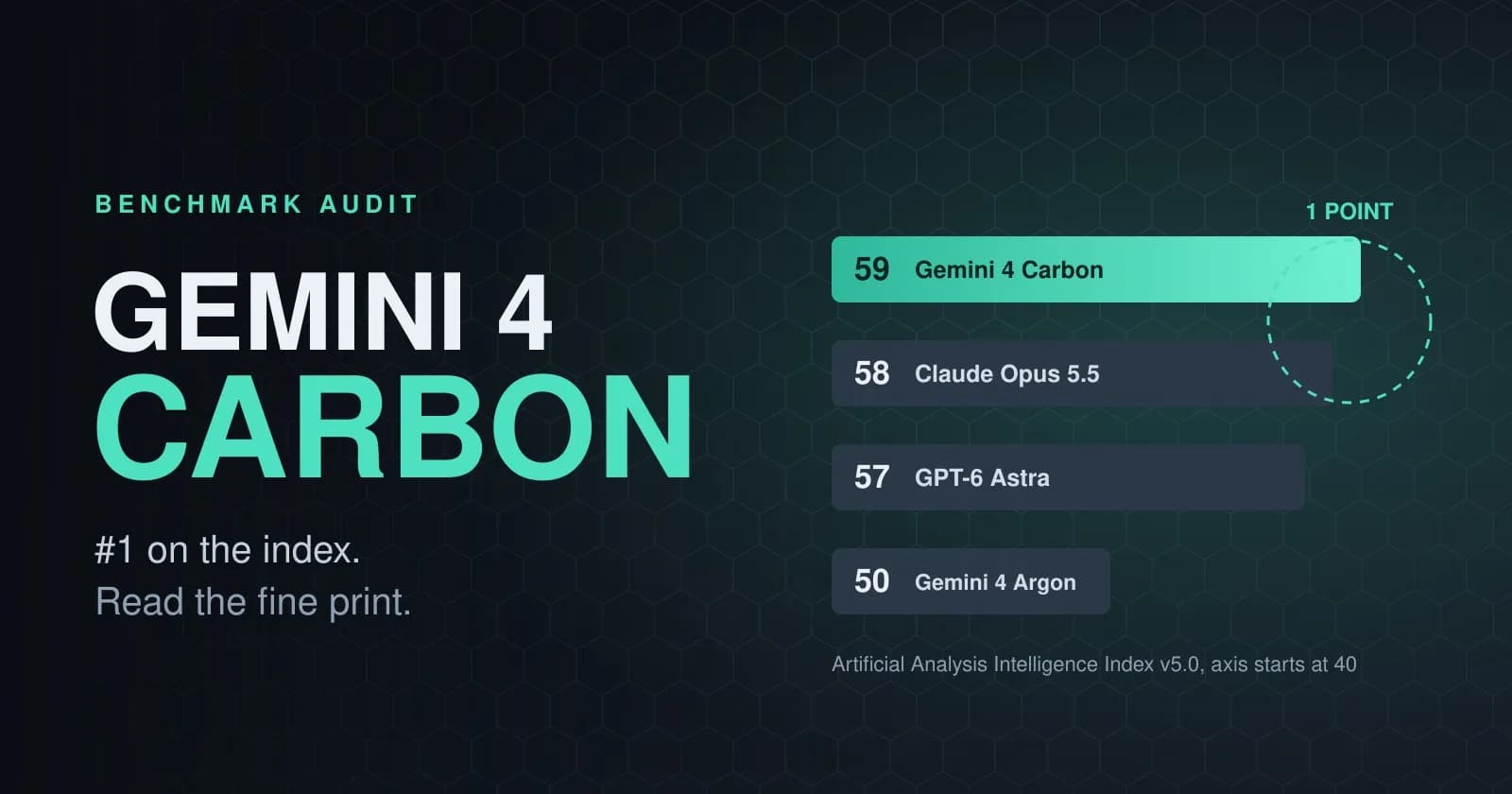
Gemini 4 Carbon went from an internal codename in a Business Insider scoop to Google's announced flagship in under three weeks. Google announced it on October 28, 2026, two weeks after Argon opened to paying users, and the headline is first place on a freshly rebuilt Artificial Analysis index. As of this writing, only a subset of vetted cyber defenders can use it.
Most launch numbers cannot yet be reproduced, and several were produced under conditions unavailable to ordinary users. This audit separates independently measured results, Google's self-reported claims, and claims outsiders cannot verify, then turns them into a practical test plan.
Quick take: Carbon's lead over Claude Opus 5.5 is one point (59 vs 58) on an index that is one day old. It wins on reasoning, knowledge and science, trails Opus on coding agents, and shows a higher wrong-answer rate than Argon. The cyber scores were run with guardrails off. The $2/$10 price is a 50% launch discount with no announced end date. Treat Carbon as a strong candidate to evaluate when it ships, not a reason to rewrite anything today.
From codename to launch in three weeks
timeline
    title Gemini 4 Carbon, from leak to launch
    Sep 30 : Argon announced to Fairwind cyber defenders only
    Oct 9 : Business Insider reports Carbon testing on Jetski
    Oct 13 : Argon opens to the paid API and AI Pro and Ultra
    Oct 21 : Carbon early access and LMArena testing reported
    Oct 27 : Artificial Analysis publishes Intelligence Index v5
    Oct 28 : Carbon announced and ranked first at 59
The first public sign was a Business Insider report (Japanese edition) on or about October 9. Citing internal documents and screenshots, it said Google employees were testing a Gemini 4 checkpoint called Carbon on Jetski, the company's internal coding platform. One employee compared its coding to Claude Opus 5.5. The same documents said a different checkpoint, Barium-B, had been picked to ship as Argon.
Two weeks later, TestingCatalog reported that a Carbon early-access program had started with partners and that the model was appearing on LMArena. Testers described better 3D output than Argon, weak UI work, and a model that ran two to four times slower while cutting fewer corners. TestingCatalog itself cautioned that these were arena matchups on hand-picked prompts, and that nobody could be sure which checkpoint they were being served.
The leak's coding comparison looks directionally right: Carbon appears competitive with Opus 5.5, but the independent results do not put it ahead.
There is also a backdrop to keep in view. At Argon's launch, Bloomberg reported that some Google employees said the model did well on benchmarks but struggled with some real-world coding tasks, a characterization Google disputed. Carbon's announcement is again built mostly on benchmark scores, so the gap between score and daily work stays the question to ask of every number below.
Three kinds of numbers
Every claim in the launch material lands in one of three buckets. The bucket decides how much weight it can carry.
Claim | Who measured it | Can you check it? |
|---|---|---|
#1 at 59 on Intelligence Index v5.0 | Artificial Analysis | Method is public, but Carbon has no public API yet |
Hallucination rate 4% to 11%, cost per task, Coding Agent Index | Artificial Analysis | Same |
88.2% SEC-bench Pro, 54.8% ExploitGym, 71.0% CWE-bench | Google, on external benchmarks, guardrails off | Only Fairwind partners can try |
More than 2x Argon on secure-code generation | Google, internal benchmark | No |
Chrome team: patches more than 10x better than another lab's model | Google, internal, rival unnamed | No |
Misalignment alerts down almost 80%, unsupported claims roughly halved, cheating at 0.0% | Google, internal testing | No, and no technical report yet |
Highest score in 15 of 17 rows of Google's table | Google's compilation, including third-party indices such as Vals and Artificial Analysis | Row by row |
Third-party results are the strongest evidence, but limited access prevents reproduction. Google's internal claims may be accurate; without a technical report or uncertainty estimates, their margins are hard to interpret, as VentureBeat noted.
First place by one point, on a one-day-old index
Artificial Analysis ranks Carbon (high reasoning) first on Intelligence Index v5.0 at 59. The chart below shows how tight the top is and how large the jump from Argon is.
xychart-beta
    title "Artificial Analysis Intelligence Index v5.0"
    x-axis ["Gemini 4 Carbon", "Claude Opus 5.5", "GPT-6 Astra", "Gemini 4 Argon"]
    y-axis "Index score" 40 --> 65
    bar [59, 58, 57, 50]
Two details matter. First, v5 launched on October 27, and Opus 5.5 held first place at 58 until Carbon arrived a day later. The index was rebuilt so that 60% of it uses private tests or withheld answers, with new evaluations added and others replaced, so v5 scores cannot be compared with older index numbers.
Second, Carbon takes the top score on four of the nine evaluations: HLE-Diamond, Terminal-Bench-Science, AA-Omniscience and AutomationBench-AA. Artificial Analysis attributes the lead to complex reasoning, knowledge and science tasks. The composite also hides a split that the next section shows. On Arena, Carbon placed first in Text Arena, second in Agent Arena and fourth in WebDev, where Google reports a gain of 89 Elo to 1768.
The nine-point gain over Argon is more informative than the one-point lead over Opus, which could change with the next index revision.
Where Carbon trails, and where it leads by a mile
Google's own table has Carbon first in 15 of 17 rows. The two exceptions and the narrowest wins are the useful part, so here they are next to the biggest lead and the independent coding and knowledge-work boards.
Benchmark | Carbon | Who else is in the picture | Gap |
|---|---|---|---|
FrontierSWE 2 | 61.2% | GPT-6 Astra 65.5%, Opus 5.5 62.3% | 4.3 points behind the leader |
OSWorld-2.1, offline subset | 81.5% | Opus 5.5 87.2% | 5.7 points behind |
Coding Agent Index (Artificial Analysis) | 59 | Claude Code with Opus 5.5 62 | 3 points behind |
AA-Briefcase, knowledge work (Elo) | 1609 | Kimi K3.1 Pro 1678, Muse Wonder 1659, Grok 4.7 1638, among others | At least 69 Elo behind the top |
SWE-sweep | 9.6% | GPT-6 Astra 9.5% | +0.1, too close to call |
Vals Index v2.2 | 70.4% | Opus 5.5 70.2% | +0.2, too close to call |
GraphWalks, 256K to 1M tokens | 96.2% | Astra 71.8%, Opus 5.5 66.8% | +24.4 points |
The pattern is consistent. Long-context retrieval is a real lead, and so is the jump over Argon on reasoning and science. Agentic coding and computer use are closer races, and in the rows above Anthropic and OpenAI still come out ahead. The AA-Briefcase result is the cleanest example of improvement without leadership: Carbon gained 126 Elo over Argon and still sits behind at least three other models.
One caution on the coding row. The Coding Agent Index scores a model inside a coding tool, here Antigravity CLI for Carbon and Claude Code for Opus, so it measures a pairing rather than a model. VentureBeat points out the effect in one number. Artificial Analysis's Antigravity run gives Carbon 64% on Terminal-Bench 4.0, while Google's table reports 65.2%. Same benchmark name, different evaluation setup, different result. The GraphWalks lead likewise shows performance on that specific evaluation, not Carbon's production limits.
The hallucination number deserves a second read
In Artificial Analysis's updated AA-Omniscience test, Carbon scores 54, six points above Opus 5.5 at 48 and eight above Argon at 46. Accuracy rises ten points over Argon to 58%. The same report shows its hallucination rate rising from 4% to 11%, which is still the second lowest of any model tested, behind only Argon. Opus 5.5 and GPT-6 Astra sit at 50%.
The definition explains how both things can be true. Per VentureBeat's reading of the methodology, the rate is incorrect answers divided by the total of incorrect, partially correct and unanswered ones. It measures how often a model guesses wrong instead of holding back when it does not have the answer. The snippet below computes both metrics from labeled outcomes.
type Outcome = "correct" | "partial" | "incorrect" | "unanswered";

export function knowledgeScores(outcomes: Outcome[]) {
  const count = (o: Outcome) => outcomes.filter((x) => x === o).length;
  const notCorrect = outcomes.length - count("correct");

  return {
    // Share of all questions answered correctly.
    accuracy: count("correct") / outcomes.length,
    // Of the questions the model did not get right, how often it guessed
    // wrong instead of partially answering or abstaining.
    hallucinationRate: notCorrect === 0 ? 0 : count("incorrect") / notCorrect,
  };
}
Fed invented counts shaped like the published figures, it reproduces the same tension: a model with 48 correct, 2 wrong and 50 abstentions per 100 questions scores about 4%, and one with 58 correct, 5 wrong and 37 abstentions scores about 12%. Those counts are an illustration, not measurements of either model.
Back-of-envelope arithmetic on the rounded figures tells the same story. For Argon, 4% of the 52% of questions it missed means about 2 in 100 questions drew a wrong answer. For Carbon, 11% of its 42% misses means about 5 in 100.
Google's internal claim points the other way: unsupported claims cut by roughly half compared with Argon. That is a different measurement, taken in Google's internal testing, so the two results do not cancel. If your product punishes confident wrong answers, as support bots, legal tools and documentation assistants do, measure the wrong-answer rate on your own questions before you assume the reliability story carries over.
The cyber scores come with the guardrails off
Cybersecurity is the center of Carbon's launch, and the three headline benchmarks map to the stages of defensive work. The Argon figures below come from the table in VentureBeat's coverage of Google's release graphic.
Benchmark | Stage it tests | Argon | Carbon | Change |
|---|---|---|---|---|
SEC-bench Pro | Finding real vulnerabilities | 83.4% | 88.2% | +4.8 |
ExploitGym | Proving a flaw is exploitable | 42.0% | 54.8% | +12.8 |
CWE-bench | Patching the root cause | 68.0% | 71.0% | +3.0 |
Google's launch post states that these external benchmarks were "evaluated without guardrails." A public release is expected to carry guardrails, so the same scores are not guaranteed. VentureBeat made the same point: the announcement does not establish that customers get these numbers under the restrictions that accompany a deployment.
The distribution of gains is the other thing to read. The biggest jump is on exploitation, at nearly thirteen points, while finding and patching moved by three to five. Exploitation is also the most dual-use stage of the three, which is a reasonable reading of why Google is iterating on guardrails with defenders before a wider release.
For anyone building security tooling, two cautions apply. A 71.0% score on CWE-bench still leaves roughly three in ten benchmark cases unresolved, so AI-written fixes need the same review and test coverage as human ones. And Google's 0.0% attack success rate on Gray Swan's indirect prompt-injection benchmark covers the attacks evaluated, not immunity to injected instructions in every repository or web page an agent reads.
The Chrome team's reported tenfold advantage in patch quality is the weakest claim in the launch for a simple reason. It compares Carbon with an unnamed rival lab's large model, with no data attached. Treat it as unverified until the underlying results appear.
Price per token is not the price of the work
Carbon launches at the same introductory rates as Argon. Google's announcement gives the standard rates in a footnote.
Per 1M tokens | Carbon | Argon |
|---|---|---|
Introductory input / output | $2 / $10 | $2 / $10 |
Standard input / output | $4 / $20 | $4 / $20 |
Cached input, introductory / standard | $0.10 / $0.20 | $0.10 / $0.20 |
Introductory period ends | Not announced | November 30, 2026 |
Artificial Analysis describes the $2/$10 as a 50% launch discount with no confirmed end date, and it charts everything at standard pricing. Argon's own discount ends on November 30, and Carbon's end date is unannounced, so the cautious assumption is that it could end as early as Argon's. At standard rates Carbon matches Claude Opus 5.5's $4/$20 list price.
List price is only half of the bill. Artificial Analysis measures cost per task on its index, and the results do not follow the price sheet.
xychart-beta
    title "Cost per Intelligence Index task, standard pricing (USD)"
    x-axis ["Claude Opus 5.5", "Gemini 4 Carbon", "Gemini 4 Argon", "GPT-6 Astra"]
    y-axis "USD per task" 0 --> 12
    bar [10.04, 7.76, 7.68, 6.25]
Carbon costs about 23% less per task than Opus 5.5 at the same $4/$20 list price. It uses 123k output tokens per task against 173k for Opus, 29% fewer. GPT-6 Astra is cheaper per task than all three at $6.25 despite a listed price of $10/$50, which implies it consumes far fewer tokens. Token efficiency can outweigh the rate card.
The snippet below estimates an illustrative run. The 123k output tokens come from Artificial Analysis; the 1.3M input tokens are an assumption chosen to approximate the reported $7.76 standard-rate cost.
// USD per 1M tokens. Rates are the ones Google published for Gemini 4 Carbon.
interface Rates {
  input: number;
  output: number;
  cachedInput: number;
}

const RATES = {
  intro: { input: 2, output: 10, cachedInput: 0.1 },
  standard: { input: 4, output: 20, cachedInput: 0.2 },
} satisfies Record<string, Rates>;

interface TaskProfile {
  inputTokens: number;
  cachedShare: number; // 0..1, fraction of input served from cache
  outputTokens: number; // includes reasoning tokens
}

export function taskCost(task: TaskProfile, rates: Rates): number {
  const cached = task.inputTokens * task.cachedShare;
  const fresh = task.inputTokens - cached;
  const dollars =
    fresh * rates.input +
    cached * rates.cachedInput +
    task.outputTokens * rates.output;
  return dollars / 1_000_000;
}
Running it on that profile gives these totals.
Cache share | Introductory rates | Standard rates |
|---|---|---|
0% | $3.83 | $7.66 |
80% | $1.85 | $3.71 |
At an 80% cache share, the standard-rate bill drops by about half, similar to the launch discount. Carbon's caching mechanics are not documented yet: Argon's documentation describes automatic caching without explicitly created caches, according to VentureBeat, but Google's announcement does not confirm that Carbon works the same way. Budget at standard rates without assuming caching, and treat any discount as upside.
What to test before it ships
Carbon has no published API specification, so you cannot yet confirm its context limit, output cap or supported features. You can still prepare the evidence you will need on the day it arrives.
Build a small eval from your own work. Thirty to fifty real tasks from your repository or ticket history beats any public benchmark. Run them on Argon today and on Claude Opus 5.5 as the reference.
Keep the model a config value. Route through one adapter so Carbon is a one-line change when its model ID is published. Do not hard-code an ID you have not seen.
Log latency and tokens, not only pass rates. Early latency reports came from a pre-release checkpoint on arena prompts, not a public API. Artificial Analysis shows a similar cost per task to Argon but does not report production speed.
Score wrong answers separately from accuracy. On knowledge-heavy flows, track how often the model answers incorrectly instead of abstaining, using the metric above.
Budget conservatively. Use standard rates in your cost model and treat introductory pricing as temporary.
Plan for human review. Validate generated patches against the guarded release rather than assuming the research scores will carry over.
On timing, Argon went from defenders-only on September 30 to public on October 13, a gap of 13 days. If Carbon repeats that pattern, a public release in mid-November is plausible. That is an inference from one precedent, and Google has given no date. Its participation in the US government's voluntary pre-release testing process, which it cites in the announcement, could change the schedule.
The verdict
Carbon is a large step over Argon and a credible new leader on a rebuilt index, with real strengths in long-context retrieval, scientific reasoning and cost per task against Opus 5.5. It is also an unfinished product story: restricted access, an undated price change, a higher wrong-answer rate than its predecessor, and cyber scores that will not transfer one-to-one to the public model.
If you run Argon, wait for Carbon's API specification and test it on your tasks. If you run Opus 5.5 for agentic coding, the independent evidence does not show a reason to move: Anthropic's pairing still leads the Coding Agent Index by three points. If you are choosing for knowledge or reasoning workloads with long contexts, Carbon is the model to put on your shortlist.
No one outside Google's Fairwind cohort can run Carbon yet, so none of the figures in this post were reproduced independently. Numbers are as published by Google, Artificial Analysis and the outlets linked above as of October 29, 2026, and several may change as access widens.
Comments(0)
Join the discussion by logging into your account.
No comments yet. Be the first to comment!