
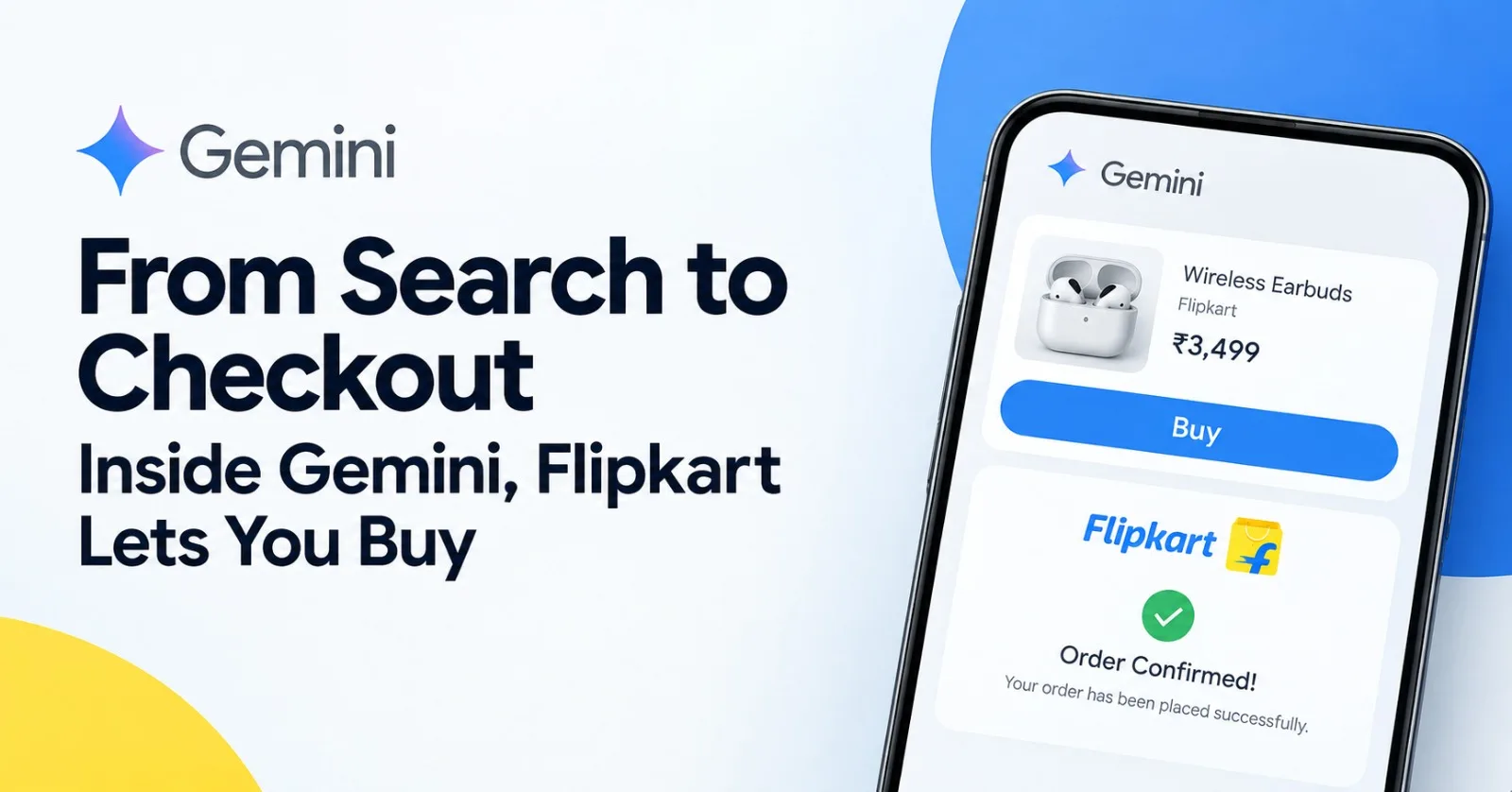
Somewhere in India this week, a small number of Gemini and AI Mode users are seeing something new sitting under a handful of Flipkart product listings: a plain "Buy" button. Tap it, and instead of getting bounced to a browser tab or the Flipkart app, a Flipkart-branded checkout screen opens right there inside Google's AI interface. No new tab. No app switch. Just a smartphone, a pair of earbuds, or a phone case moving from "here's what I found" to "here's your order confirmation" without ever leaving the conversation.
It's a quiet test. It's also a bigger deal than it looks.
At a glance
What's new: Select Flipkart listings in Gemini and AI Mode now show a "Buy" button that opens a Flipkart checkout flow in-app.
Scope: A small group of users, a narrow set of products: smartphones, electronics, mobile accessories.
Timeline: Google is reportedly planning a wider rollout later in October, just ahead of India's festive shopping season.
The twist: The test appears different from the Google-hosted native checkout experience Google originally demonstrated for UCP. But Google also supports an embedded checkout path that lets approved merchants keep more of their own checkout experience.
What the test actually looks like
According to people familiar with the matter, as first reported by TechCrunch, the experience is narrow by design. Only some users see the Buy button at all, and it appears on a limited slice of Flipkart's catalog: phones, electronics, and accessories, categories where India's online shoppers are already comfortable buying without touching the product first. Everyone else browsing Gemini or AI Mode still sees the regular Flipkart listings (prices, specs, reviews), just no way to complete a purchase without leaving the app.
Google, characteristically, isn't saying much. A company spokesperson described it as one of the routine experiments Google runs to help people find and engage with businesses, and declined to go further. There was no confirmation of a launch date, no explanation of the technology underneath it, and no detail on which users were selected or why.
What is clear is the timing. Google is said to be aiming for a broader rollout later in October, positioning the feature to go live just as India heads into its biggest shopping window of the year.
The part that doesn't quite match the blueprint
Here's what makes this test more interesting than a routine feature rollout: the checkout experience appears different from the native UCP flow Google originally demonstrated.
Back in January 2026, at the National Retail Federation's annual conference, Google unveiled the Universal Commerce Protocol (UCP), an open standard meant to let AI agents like Gemini and AI Mode talk directly to a merchant's backend for everything from product discovery to checkout to post-purchase support.
Google built it in collaboration with major names across retail and payments, including Shopify, Etsy, Wayfair, Target, and Walmart. More than twenty additional companies, including Best Buy, Mastercard, Visa, Stripe, and Flipkart, signed on to endorse the standard.
The native checkout flow Google originally described places the checkout experience inside Google's surface, with shoppers using Google Pay, while payment methods and shipping information are saved in Google Wallet. The retailer remains the merchant of record.
But UCP isn't limited to that one model. Google's documentation also describes an embedded checkout option for approved merchants that need a more customized experience, including bespoke branding or more complex checkout flows.
That's where the Flipkart test gets interesting. When a shopper taps Buy, they land in a Flipkart-branded checkout flow rather than the Google-rendered native checkout experience. Google has not publicly explained whether this test is powered by UCP's embedded model or by something else.
That distinction matters because it means the current test doesn't prove that Flipkart is outside UCP. It shows that Google is willing, at least in this experiment, to surface a merchant-controlled checkout inside its AI shopping experience.
Flipkart has particular reason to want that. It has spent years building its own payments stack, launching Flipkart UPI in 2024 to keep transactions in-house rather than routing through PhonePe or other wallets, and following that with super.money, which became one of India's top-five UPI apps in 2025.
That's notable given PhonePe, Flipkart's original payments arm, was fully spun off into a separate Walmart-owned company in 2022. A retailer with that kind of infrastructure already in place has less incentive to replace its own payment experience with somebody else's, which could help explain why this test appears to keep Flipkart's branding and checkout in the loop.
Why Flipkart, and Why the Ties Run Deep
This isn't Google and Flipkart's first collaboration. In May 2024, Google agreed to put roughly $350 million into Flipkart as part of a nearly $1 billion funding round led by Walmart, Flipkart's majority owner, valuing the company at roughly $36-37 billion.
The investment came bundled with a cloud computing partnership, giving Google a commercial foothold inside one of India's largest retailers well before "agentic shopping" was a phrase anyone used. At the time, Bernstein estimated Flipkart controlled roughly 48% of India's e-commerce market, making it, by that measure, the country's largest online retailer, ahead of Amazon.
More recently, Google named Flipkart among the merchant partners it's working with to bring what it calls "agentic" shopping experiences to Indian consumers, though the announcement came without details on what the collaboration would actually look like in practice. This test appears to be the first concrete example of that relationship showing up inside Google's consumer AI products.
It's also worth noting who's conspicuously absent. In the version of the test reviewed by reporters, Amazon listings appeared right alongside Flipkart's in Gemini and AI Mode search results, but without any Buy button of their own. Whether that's a temporary gap or something Google eventually expands to other retailers remains unclear.
The bigger race: AI assistants as checkout counters
Google isn't the only company racing to turn its AI product into a place where money actually changes hands. In September 2025, OpenAI launched Instant Checkout inside ChatGPT, letting U.S. users buy directly from Etsy sellers and, shortly after, from merchants on Shopify: more than a million stores, including brands like Glossier and Skims.
OpenAI built the feature on its own open standard, the Agentic Commerce Protocol, developed jointly with Stripe, and pitched it as ChatGPT acting as a shopper's agent, passing information between buyer and merchant without taking control of fulfillment. Etsy remained responsible for the order, payment processing and fulfillment.
The parallels to Google's approach are obvious, and so are the differences. Both companies have built open protocols rather than closed, proprietary systems, in an apparent bid to get retailers on board faster. Both have also said product rankings inside their AI shopping experiences should remain separate from paid placement.
But the Flipkart test suggests the real world may require more than one checkout model. Not every retailer will want to hand its full checkout experience over to the AI platform sitting on top of it.
Why India, and why now
None of this is happening in a market Google can afford to ignore. India has one of the world's largest internet populations, and its e-commerce market is led by Flipkart and Amazon alongside increasingly important players such as Meesho and quick-commerce companies. That rivalry becomes especially intense during the festive season stretching from late September through Diwali, when Flipkart's Big Billion Days and Amazon's Great Indian Festival compete for shoppers.
The scale involved is enormous. During the 2025 festive season, Flipkart reported unit sales growth of 24% year-over-year, with more than 60% of orders coming from smaller tier-2 and tier-3 towns, and said its logistics network moved more than 7.3 million shipments in a single peak day. Big Billion Days reportedly drew over 606 million visits in its first 48 hours alone; Amazon's Great Indian Festival pulled in more than 380 million in the same window.
Layering an AI-native checkout on top of that volume, even a limited one, is Google placing a bet on where the next generation of festive-season shoppers will start their search: inside a chat box, not a search results page or an app icon.
What's still unknown
A lot remains genuinely unclear. Google hasn't said what technology underpins the Flipkart checkout, whether the test is using UCP's embedded checkout capability, whether it will eventually expand to Google's native checkout model, or whether Amazon and other Indian retailers will get a similar Buy button once the wider rollout arrives.
Google also hasn't explained how merchants are being selected for this test. Its financial relationship with Flipkart naturally makes that an obvious question, but the current experiment is too limited to establish whether that relationship has anything to do with Flipkart receiving the Buy button.
For now, what exists is a bounded experiment: a handful of users, a narrow set of products, and a company that's confirmed almost nothing beyond the fact that it's testing something. But the direction is unmistakable. The distance between asking an AI assistant a question and handing it your card details is shrinking fast, and India's festive season, the biggest live test any e-commerce feature can get, is about to show how far Google is willing to push that idea before Diwali.
Further reading
Google tests buying from Walmart-owned Flipkart through Gemini and AI Mode in India (TechCrunch)
New tech and tools for retailers to succeed in an agentic shopping era (Google's official UCP announcement)
Google invests $350 million in India's Flipkart (TechCrunch)
OpenAI's ChatGPT now lets users buy from Etsy, Shopify in push for chatbot shopping (AP via Barchart)
Festive Sales Strategies for E-commerce Brands in 2026 (Unicommerce, on Flipkart's 2025 Big Billion Days data)
About the Universal Commerce Protocol (UCP) (Google Merchant Center Help)
Flipkart launches its own UPI service to rival Amazon, Paytm and PhonePe (Business Today)
Flipkart launches payments app super.money (beta version) (MediaNama)
Comments (0)
Join the discussion by logging into your account.
No comments yet. Be the first to comment!