
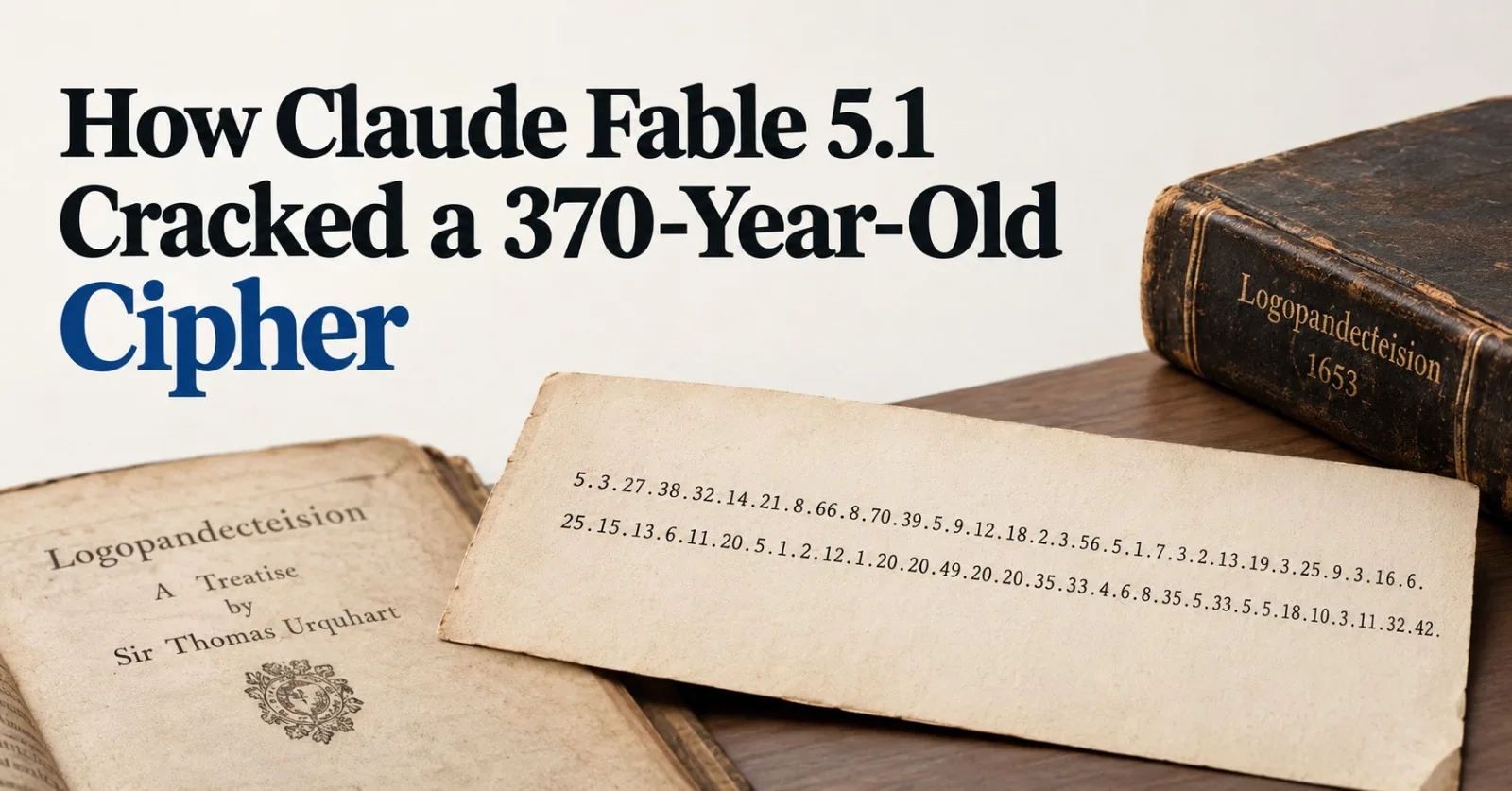
For 373 years, a string of numbers sat at the back of a nearly unreadable 17th-century book, waiting for someone to make sense of it. People tried. It showed up as an open problem in an 1899 issue of Notes and Queries, got picked up again by 20th-century cryptographers, and eventually made a modern researcher's list of the fifty most notorious unsolved ciphers in history.
Then, this past August, Anthropic's Claude Fable 5.1 was handed an open-ended task: find an unsolved cipher and solve it. Forty-four minutes later, it had one.
The puzzle
The cipher is called the Cyphral Distich, and it comes from Logopandecteision, a strange treatise by the Scottish writer Sir Thomas Urquhart (best known otherwise for translating Rabelais and for inventing an entire imaginary universal language, at great length).
At the very end of the book, Urquhart printed two lines of 32 numbers each, with no key and no worked example, just a promise that a careful reader would recognize their own wishes in the answer:
5.3.27.38.32.14.21.8.66.8.70.39.5.9.12.18.2.3.56.5.1.7.3.2.13.19.3.25.9.3.16.6.
25.15.13.6.11.20.5.1.2.12.1.20.20.49.20.20.35.33.4.6.8.35.5.33.5.5.18.10.3.11.32.42.
That's it. That's the whole cipher.
Frequency analysis didn't touch it. Neither did substitution or homophonic substitution, the usual first moves for a puzzle like this. So it just sat there, cited but never cracked, for nearly four centuries.
The setup
The experiment came from Gaby Jaffe at Vals AI, a firm that evaluates frontier models. Jaffe had spent months trying to get various models to solve a real, independently checkable historical cipher, without much luck. The point wasn't just curiosity: a model that can find an actual unsolved problem and work it through to the end, with no answer key anywhere to check itself against, is doing something a standard benchmark can't really test.
The instructions given to Fable 5.1 were loose on purpose: find something unsolved with one verifiable answer, skip the famous ones like Kryptos K4 that have already eaten up decades of expert attention, and go.
Fable 5.1 worked the problem for about 44 minutes and 176,000 tokens, with no hints along the way, before landing on an answer.
What it noticed
Two things, according to Vals AI's writeup. The cipher is printed right after a section of the book containing exactly 32 short passages Urquhart calls his "Proquiritations," and elsewhere in the text Urquhart practically flags the number himself, making a point of how significant thirty-two is.
The verse introducing the cipher also promises the reader will find their own wishes in it. Those 32 Proquiritations, it turns out, keep ending in phrases like "is the desire" or "wish."
Thirty-two passages. Thirty-two numbers per line. A poem about wishes. Once you notice the overlap, the shape of an answer starts to suggest itself.
Everyone before this had assumed the key lived outside the text somewhere: a cipher alphabet, a lookup table, something to be reconstructed independently. It didn't. The book itself was the key.
Take the i-th number, go to the i-th Proquiritation, count to that word, and grab its first letter.
Do that across both lines and you get a rhyming couplet praying for the restoration of King Charles II, which lines up neatly with what's known about Urquhart: he was a die-hard Royalist writing not long after the English Civil War.
O GOD UPHOLD KING CHARLS THE SECOND AND MAKE HIM THE SUPREME RULER OF THIS LAND
It even checks its own work. Each line comes out to exactly 32 letters, and the two lines rhyme, which is what a "distich" (a two-line verse) is supposed to do.
The second cipher
Urquhart had left a bigger, equally unsolved cousin of this cipher in an earlier book, The Jewel (1652): the Cyphral Octastich, 285 numbers long. Fable 5.1 used the same trick, swapping paragraphs for pages, and recovered an eight-line royalist prayer almost in full.
Nine letters in one line are still uncertain, because the only surviving digital copy is missing the page needed to check them. Someone would need an actual 1652 copy, or a 1983 scholarly edition, to close that gap.
A caveat
This is a claim from Vals AI, the firm that ran the test, not a peer-reviewed result, and no historical-cipher specialist had independently confirmed it as of this writing. The decoding fits the history and rhymes on command, which is a good sign, but a good sign and a confirmed answer aren't quite the same thing yet.
Why it's worth paying attention to
There's nothing especially clever about the cryptanalysis itself. By the model's own account, the trick is almost embarrassing once you see it.
What actually happened is that Fable 5.1 read closely, tried things that didn't work, and kept going instead of stopping at the first dead end, for 44 minutes straight, with nobody checking in.
Which might be the real story here. A lot of old puzzles like this one weren't unsolved because they were hard. They were unsolved because nobody had put in the hours. If that bottleneck is loosening, there's probably no shortage of other forgotten problems worth pointing a model at next.
Source: Gaby Jaffe, "Claude Fable 5.1 Solves the Cyphral Distich," Vals AI, August 31, 2026.
Comments (0)
Login to post a comment.