
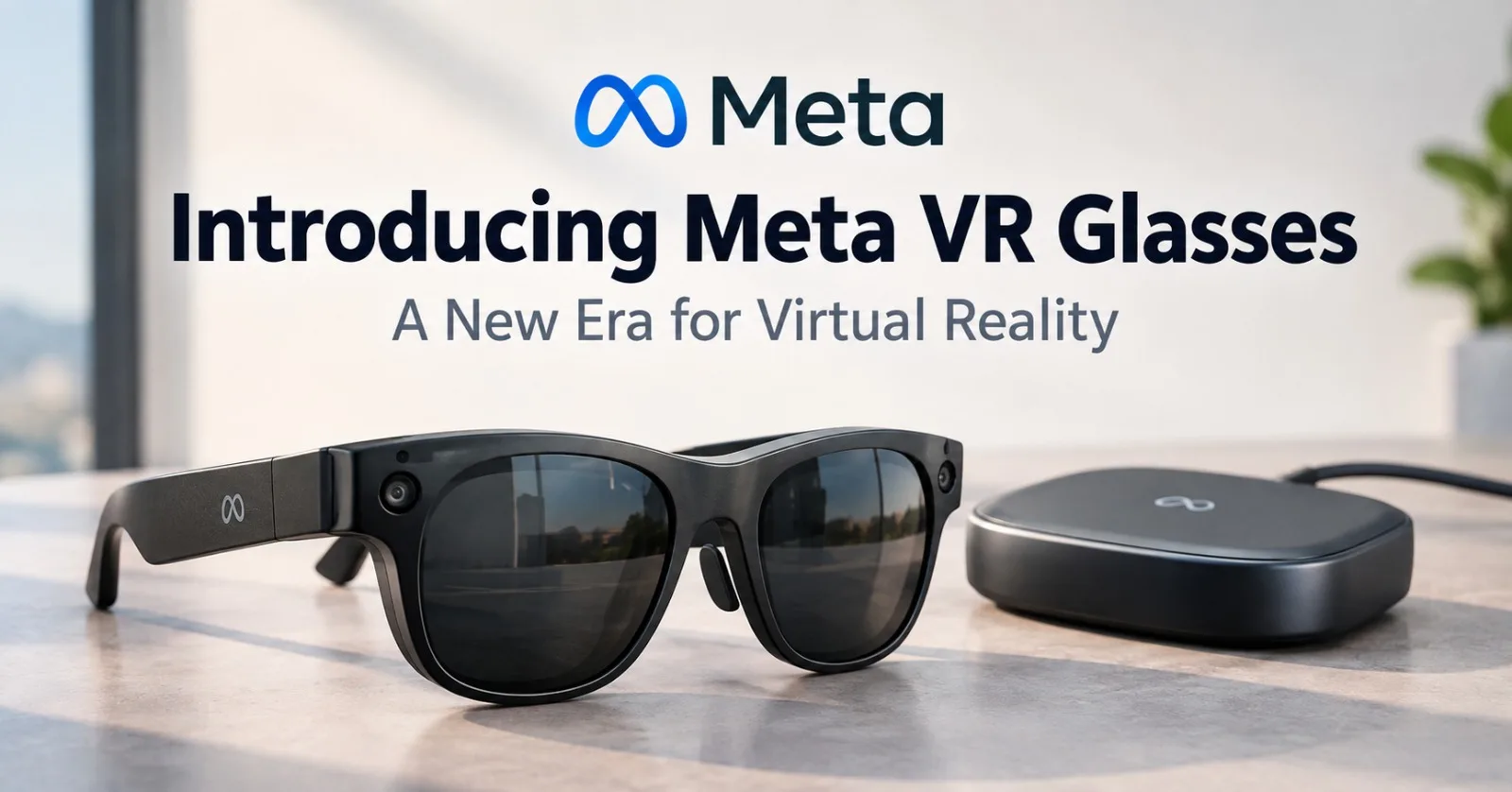
Meta is taking a different approach to virtual reality with Meta VR Glasses, a lightweight VR device that moves much of the computing hardware, battery, and storage into a separate compute puck while keeping the displays and sensors in a glasses-like form factor.
Announced at Meta Connect 2026, Meta VR Glasses are scheduled to go on sale in spring 2027 for $1,299.99 in the US. The glasses themselves weigh about 100 grams, roughly the weight of a deck of cards.
Meta: Introducing Meta VR Glasses
What Are Meta VR Glasses?
Meta VR Glasses are built around a two-part design.
The glasses contain the display, cameras, sensors, and audio hardware. A separate compute puck, connected through an optical tether, handles computing, battery power, and storage. The puck can be clipped to a pocket or bag rather than sitting on the user's face.
Meta says this architecture makes the glasses about five times lighter than Meta Quest 3.
The result is a different VR experience: most of the weight is moved away from your head, while the system remains capable of running VR applications, games, media, and productivity experiences.
Meta also describes VR Glasses as an addition to its VR lineup rather than a replacement for Quest devices. The glasses use the same Horizon OS ecosystem, Store delivery system, and SDKs as Meta Quest, although the input model and hardware form factor are different.
5K Micro-OLED Display
The central hardware feature is Meta's 5K Infinite Display, built using micro-OLED panels and delivering 37 pixels per degree (PPD).
The combination is designed to improve image clarity and text legibility compared with conventional VR displays. Meta also uses compact pancake lenses to fit the display system into the glasses form factor.
The glasses support Dolby Vision for compatible video content, while Dolby Atmos spatial audio is integrated into the frames.
The Field-of-View Trade-Off
Higher pixel density does not mean a larger viewing area.
Meta's developer documentation lists the nominal field of view of Meta VR Glasses at approximately 70° horizontally × 66° vertically. For comparison, Meta lists Quest 3 at roughly 110° × 96°.
That is an important trade-off.
Meta VR Glasses prioritize a compact form factor and higher resolution per eye, while Quest 3 provides a considerably wider field of view.
The exact visible area can also vary depending on how the glasses fit the user's face and where the user's eyes are looking. Meta recommends that developers keep important interface elements away from the extreme edges of the display.
Meta AI, Eyes, and Hands
Meta has integrated its Meta AI agent directly into the operating system.
Users can interact with the glasses using voice, eye tracking, and natural hand gestures to perform actions such as opening applications, playing media, adjusting a workspace, or searching for information.
Eyes and hands are the primary input methods.
Meta VR Glasses are controller-free by default and ship without controllers. However, the platform supports compatible controllers sold separately, and some applications can still require controller input.
For developers, that means existing Quest applications may need their interaction models adapted for gaze and hand input rather than assuming controllers are always available.
A Private Cinema Anywhere
Meta is positioning VR Glasses heavily around entertainment.
The device is the first VR device certified for IMAX Enhanced, with support for 3D movies and an expanded cinematic format for compatible content.
Meta says Disney+ subscribers in select countries will be able to stream selected movies in 3D beginning in November, while the separate Disney Immersive Cinema by ILM experience is planned for Meta VR Glasses. Meta says that experience will include VR Enhanced versions of films such as Avengers: Infinity War and Star Wars: A New Hope.
This timing is worth noting: the general Disney+ 3D announcement begins in November, while Meta VR Glasses themselves do not launch until spring 2027.
Meta is also working with:
Prime Video
YouTube
DIRECTV
AMC+
Crunchyroll
Plex
ESPN
Tubi
Peacock
HBO Max
Paramount+
Meta says thousands of titles are expected to be available internationally by the time VR Glasses launch.
Immersive Sports
Sports is another major use case.
Meta says its Immersive Sports experience will provide front-row perspectives, including 8K streaming and 180-degree views for supported content.
The company says that once Meta VR Glasses launch, users will have access to more than 100 immersive live US sports events each year, with partners including MLB, NBC Sports, TNT Sports, and UFC.
The broader immersive-sports program is not limited to VR Glasses. Meta says college football is already part of the Immersive Sports rollout on Meta Quest, with additional sports planned for 2027.
Your Office, Wherever You Are
Meta also wants VR Glasses to function as a portable workstation.
Users can create a large virtual display, or multiple displays, while continuing to see their physical environment through full-color passthrough.
One of the more interesting features is the ability to turn a flat surface into a virtual keyboard and touchpad. That means users can type or interact with a virtual workspace without carrying a separate physical keyboard or trackpad for supported workflows.
The glasses can also work with connected devices, allowing users to bring existing screens and workflows into a virtual multi-screen environment.
For developers, this is important because Meta VR Glasses are not simply a smaller Quest headset. The operating system and SDK foundation is shared with Quest, but the interaction model, field of view, and physical form factor require apps to be adapted.
Gaming Without Controllers
Meta says more than 75 games will support hand-gesture-only gameplay at launch.
Xbox Cloud Gaming will also allow users to stream hundreds of additional games.
The glasses are designed around eyes and hands as the primary input, but controllers remain supported for applications that benefit from them.
Meta's developer documentation specifically notes that some experiences, such as virtual locomotion or controller-oriented gameplay, may work better with Touch Plus controllers. Those controllers are sold separately.
This means the platform is best thought of as controller-optional rather than controller-incompatible.
Hologram Calling
Meta is also introducing Hologram Calling.
The system creates a photorealistic digital version of the person wearing the glasses, including their real-time expressions and reactions, for hands-free video calling.
For the person wearing Meta VR Glasses, the other participant can appear as a hologram in the user's environment with spatial audio that positions their voice within the scene.
People joining from a phone or computer can see the glasses user's hologram on their normal screen.
Meta says Hologram Calling works with calling applications including WhatsApp and Zoom.
Battery and Compute Puck
Moving the processor and battery away from the face makes the glasses lighter, but it also means the system depends on the separate compute puck.
Meta says the puck provides up to three hours of continuous high-resolution media playback and supports 45W fast charging.
The three-hour figure is specifically a media-playback claim, so it should not automatically be interpreted as three hours of battery life for every possible workload.
That distinction will matter once developers and consumers can test the device with demanding VR applications.
Meta VR Glasses vs. Quest 3
Meta VR Glasses and Quest 3 share the same broader software ecosystem, but they are designed around different hardware priorities.
Feature | Meta VR Glasses | Meta Quest 3 |
|---|---|---|
Form factor | Lightweight glasses | Traditional VR headset |
Glasses weight | About 100g | Significantly heavier |
Display | 5K Infinite Display, micro-OLED | LCD-based VR display |
Pixel density | 37 PPD | Lower than VR Glasses |
Field of view | About 70° × 66° | About 110° × 96° |
Primary input | Eyes + hands | Controllers + hands |
Controllers included | No | Yes |
Compute | Separate puck | Integrated into headset |
Launch price | $1,299.99 | Existing Quest 3 pricing varies |
The most important difference is therefore not simply resolution.
VR Glasses move computing and battery off the user's head, while Quest 3 keeps the main hardware integrated into the headset.
The VR Glasses approach also accepts a narrower field of view in exchange for the lighter glasses design and higher pixel density.
What to Know Before Buying
There are several unresolved practical questions that won't be answered until the hardware reaches consumers.
Weight
The glasses themselves are only about 100 grams, but the complete system includes the compute puck and tether.
Battery
Meta quotes up to three hours of continuous high-resolution media playback from the puck. Real-world battery life may vary considerably depending on the workload.
Field of View
The approximately 70° × 66° nominal field of view is substantially narrower than Quest 3's roughly 110° × 96°.
Controllers
The glasses ship without controllers. Hand and eye tracking are the default interaction model, but compatible Touch Plus controllers are available separately for applications that need them.
Price
At $1,299.99, Meta VR Glasses will sit firmly in the premium VR hardware category.
Availability
The product is not scheduled to launch until spring 2027, so comfort, battery performance, software compatibility, and the real-world quality of the launch content library cannot yet be evaluated by ordinary buyers.
Meta VR Glasses FAQ
How much do Meta VR Glasses cost?
Meta VR Glasses are announced at $1,299.99 USD in the US.
When will Meta VR Glasses launch?
Meta says the glasses will go on sale in spring 2027.
How much do Meta VR Glasses weigh?
The glasses weigh about 100 grams. The compute puck contains the processor, battery, and storage.
Are Meta VR Glasses the Quest 4?
No. Meta describes VR Glasses as an addition to the Meta Quest family rather than a replacement for Quest devices. They use the same operating system and developer ecosystem, but have a different hardware form factor and interaction model.
Do Meta VR Glasses require controllers?
No. They are designed around eye tracking and hand gestures and ship without controllers. Compatible controllers are supported and sold separately for applications that require them.
How long does the Meta VR Glasses battery last?
Meta says the compute puck supports up to three hours of continuous high-resolution media playback and 45W fast charging.
Can Meta VR Glasses be used for work?
Yes. Meta is positioning them as a multi-screen private workspace, including the ability to turn a flat surface into a virtual keyboard and touchpad.
Can Meta VR Glasses play 3D movies?
Yes. Meta says VR Glasses support 3D movies, Dolby Vision, Dolby Atmos, and IMAX Enhanced content.
What is the field of view of Meta VR Glasses?
Meta's developer documentation lists the nominal straight-ahead field of view at approximately 70° horizontal × 66° vertical. Device fit and gaze direction can reduce the visible area further.
Does Meta VR Glasses support existing Quest apps?
Meta VR Glasses use the same operating system, Store delivery system, and SDKs as Quest. However, developers may need to adapt applications for the glasses' eye-and-hand input model and narrower field of view.
The Bottom Line
Meta VR Glasses are an attempt to change what a VR device looks like.
Instead of putting the processor, battery, and most of the electronics on the user's head, Meta is moving those components into a separate compute puck and keeping the glasses themselves around 100 grams.
That architecture enables a much lighter form factor while delivering a 5K micro-OLED display, 37 PPD, eye and hand tracking, Meta AI, spatial audio, immersive entertainment, multi-screen productivity, and controller-free gaming.
But the design comes with trade-offs.
The separate compute puck and tether add another piece of hardware to carry. The quoted media-playback battery life is up to three hours, and the field of view is considerably narrower than Quest 3. The glasses also launch without controllers, meaning developers have to design around eyes and hands for the default experience.
The bigger question is whether people will find that combination of lighter hardware, higher pixel density, immersive content, and wearable computing compelling enough at $1,299.99.
That answer will become clearer when Meta VR Glasses arrive in spring 2027.
Sources
Meta — Introducing Meta VR Glasses: A Cinema, Courtside Seat, and Workspace in Just 100 Grams
Meta Horizon OS Developers — VR Is Expanding. Start Building for Meta VR Glasses Today
Meta Horizon OS Developers — Get Started with Meta VR Glasses
Meta Horizon OS Developers — Field of View and Display Values
Meta Horizon OS Developers — Platform Services on Meta VR Glasses
Meta Horizon OS Developers — Bring Your App to Meta VR Glasses
Comments (0)
Join the discussion by logging into your account.
No comments yet. Be the first to comment!