
Meta is introducing the Muse Wonder series with Muse Wonder and Muse Wonder Full, our most capable models to date, built on the groundwork we laid with Muse Spark. Together, they mark the next step on our scaling ladder and a major leap toward personal superintelligence.
Where Muse Spark aimed to be a lightweight model that could perform at low latency, the Wonder models are larger and said to be more capable, with higher benchmark scores and better results on complex tasks.
What Makes Wonder Different
Muse Wonder and Muse Wonder Full bring capability to expert domains including law, finance, and health, along with frontier coding performance for people building everything from a game to an app for a new business.
Whether the job is navigating an insurance claim, understanding a lease, or making sense of someone's finances, a model has to interpret the information in front of it and work through the problem.
This is not a single-turn chatbot. It's built for work that unfolds over time.
Training: Prometheus + Test-Time Compute
The models were trained at Meta's gigawatt-scale Prometheus data center, utilizing increased test-time compute to improve out-of-distribution reasoning and handle unfamiliar tasks.
That scaling choice matters for agents: instead of just training bigger, Meta scaled how much the model can think at inference time, which helps on unfamiliar tasks outside the training distribution.
Two Core Innovations
1. Active Memory
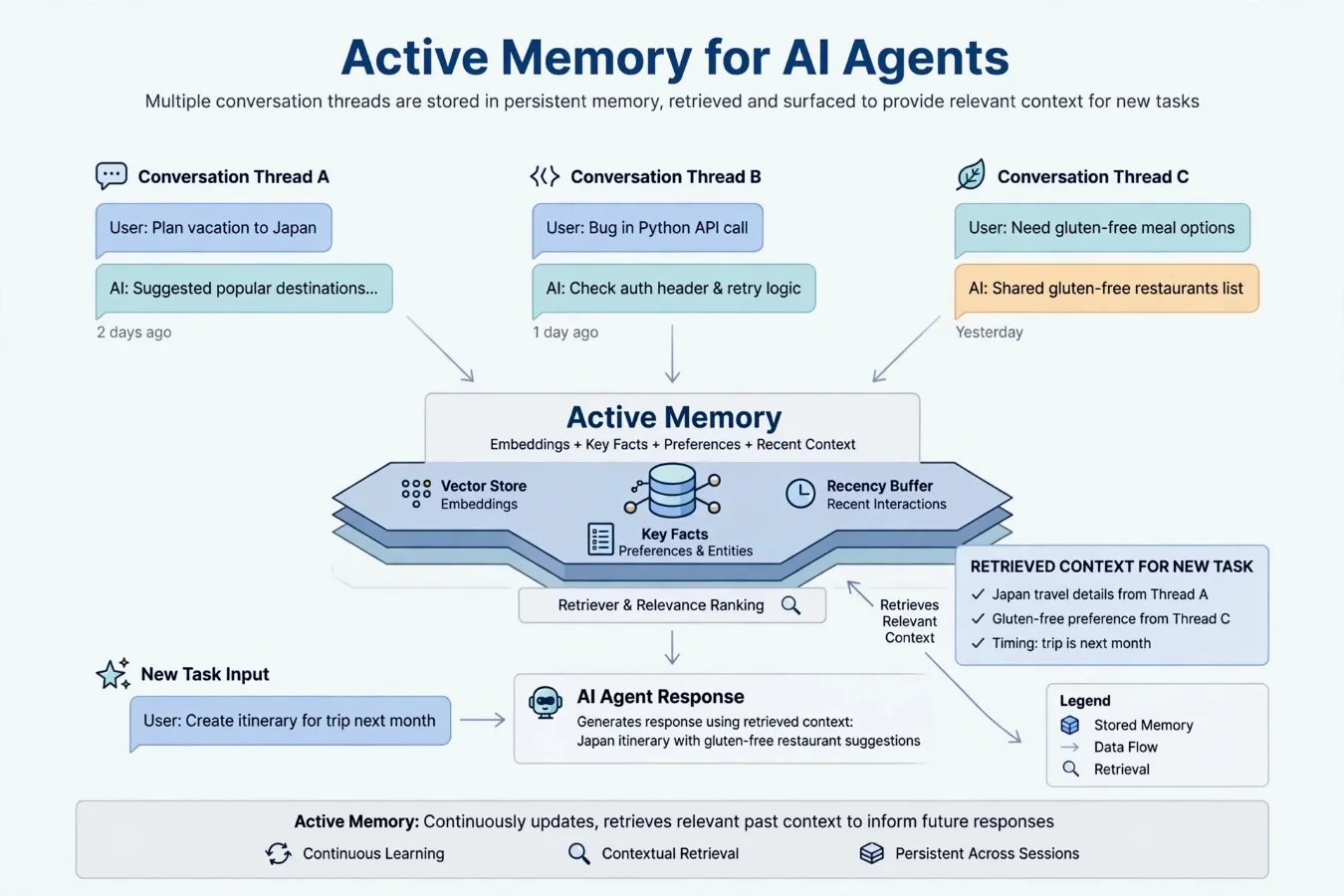
The ability to carry what matters to you across conversations and bring back the details that are relevant to the task at hand.
In practice:
Multiple threads (vacation planning, Python API bug, dietary preferences) are stored in persistent memory
Memory = Embeddings + Key Facts + Preferences + Recent Context
Components: Vector Store, Key Facts, Recency Buffer
Retriever & Relevance Ranking surfaces only relevant context for the new task
Pattern for developers:
def handle_new_task(new_input, memory_store):
    relevant = memory_store.retrieve(
        query=new_input,
        rank_by="relevance"
    )
    enriched = merge(new_input, relevant)
    return agent.generate(enriched)
Result: User says "Create itinerary for trip next month" → agent generates Japan itinerary with gluten-free restaurants, without being told again.
2. Active Focus
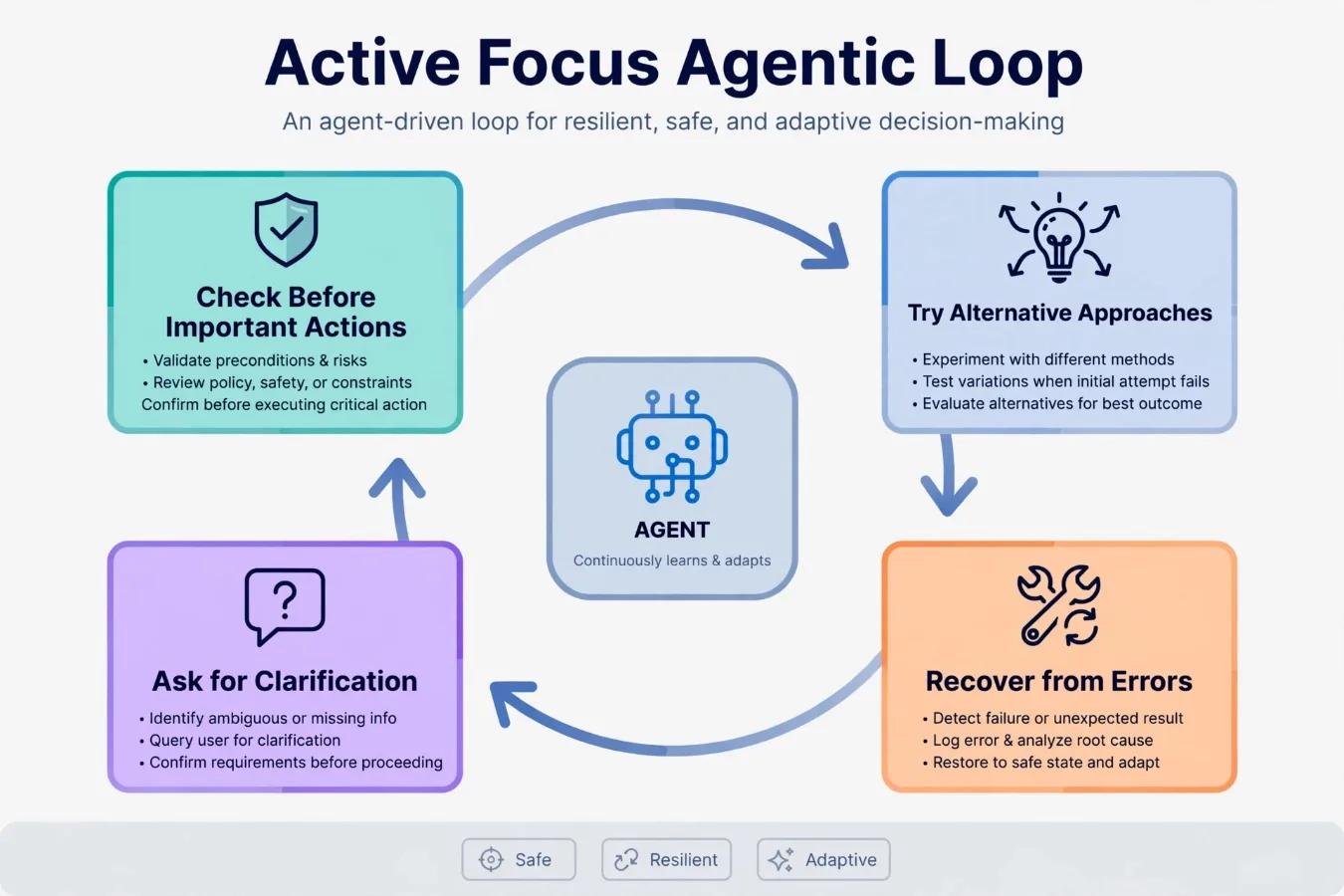
The ability to keep working toward your goal when a task gets hard, try other approaches, recover from errors, and follow through, asking for clarification when needed and checking in before following through on anything important.
The loop:
Try Alternative Approaches - experiment with different methods when initial attempt fails
Recover from Errors - detect failure, log root cause, restore to safe state
Ask for Clarification - identify ambiguous info, query user
Check Before Important Actions - validate preconditions, review safety, confirm
Center: Agent that continuously learns & adapts. Properties: Safe, Resilient, Adaptive.
Pattern for developers:
while not goal.achieved():
    try:
        action = agent.plan_next(goal, context)
        if action.is_critical():
            agent.validate_and_confirm(action)
        execute(action)
    except RecoverableError as e:
        agent.log_and_analyze(e)
        agent.try_alternative_approach()
    except AmbiguousState:
        agent.ask_for_clarification()
How Meta Evaluates It
Meta says it uses FocusBench to assess focus and SWE-Marathon to test continued execution on software projects over extended periods.
The release introduces Active Memory for retaining context across conversational sessions and Active Focus for sustained execution on long-running software projects like the SWE-Marathon benchmark.
Meta also compares Muse Wonder Full with Muse Spark 1.3 on familiar vs unfamiliar tasks, saying Wonder Full exceeds the unfamiliar-task performance predicted by the older model's trend — a sign of improved out-of-distribution generalization.
From Spark to Wonder: The Ladder
Muse Spark 1.3 (Sept): Lightweight, low-latency, strong on reasoning and agentic tasks, with max reasoning mode
Muse Wonder / Wonder Full: Larger frontier models, built for personal and professional autonomous agentic workflows, with Active Memory and Active Focus
Muse Spark proved an AI could do work for you. Wonder is built to prove it can stay with that work.
Safety by Design
A personal agent working across messages, calendars, and documents must be trustworthy. Meta says Wonder was trained to:
Avoid sharing private information without permission
Turn down requests to assist in performing actually harmful acts
Improve security and strengthen defenses against cyber attacks
Trained and evaluated in line with the Meta Superintelligence Scaling Framework. Full safety evaluations report coming soon.
How to Access
Muse Wonder is not part of the free Muse tier and is not the model behind Meta AI.
Meta Model API - direct API access for developers
Muse Code - professional coding tool. Muse Wonder Full is available only through Muse Code
Muse app - personal agent product, rolling out Wonder first to subscribers
Muse Wonder is available today via the Meta Model API and Muse Code, while the heavier Muse Wonder Full is restricted strictly to Muse Code subscribers.
Meta says it eventually plans to power its Muse AI agent with Wonder, starting with subscribers, and will develop specialized models it can bring to everyone using Muse.
For full technical deep dive, see the official research blog at research.meta.ai/blog/muse-wonder
Comments(0)
Join the discussion by logging into your account.
No comments yet. Be the first to comment!