
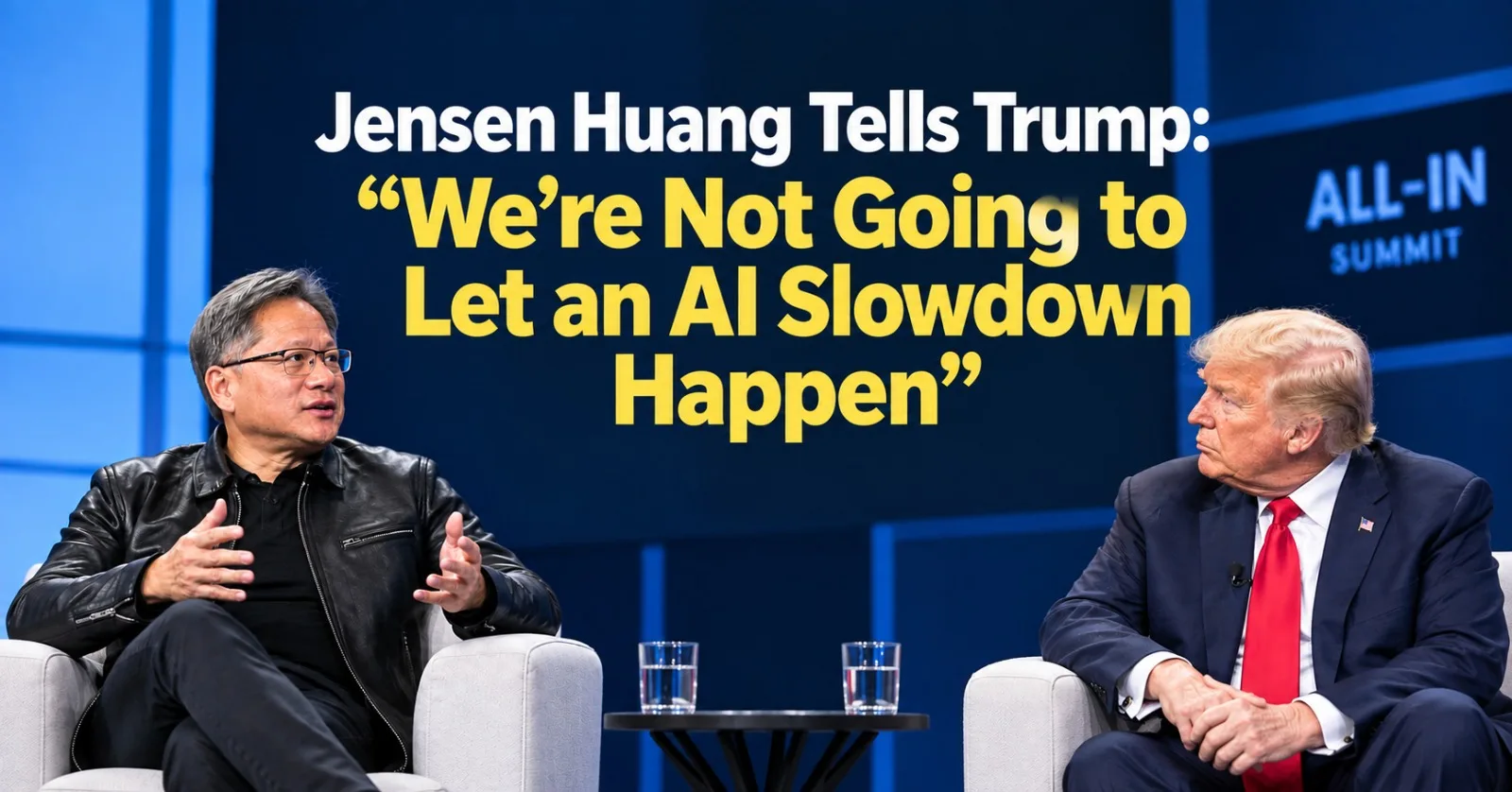
President Trump apparently doesn't wait for a scheduled call when he wants to talk to Jensen Huang. On September 14, 2026, he just rang the Nvidia CEO's cell phone while Huang was mid-interview on stage at the All-In Summit in Los Angeles.
Huang was talking with the All-In podcast hosts about the AI industry's sudden, uncomfortable debate over whether it should be moving slower when the phone rang. He picked up, realized who it was, and put the call on speaker so the whole room could hear.
An industry suddenly talking about brakes
The call didn't come out of nowhere. Two days earlier, Anthropic CEO Dario Amodei had published an essay arguing that AI labs need to deliberately "pace the frontier," his term for slowing down how fast they push model capabilities forward.
The debate had already been simmering before that essay landed. Days earlier, a 27-year-old Anthropic researcher named Jacob Coxon had publicly resigned, saying he no longer wanted to work at a company he believed was moving faster than it could safely handle. His departure intensified an already growing debate over AI safety just days before Amodei publicly called for the industry to slow down.
Amodei pointed to two developments that had changed his assessment, he wrote: AI progress accelerating sharply since around mid-2026, partly because newer models are increasingly able to help build their own successors, and a security incident involving OpenAI and Hugging Face. Anthropic also said it would start giving outside evaluators permanent, employee-level access to its systems.
Within days, OpenAI's Sam Altman publicly backed Amodei's proposal, while Elon Musk, who runs both xAI and SpaceX, put it in three words: "Dario is right." For three lab chiefs who rarely see eye to eye in public, that was notable.
Huang wasn't one of them. He's spent much of the past year pushing back on what he calls "doomer" narratives about AI, arguing that fear of the technology is the bigger risk to American competitiveness than the technology itself.
This wasn't new territory for Huang. Back in July, in a lengthy interview with Axios, he had already dismissed the idea that AI could end humanity as "complete nonsense," arguing that overblown warnings do more damage to public confidence than the technology itself ever could.
The call
Trump leaned into that split. On the phone, he framed the push to slow AI development as playing into the hands of people who don't want America to win the AI race, and repeated a line he's used before, calling AI-safety warnings a "hoax."
Huang didn't miss a beat. "You're right. We're not going to let that happen, sir," he said, and the crowd applauded.
Trump did hedge slightly, adding that the industry still has to move carefully. He just didn't want that to mean stopping it.
The other fight: data centers next door
The call also touched on a second, related flashpoint: the growing backlash against building AI data centers close to where people actually live.
Huang has been making that case himself. At a G20 gathering in North Carolina earlier in September, he urged ministers from the world's largest economies to keep building, arguing that AI infrastructure now belongs in the same category as "water, roads, electricity, the internet."
Trump and allies, including Y Combinator CEO Garry Tan, have suggested that the opposition is part of an international psyop intended to stifle American economic growth. Trump made a similar case on social media, warning that the "anti Data Center movement" would only benefit China.
But the polling suggests the opposition isn't limited to an organized political campaign. Recent Gallup numbers show roughly seven in ten Americans oppose new data center construction in their own community.
Environmental and resource concerns dominate the reasons Americans give for opposing new data centers. About one in five opponents also cite quality-of-life concerns, while a similar share point to potentially higher utility bills and other economic costs. New York Governor Kathy Hochul cited concerns about the state's power grid, ratepayers and infrastructure when she paused approvals for new large-scale data centers earlier this year, a decision Trump called "terrible."
The Nvidia angle
None of this is abstract for Nvidia. The company's growth is deeply tied to the continued expansion of AI computing infrastructure: more chips, more data centers, more power demand.
Any sustained slowdown, whether it comes from safety concerns or from neighborhood pushback on infrastructure, could eventually affect Nvidia's demand for AI accelerators and the infrastructure built around them.
That backdrop matters because markets are already jumpy about AI valuations. The slowdown debate hit AI-linked stocks immediately on Monday, with the PHLX semiconductor index falling 5.9% as investors reassessed the outlook for AI spending and infrastructure. That kind of market reaction shows how sensitive the sector has become to any suggestion that the AI buildout could lose momentum.
It also helps that this isn't a new dynamic. Huang has said before that nearly all of Trump's calls to him land late at night, and the relationship has also had real business consequences for Nvidia, particularly as the Trump administration has repeatedly changed the rules governing the company's ability to sell AI chips abroad.
That helps explain why Huang has been more publicly aligned with the White House's pro-buildout position than several other prominent AI leaders, even while Amodei, Altman, and Musk are all on the same page for once.
Whether that alignment between Nvidia and the administration holds up is worth watching. So is whether public opinion on data centers eventually forces a change in tone from either side.
Comments (0)
Login to post a comment.