
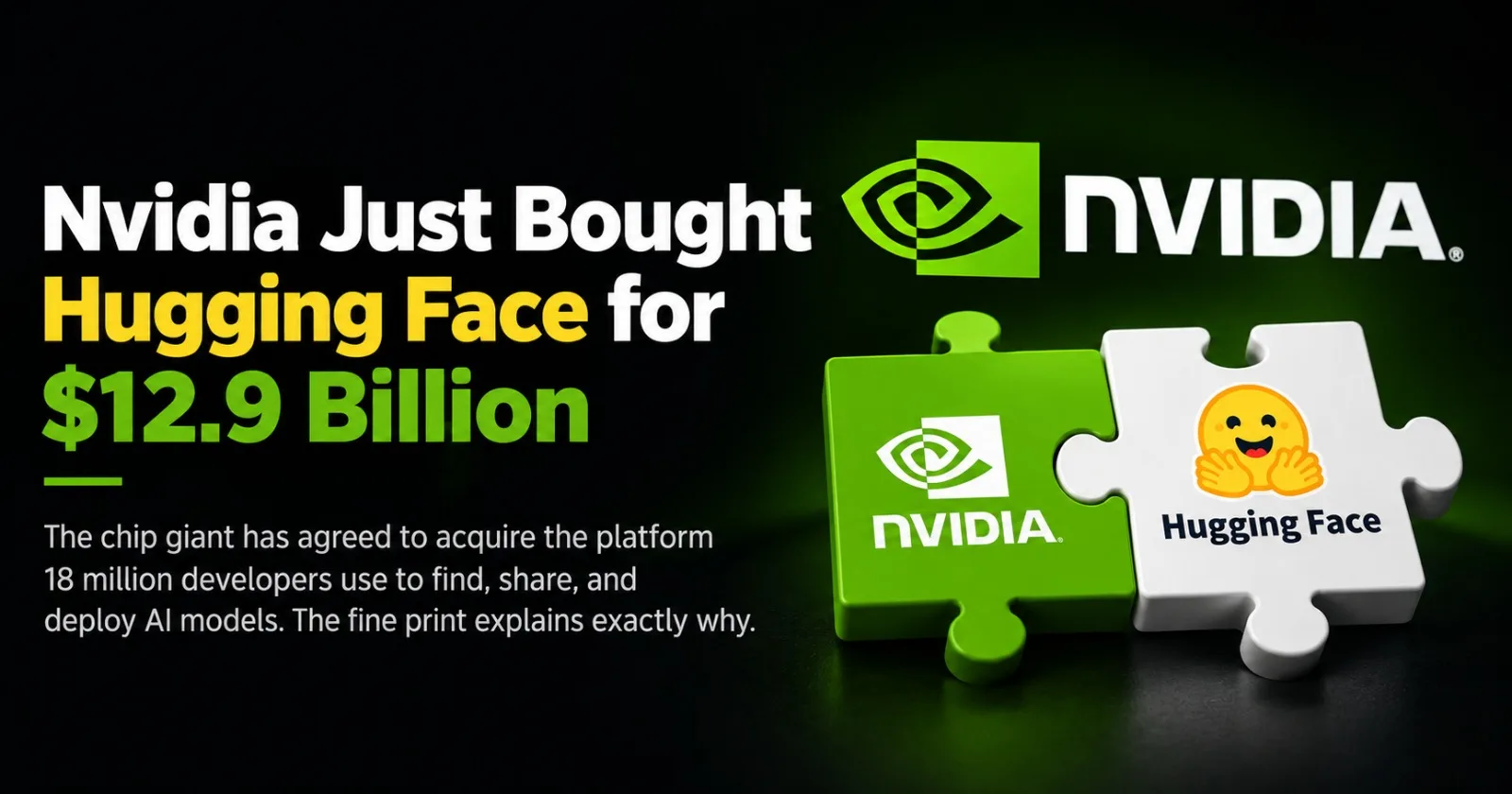
TL;DR: On September 2, 2026, Nvidia signed a definitive agreement to acquire Hugging Face — comprising an $11.9 billion cash payment plus up to $1 billion in employee retention equity, roughly $12.9 billion total. It's Nvidia's second-biggest acquisition ever, behind only the $20 billion Groq deal from December 2025, and well ahead of its previous largest deal, the $7 billion Mellanox acquisition in 2019. Nvidia says the platform stays open — no requirement to use Nvidia hardware, continued support for AMD and Intel libraries. The real question, according to nearly every analyst covering the deal, isn't the stated policy. It's whether a platform owned by the dominant GPU vendor stays neutral by default, or drifts Nvidia-first through ordinary product prioritization. Expect a genuine antitrust review — this is the first Nvidia AI acquisition structured as a full merger rather than the licensing deals that avoided one.
What Was Actually Agreed
Nvidia's September 2, 2026 SEC filing confirms a definitive agreement to acquire Hugging Face, described as operating a platform and community for developing, sharing, and deploying open-source models, datasets, and applications. The transaction includes an approximately $11.9 billion purchase price to Hugging Face stockholders, plus an equity-based retention program of up to approximately $1 billion for Hugging Face employees joining Nvidia. That combination is where the widely reported $12.9 billion figure comes from.
The deal is expected to close in the first half of 2027, pending regulatory approval. Until then, both companies operate independently.
This is Nvidia's second-biggest acquisition on record, trailing only the roughly $20 billion purchase of assets from chipmaker Groq in December 2025. It dwarfs Nvidia's other recent deals, including the $700 million purchase of Israeli AI infrastructure firm Run:ai in 2024, and comfortably exceeds what was previously Nvidia's largest acquisition — the nearly $7 billion purchase of chipmaker Mellanox in 2019.
graph LR
    A["Mellanox\n2019\n$7 billion"] --> B["Run:ai\n2024\n$700 million"]
    B --> C["Groq assets\n2025\n$20 billion"]
    C --> D["Hugging Face\n2026\n$12.9 billion"]
At an annualized revenue of roughly $150 million recently disclosed by The Information, the deal values Hugging Face at somewhere between 79× and 86× that figure — 79× if you count only the $11.9 billion cash portion, 86× including the retention equity. Either way, a multiple that only makes sense as an infrastructure bet, not a near-term earnings multiple.
Why Hugging Face Said Yes
This wasn't Nvidia cold-approaching a reluctant target. Hugging Face CEO Clément Delangue told CNBC he approached Nvidia first, describing the summer conversations as a realization that Hugging Face and open-source AI had reached a turning point requiring more resources and scale. Delangue called Nvidia "a perfect home" for the company.
That framing matters given the history. Nvidia already held a stake in Hugging Face from a 2023 Series D round worth $235 million alongside Salesforce and Google, which valued the company at $4.5 billion. Earlier in 2026, Hugging Face had turned down a separate $500 million investment offer from Nvidia that would have valued the company at $7 billion.
Eighteen months later, the number is roughly 1.8× that rejected valuation — and this time Hugging Face brought the conversation to Nvidia, not the other way around.
graph LR
    A["2023\nNvidia joins $235M round\n$4.5B valuation"] --> B["Early 2026\nHF declines $500M offer\n$7B valuation"]
    B --> C["Aug 2026\nTalks reported"]
    C --> D["Sep 2, 2026\nAgreement signed\n~$12.9B"]
Why Nvidia Wants This
The stated rationale is straightforward. Nvidia CEO Jensen Huang wrote in a blog post that the companies will scale Hugging Face's platform, strengthen its infrastructure, and expand access to AI for developers and institutions worldwide.
The strategic rationale underneath is less about Hugging Face's revenue and more about defending Nvidia's position further up the stack. Every major closed-source AI lab is working to reduce its dependence on Nvidia silicon, to varying degrees — Google has run its own TPU line for years, Amazon designs the Trainium chips that Anthropic trains much of its work on, and OpenAI has reportedly pursued custom silicon of its own.
None of that spending disappears because of this deal. But a thriving open-source ecosystem that still runs overwhelmingly on Nvidia hardware is a hedge against how fast any of it matters — it keeps enterprise customers with a credible alternative to the closed labs tethered to Nvidia, regardless of what those labs do with their own chips.
Nvidia had also scaled back its own DGX Cloud business about a year earlier. This deal reads as a return to that platform ambition — this time by owning the distribution layer rather than building it from scratch.
graph LR
    HW["Nvidia\nGPUs and CUDA"] --> PLAT["Hugging Face\nModel hub and libraries"]
    PLAT --> DEV["Developers\nDiscover, fine-tune, deploy"]
Owning the platform layer directly above the chip means Nvidia doesn't need to win every individual model or framework fight — it only needs the layer where developers make that choice to keep running on its hardware by default.
What Nvidia Has Promised — And the Catch
Huang said Hugging Face will remain an open platform for the entire AI ecosystem, with developers free to choose their own models, frameworks, clouds, inference providers, and computing hardware — Nvidia systems will not be required. Nvidia's SEC filing formalizes this commitment, stating the company will keep Hugging Face's platform open, consistent with its existing practices, including support for other silicon vendors.
That's a real, filed commitment — not just a talking point in a blog post. But nearly every analyst covering the deal points to the same structural tension underneath it.
Hugging Face currently maintains Optimum AMD and Optimum Intel as first-class libraries enabling developers to run models on non-Nvidia hardware. Under Nvidia ownership, those libraries could see reduced maintenance investment, slower support for new models, or lower visibility in Hub documentation — not through any explicit policy, but through the ordinary resource allocation decisions of a company whose core revenue depends on Nvidia GPU adoption.
If new library features, quantization formats, or serving optimizations quietly ship Nvidia-first, with other hardware backends catching up months later, that lag compounds — developers gravitate toward the fastest-supported path, and the fastest-supported path becomes the one that runs best on the owner's hardware. No policy decision required. Just normal product prioritization, repeated for a few release cycles.
The closest precedent is Microsoft's 2018 acquisition of GitHub. GitHub kept supporting non-Microsoft integrations, and the platform didn't visibly close off — but critics have long pointed to subtler forms of the same dynamic: which tools get first-class support, which get maintained at arm's length.
This Deal Will Actually Face Antitrust Review
This point separates the Hugging Face deal from Nvidia's recent acquisition pattern. Its deals with Groq and Poolside — an AI coding startup Nvidia has an investment and technology partnership with — were structured in ways that avoided triggering mandatory Hart-Scott-Rodino review, the standard US pre-merger antitrust filing.
The Hugging Face deal is different: an outright acquisition of the platform millions of developers rely on to distribute and discover models, it cannot be structured the same way. It triggers mandatory merger review in both the US and EU.
The FTC and DOJ opened a joint inquiry into competitive AI partnerships in February 2026, specifically examining whether "quasi-merger" structures were designed to sidestep standard antitrust review — making this the first real test of that scrutiny against Nvidia's current acquisition strategy.
For comparison: Nvidia's much smaller $700 million Run:ai acquisition took months of EU review before receiving unconditional clearance, despite Nvidia's roughly 80% share of the AI GPU market being a central point of regulatory concern even at that deal size. A $12.9 billion platform acquisition sitting squarely on top of that same market share is a materially bigger question for regulators to work through.
Don't expect a fast close. The stated H1 2027 timeline already assumes a real review process, not a formality.
What This Means If You Build on Hugging Face Today
For the next several months — likely through the H1 2027 close, and probably well beyond it — practically nothing changes for day-to-day usage. The Transformers library, model hub, and Spaces continue operating as they do now. The acquisition doesn't touch model licensing terms.
What's worth actually watching:
Hardware-neutral tooling investment. If you rely on Optimum AMD, Optimum Intel, or other non-Nvidia deployment paths, watch their release cadence over the next 12–18 months relative to Nvidia-first tooling. A slowdown wouldn't be announced — it would just show up as slower issue resolution and fewer supported model architectures.
Alternatives exist, but none fully match Hugging Face's combined scale. Ollama offers neutral local inference, AWS Bedrock and Google's Vertex AI Model Garden provide managed hosting tied to their own hardware, and ModelScope serves a similar role in the Chinese market — but none currently matches Hugging Face's combined reach across model hosting, datasets, and the Transformers ecosystem. Diversifying your deployment tooling now costs little and reduces platform-risk exposure later.
Regulatory conditions could reshape the deal before it closes. If antitrust review results in behavioral commitments — guaranteed non-Nvidia library support levels, for instance — those terms would matter more to working developers than anything in Nvidia's current messaging.
Licensing hasn't changed and there's no indication it will. Nothing reported so far suggests Hugging Face's open-source licensing model changes as a result of this acquisition — the concern raised by analysts is about hardware neutrality and platform incentives, not the licenses attached to hosted models.
FAQ
Is the deal final? No. A definitive agreement is signed, but it's subject to regulatory approval in the US and EU, with an expected close in the first half of 2027. Signed agreements at this scale can still be modified, delayed, or in rare cases blocked during review.
Does this affect the Hugging Face Transformers library or model licenses? Not based on anything disclosed so far. The library remains open source, and existing model licenses are unaffected by a change in company ownership.
Will Hugging Face still work well with AMD and Intel hardware? Nvidia's SEC filing commits to it. The more useful question is what a slow drift away from that commitment would actually look like in practice — not an announced policy reversal, but Optimum AMD and Optimum Intel quietly falling behind on release cadence and model coverage over several quarters. That's the signal worth tracking, not the press release.
How does this compare to Nvidia's other recent AI deals? It's structurally different. The Groq and Poolside transactions avoided triggering standard merger review. This is a full acquisition of a widely used developer platform, which means mandatory antitrust review in both the US and EU — the first time Nvidia's AI dealmaking faces that level of scrutiny.
Further Reading
📰 Hugging Face Approached Nvidia's Huang Weeks Ahead of Deal — CNBC
📰 AI Giant Nvidia to Buy Hugging Face for $12.9 Billion — Variety
📰 Nvidia's $12.9B Deal Must Pass the Antitrust Review Its Quasi-Mergers Dodged — Tech Times
📰 Nvidia Agrees to Buy Hugging Face for $12.9 Billion — Quartz
📰 Nvidia Finalizes $700 Million Run:ai Acquisition After EU Approval — Barchart
Published: September 3, 2026 · Read time: ~9 minutesTags: Nvidia, Hugging Face, AI Infrastructure, Open Source AI, Machine Learning, M&A, AI Backend, Developer Tools, 2026
The commitments in Nvidia's SEC filing are real and legally meaningful — but they describe today's policy, not a guarantee about release priorities eighteen months from now. If your stack depends on non-Nvidia inference paths through Hugging Face, that's worth tracking as its own signal, independent of anything either company says publicly.
Comments(0)
Join the discussion by logging into your account.
No comments yet. Be the first to comment!