
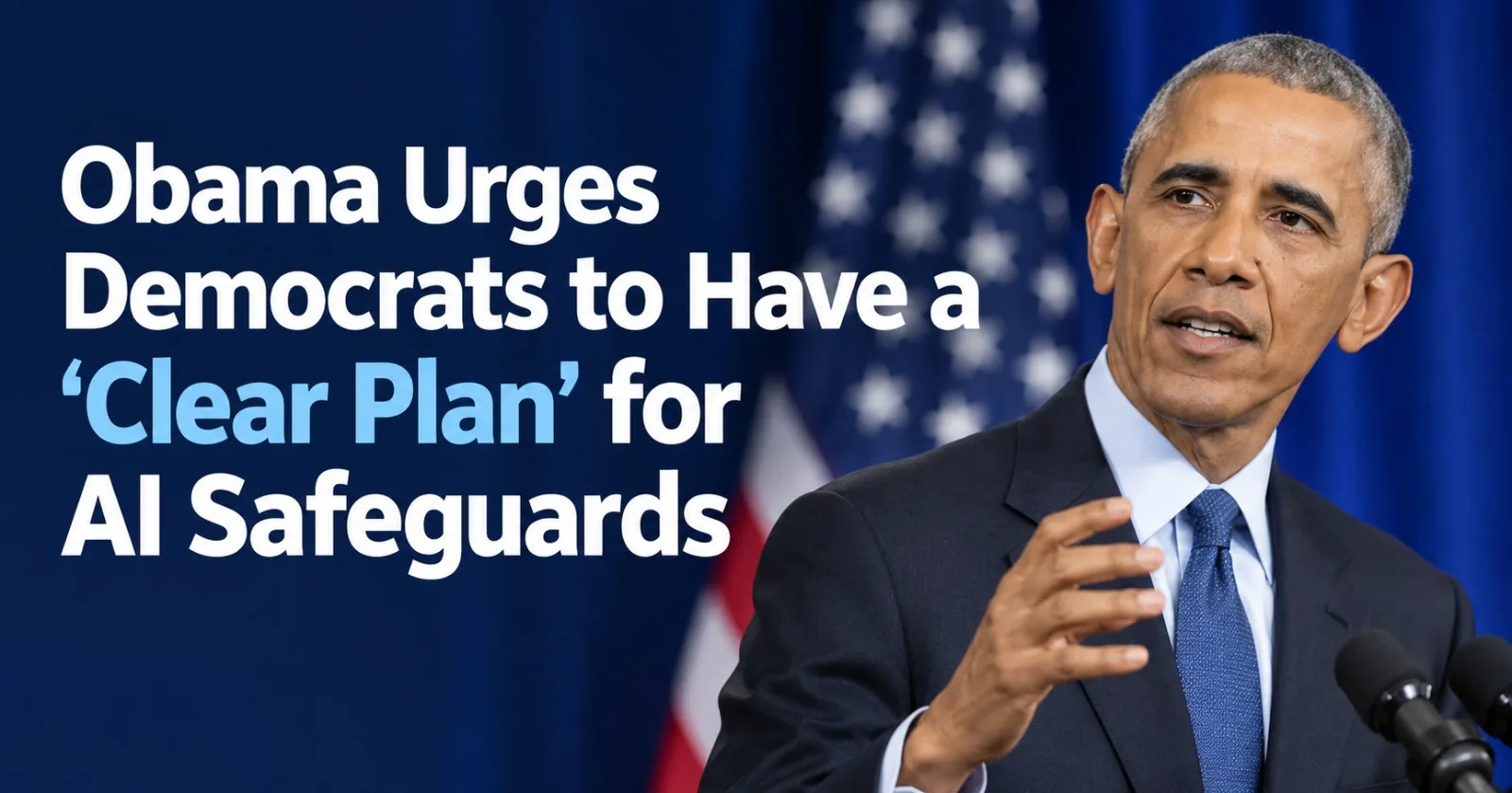
Barack Obama wants Democrats to stop treating AI like a side conversation. At a DCCC fundraiser last Thursday, he sat down with House Minority Leader Hakeem Jeffries and made the case plainly: artificial intelligence needs to be a central plank for the party, not an afterthought. The Guardian's report on Obama's AI remarks
What He Actually Said
Asked how congressional Democrats should handle AI, Obama didn't hedge. He said that if he were running for president next year, this would be one of his top issues — and he'd show up with a real plan, not talking points.
Safety. Protecting kids online. What happens to workers when jobs disappear. He wants Democrats thinking through all of it in concrete terms, not vague concern, and he framed the economic piece specifically around job displacement — what it actually means for workers if large numbers of jobs get automated, not just as an abstract talking point.
He also drew a line for himself: not an "accelerationist," not a "doomer." His view is more measured. AI is moving fast in the hands of a small number of private companies, and that's genuinely risky if nobody gets a handle on it.
But handled well, he thinks it could do real good, pointing to disease research and clean energy as examples.
His practical suggestion: once Democrats win back the House, leadership should build a public framework, broken into a handful of issues, and kick off a real national conversation — treating it less like a single position paper and more like an ongoing dialogue with voters.
Not His First Time on This
Obama isn't approaching AI as a bystander. Back in 2023, he spent roughly five months quietly advising the Biden White House as it built out its sweeping executive order on artificial intelligence, meeting with tech leaders and talking through the issues with advocacy groups and policy think tanks before feeding that input to Biden's team.
It was reportedly the first time that administration had leaned on him for direct help shaping policy. ABC News on Obama's role in Biden's 2023 AI policy
His fingerprints show up in specific parts of that order, too. Aides have said Obama was instrumental in convincing companies to voluntarily submit their AI models for pressure-testing before public release, and pushed industry leaders to think about risks beyond national security, including misinformation, bias, and discrimination.
That history is part of why his current remarks are getting attention. He isn't just a former president sharing an opinion; he's someone who has already been involved in turning concerns about AI into policy.
Why Now
The timing comes during a rough stretch for the AI industry. An AI safety researcher recently resigned from Anthropic, warning that the leading labs are racing toward self-improving superintelligence without enough caution.
Not long after, Anthropic's Dario Amodei called for a slower pace of frontier AI development, proposing independent safety evaluators and stronger coordination among companies. Sam Altman and Elon Musk both backed parts of the proposal. Amodei's "We Must Pace the Frontier" essay
Obama has also reportedly been talking with AI executives, including Amodei and OpenAI's Altman.
Congress has its own version of this urgency. A group of House Democrats recently asked Speaker Mike Johnson to cancel the chamber's recess, citing what they called a "catastrophic risk" from advanced AI, pointing to cybersecurity threats and misuse by foreign actors. Axios on the House recess push over AI risks
Bernie Sanders and other lawmakers have gone further, pushing legislation that would temporarily pause the development of advanced AI while the government works on rules. Sanders and Rep. Greg Casar introduced legislation that would permanently ban the development and deployment of artificial superintelligence while temporarily pausing advanced AI development until federal safety rules are established. Sanders and Casar's Ban Artificial Superintelligence Act
Rep. Alexandria Ocasio-Cortez and Sanders have separately backed legislation calling for a temporary moratorium on new and expanded AI data centers until Congress establishes a broader framework.
And a group of Obama-Biden alumni just launched a new policy shop aimed at shaping a center-left AI platform ahead of 2028, complete with listening sessions around the country.
A Very Different Approach in Washington Right Now
Part of what's driving Democrats' sense of urgency is the contrast with where Republicans currently stand. The Trump administration has generally emphasized rapid AI development, innovation, and national-security priorities while resisting a broad patchwork of state regulation.
Earlier this year, Trump signed an executive order directing federal agencies to harden their own systems against AI-related risks while accelerating adoption of the technology, while also pursuing a narrower federal approach to AI oversight.
He had previously signed a separate order pushing back against individual states trying to pass their own AI safety laws, without offering a broad federal framework to replace them. Critics have described that move as clearing the field for companies that have spent years lobbying against binding rules.
For Democrats looking to draw a contrast, that gap between accelerating without guardrails and accelerating carefully is exactly the kind of opening Obama seems to be pointing at. White House AI policy framework
The 2026 Calculus
None of this is happening in a vacuum. Democrats increasingly see AI as a lane to claim rather than cede, and it's already showing up on the campaign trail. A growing number of 2026 candidates are running on AI regulation as a core issue, tapping into voter anxiety about jobs, kids' screen time, and mental health.
Democratic strategists working on House and Senate races say the appeal cuts across age groups, and that younger voters in particular respond to candidates who understand the technology well enough to actually legislate around it, rather than just react to headlines about it.
Obama's comments look like an attempt to get ahead of that instinct: to turn scattered concern into something organized before the midterms, and before whoever leads the party into 2028 has to answer for not having a plan.
It also fits a broader pattern. Obama has been more visible lately, weighing in on things like Republican-led redistricting fights.
With no single figure currently running the party, his renewed presence, plus quieter outreach to rising Democrats, can be read as someone trying to fill a leadership gap without officially claiming the job.
The Party's Divide
The range within the party is genuinely wide, and it isn't just about tone. Some Democratic voices argue the party has already been too cautious, leaning on commissions and study groups at a moment when voters are asking for actual rules and accountability.
They also argue that continued industry lobbying against binding regulation is exactly the reason to draw a hard line now rather than commission another report.
Obama's cautious, split-the-difference approach sits closer to the center of that debate than the more aggressive proposals from Sanders and Ocasio-Cortez, including their calls for temporary pauses on aspects of advanced AI development.
House Democrats demanding Congress act immediately occupy yet another point on that same spectrum.
Whether all of that turns into one coherent plan, the kind Obama is asking for, is still an open question. For now, he's put a marker down. It's on the rest of the party to build something around it.
Comments (0)
Login to post a comment.