
Here's a number that will either reassure you or unsettle you depending on where you sit in the developer hierarchy.
Workers with AI skills earned 56% more than colleagues doing the same jobs without those skills in 2026. The year before, that premium was 25%. The year before that, 18%. It's not flattening. It's accelerating.
Here's the other number: senior software developers saw a 10% salary decline year-over-year. Senior. Not junior. Not mid-level. Senior developers with years of experience watched their market rate fall while a subset of their peers with specific AI fluency saw theirs climb at 9.2% annually.
The job didn't collapse. It forked.
One fork leads toward a market where your value is measured by how much code you produce, and AI has made that kind of value dramatically cheaper. The other fork leads toward a market where your value is measured by whether you can design systems, direct agents, govern output quality, and make architecture decisions that AI can't make on its own.
The developers choosing the second fork — deliberately, not accidentally — are the ones whose compensation trajectories look anomalous in a flat market. This blog is about how they made that choice and what it actually looks like in practice.
What happened to the job description
The traditional senior developer job description, simplified, looked like this: deep expertise in a specific language or framework, strong ability to write correct and maintainable code, ability to debug complex problems, ability to mentor juniors and review PRs.
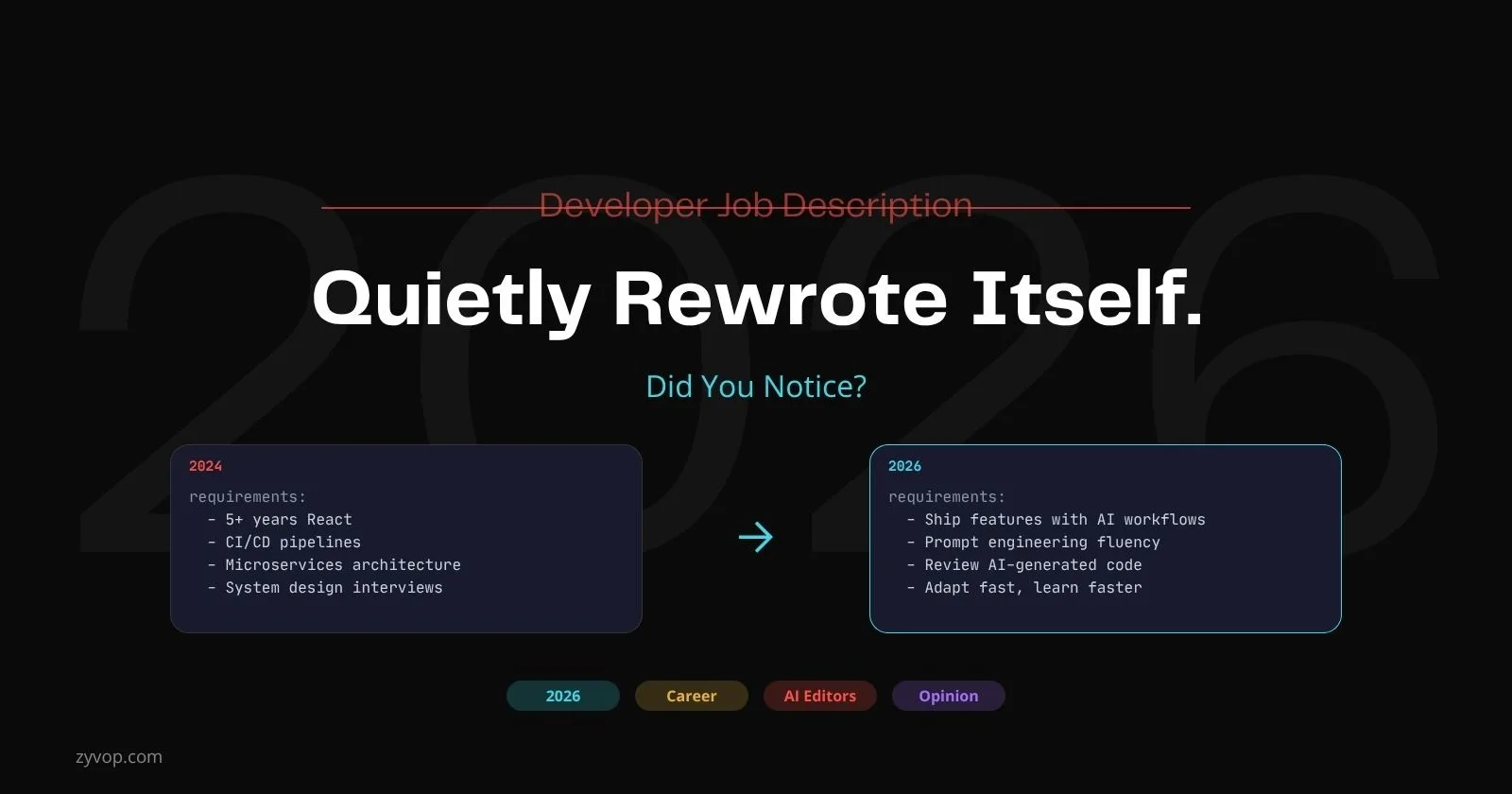
The 2026 version of that job description at a well-run engineering organisation looks notably different. The emphasis has shifted from writing to directing, from syntax to architecture, from individual contributor to systems thinker.
Addy Osmani, engineering leader at Google, described the shift as moving from coder to conductor to orchestrator. At the start of 2024, AI-assisted programming resembled a significantly improved autocomplete. By 2026, the transition is to agent systems that operate on codebases over time.
What that means concretely: the most valuable thing a senior engineer can do in 2026 is not write a feature. It's define the architecture that lets an agent write the feature correctly. It's create the context files that make agents generate consistent, idiomatic code. It's build the test infrastructure that catches what agents get wrong. It's review the agent's output with the judgment of someone who understands the system deeply enough to spot the subtle errors.
The skills that mattered most in 2021 — fast accurate implementation, deep framework knowledge, encyclopaedic API recall — are the exact skills that AI tools have made cheaper. The skills that matter most in 2026 are the ones AI tools don't have: judgment, architectural thinking, understanding of tradeoffs, and the ability to know when AI output is wrong even when it looks right.
The two roles senior developers are splitting into
Senior developers in 2026 are effectively splitting into two categories: code validators and architects. If you choose validation — code review — you'll be in demand but burned out.
That framing is a little stark, but it captures something real. Here's a fuller picture of what each path looks like.
Path 1: The AI Orchestrator
This is the role that has the strongest compensation trajectory and the most clearly defined skill set.
An AI orchestrator doesn't primarily write code. They design the system within which agents write code. They author the context files, rules, and architectural boundaries that guide agent behaviour. They define acceptance criteria that agents must satisfy. They review agent output for architectural soundness, not just syntactic correctness. They manage the MCP integrations that give agents access to the right tools. They run parallel background agents on different parts of the codebase and integrate the outputs.
The skills this requires are old and new simultaneously. Old: system design, domain modelling, architectural pattern knowledge, understanding of non-functional requirements (performance, security, scalability). These are the skills that take years to develop and can't be replaced by prompt engineering. New: context engineering, agentic workflow design, knowing which tasks to delegate and how to brief them, governing AI output quality at scale.
The new standard for senior developers is context orchestration — the ability to guide agentic IDEs that understand the entire repository, documentation, and architectural patterns.
Path 2: The Specialist Who Goes Deeper
Not every developer needs to become an AI orchestrator. The other path with a strong compensation trajectory is going deep in areas where human expertise is still clearly irreplaceable and where AI tools augment rather than replace.
Security engineering is one example. The tools generate insecure code at a documented rate and are worst at the subtle architectural vulnerabilities that only deep security knowledge catches. Security engineers who understand the full threat model, can trace attack surfaces through AI-generated code, and can design systems that are secure by construction are in shorter supply in 2026 than they were in 2024, not longer. The AI made the problem bigger, not the expertise less valuable.
Performance engineering is another. AI generates functionally correct code. It doesn't generate code that's been profiled against your actual traffic patterns, optimised for your specific hardware characteristics, or designed with the full operational context in mind. The developer who can take AI-generated output and make it production-ready from a performance standpoint is doing work AI doesn't do.
Distributed systems architecture is a third. The agent can implement a microservice. It can't decide whether you should have a microservice, whether the boundaries are right, whether the consistency model is appropriate, or whether the failure modes are acceptable for your specific reliability requirements. Those decisions require human judgment informed by years of building things that broke in unexpected ways.
GenAI Engineer and MLOps Specialist postings are growing at 2–3× the rate of traditional roles year-over-year. Developers who layer AI fluency on top of solid software fundamentals are commanding salary premiums of 15–25% above peers without AI skills.
The salary data, stated plainly
AI Engineers earn 12% more than general Software Engineers in equivalent roles and levels. The premium is higher for specialised LLM developers, who average $209,000. Mid-level AI engineers saw the highest year-over-year gains at 9.2%. Senior software developers without AI specialisation saw a 10% salary decline year-over-year.
Workers with AI skills earn 56% more than same-role colleagues without those skills — a premium that has more than doubled from 25% in 2024. The premium accrues almost entirely to experienced practitioners with genuine production depth. Surface familiarity with AI tools is now table stakes, not a differentiator.
That last sentence matters more than the headline number. The 56% premium doesn't accrue to developers who have used Copilot for six months. It accrues to developers who have built production AI systems, who understand the failure modes, who have fixed things when they broke, and who can make architectural decisions about where AI belongs in a system and where it doesn't.
The premium is accessible. It's not easy.
What "AI fluency" actually means for career development
There's a version of this conversation that reduces to "learn prompt engineering." That's not what the salary data is tracking. Here's what it's actually tracking.
System-level thinking about AI integration. Understanding where AI agents belong in a technical architecture — what they should be trusted to do autonomously, what should require human review, what should never be delegated. This requires understanding the failure modes well enough to design around them. Developers who have shipped things that broke because of AI output and understand exactly why are more valuable than developers who have only shipped things that worked.
Context engineering as a discipline. The ability to create the information environment — CLAUDE.md files, rules files, architecture decision records, system prompts — that makes agents perform reliably and consistently. This is not writing prompts. It's designing the persistent layer of institutional knowledge that makes AI tools behave like they understand your system.
Quality governance at scale. As AI generates more code faster, the bottleneck shifts to quality validation. The ability to review AI output efficiently, catch what's subtly wrong, and build automated validation that scales — test suites, linters, security scans, architecture fitness functions — is increasingly what distinguishes teams that ship reliably from teams that ship fast and break things.
MCP and tool integration design. Deciding which external tools agents should have access to, what permissions are appropriate, how to scope access safely, and how to design workflows that use agents effectively for real tasks. This is infrastructure thinking applied to AI tooling.
None of these skills are learned by watching tutorials. They're learned by building things, having them break, understanding why, and building better the second time. The developers who are making the transition well are the ones who have enough production experience that their AI fluency is anchored in real understanding — not just fluency with the tools themselves.
The honest roadmap for developers who want to make this shift
If you're a developer who has been coding for three-plus years and wants to shift toward the higher-value end of this market, here's what that actually looks like as a practice.
Build and break a production AI system. Not a toy project. Something with real traffic, real data, and real failure modes. The goal is to experience what happens when an AI component behaves unexpectedly in production — hallucination, context drift, reasoning errors under edge cases — and to understand how to build systems that handle those failures gracefully. This experience is what the premium is actually paying for.
Get deep on context engineering. Spend a week doing nothing but improving your CLAUDE.md and rules files and measuring the output quality difference. Build architecture decision records for your team's non-obvious conventions. Create a Codebase Orientation document for the project you know best. This practice builds the intuition for what makes AI tools effective at the system level.
Take ownership of your team's AI governance. If your team is using AI tools without systematic quality governance, offer to build it — the code review standards for AI-generated code, the security review checklist, the test coverage requirements. This work is undervalued, genuinely useful, and directly demonstrates the skills the market is paying for.
Write the architectural documentation that AI tools need. Go through your codebase and document the decisions that AI tools consistently get wrong because they don't have the context. Why does the payments module use optimistic locking? Why is the notification system pull-based rather than push-based? Why does the user authentication flow have that seemingly redundant step? This documentation is valuable for the AI tools that will read it, valuable for the humans who will onboard to this codebase, and it demonstrates exactly the kind of architectural understanding that commands premium compensation.
Pick one deep specialisation and go all the way in. The developers with the strongest compensation trajectories in 2026 are not generalists with light AI fluency. They're specialists — security engineers, performance engineers, distributed systems architects — with deep expertise in areas where AI tools create new problems rather than solving them, augmented by AI tool fluency that makes them dramatically more productive. Pick the specialisation that matches your existing depth and go deeper, not sideways.
What the next two years look like
The transition from coder to orchestrator is already taking place and is expected to be mostly complete by 2028. The transition represents a fundamental shift in how software is created — humans will spend less time writing code and more time directing AI agents to do so.
The framing of "will AI take developer jobs" is the wrong question. The right question is: which developer skills will be more valuable in two years and which will be less, and how do you make sure you're developing the right ones?
The skills that will be less valuable: fast accurate implementation of known patterns, deep memorisation of framework APIs, the ability to write boilerplate quickly. AI has made all of these abundant.
The skills that will be more valuable: system architecture, security judgment, performance engineering, the ability to specify precisely what you want and verify that you got it, understanding of AI failure modes, and the accumulated intuition that comes from building production systems and watching them break.
AI didn't change what matters. It just made the shortcuts disappear. The developers who thrived by "knowing the frameworks" are now struggling. The ones who understood why systems work the way they do are thriving.
The market has not been subtle about this. The compensation data is clear and the direction of the premium is consistent. The developers who are positioned well are the ones who treated the last two years as an opportunity to go deeper — not the ones who used AI tools as a reason not to.
Comments (0)
Login to post a comment.