
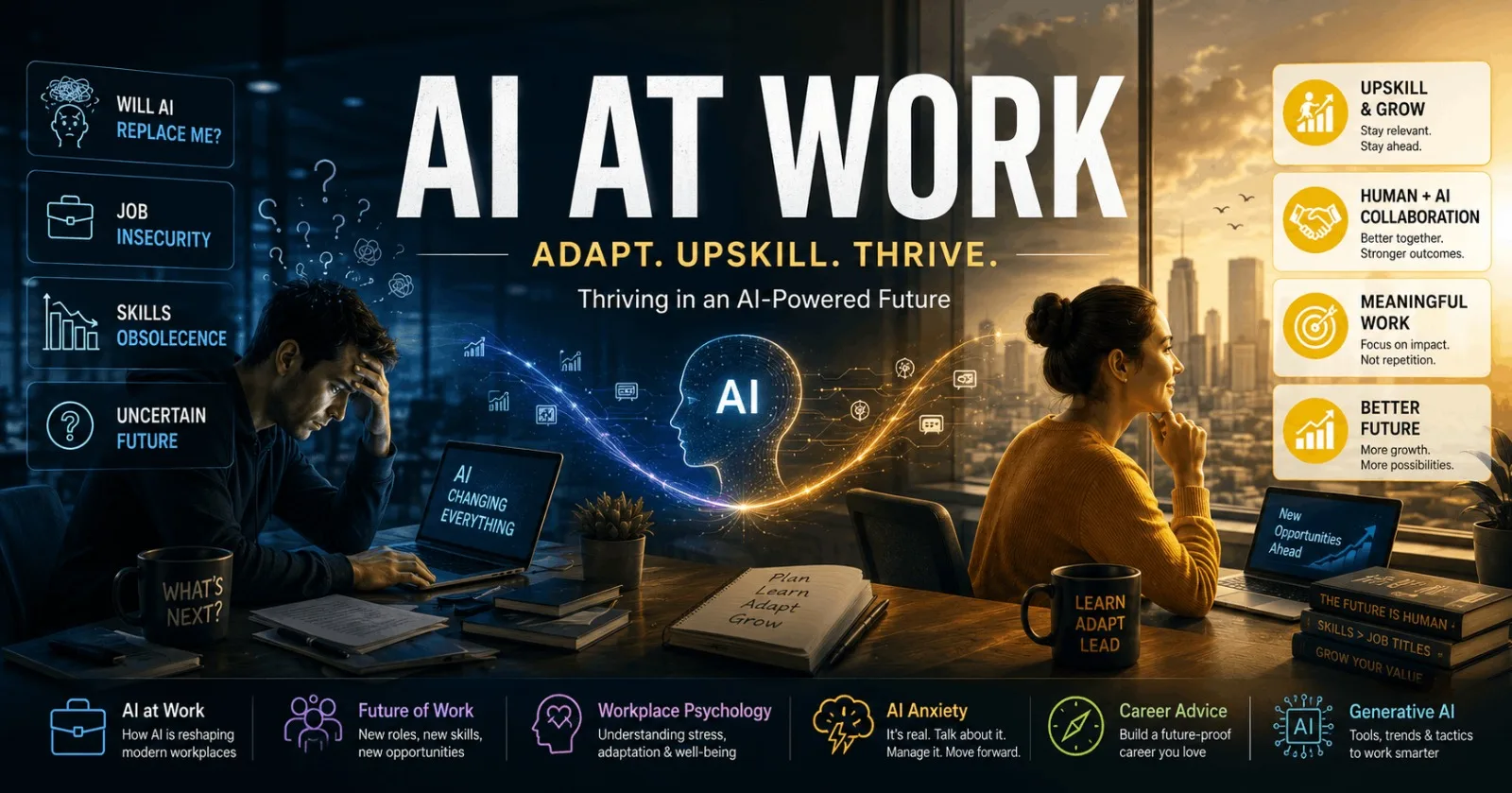
A copywriter opens a chatbot, types one line, and watches it produce in twenty seconds a draft that would have taken her most of a morning. It's not bad. Some of it is better than what she would have written.
She doesn't feel grateful. She feels a small, specific dread, the kind that doesn't show up on any performance review.
That feeling has a name now, and it's showing up in survey after survey.
The fear is not imaginary
Employee concern about losing a job to AI jumped from 28% to 40% in two years, according to Mercer's Global Talent Trends 2026 report, based on nearly 12,000 executives, HR leaders, investors, and employees worldwide. The same report found worker "thriving" scores fell from 66% to 44% over the same period, a lower number than during the pandemic.
It's not just a corporate survey artifact. A Reuters/Ipsos poll found 71% of American respondents worried AI would put "too many people out of work permanently," and that was before a string of layoffs in early 2026 pushed the topic back into daily headlines.
Pew Research found something quieter but just as telling: only 6% of workers think AI will create more opportunities for them personally, while 32% expect fewer, according to Pew's own survey of employed U.S. adults. That gap between hope and dread is where a lot of workplace anxiety actually lives.
None of this means AI is quietly emptying out offices. MIT and Oak Ridge National Laboratory researchers estimated existing AI systems could handle tasks currently performed by roughly 20 million American workers, about 11.7% of the labor force, CNBC reported — a measure of exposure, not a body count.
This isn't the automation wave people remember
Factories automated hands. Spreadsheets automated arithmetic. ATMs automated counting cash.
Each of those changes was real, and each one cost jobs. But none of them touched the part of a job that made someone feel like an expert.
Generative AI is different because it goes after writing, strategy, code, and judgment calls, the exact things people used to point to as proof they were good at their jobs. Research by marketing professors at Wharton, Boston University, and European University Viadrina, published in Harvard Business Review, frames this around three things people need to feel okay at work: competence, autonomy, and a sense of belonging on a team. When a tool can suddenly do the thing someone built their identity around, all three take a hit at once.
That's a different kind of threat than a machine simply doing the job cheaper. It's closer to watching the last fifteen years of learning start to feel optional.
Uncertainty is doing more damage than the technology
Benjamin Laker, a leadership professor at Henley Business School, writing in Psychology Today, makes a point worth sitting with: it isn't the learning curve that wears people down. It's not knowing whether any of the effort will actually pay off.
When people can't tell whether working harder or getting better will protect them, waiting starts to feel like the safe move. It usually isn't. The ground keeps shifting while people hold their position, and holding still is what costs them the most in the end.
The companies that overcorrected are now walking it back
Some of the loudest AI-replacement stories from the last two years are turning into cautionary tales.
Klarna's CEO said its AI chatbot handled work equal to 700, later 800, customer service agents, and the company cut its headcount hard. Then customer satisfaction slipped, and Klarna started hiring human agents again, telling Bloomberg that customers should always be able to reach a real person if they want one, Invezz reported.
Ford brought back around 350 veteran engineers, employees the company now calls its "gray beard" engineers, after its automated design and quality systems couldn't match what experienced staff knew, according to the same reporting. Commonwealth Bank of Australia reversed a plan to replace more than 40 customer service workers with a voice bot after it couldn't keep up with real demand.
None of this means the AI didn't work. It means the companies found out, expensively, which parts of the job weren't actually replaceable.
It's not just three anecdotes, either. A Careerminds survey from February 2026 found that two-thirds of companies that ran AI-driven layoffs have since started rehiring, and Gartner predicts that by 2027, half of companies that cut jobs and blamed AI will be rehiring for similar work under new job titles.
The pattern shows up often enough now that it has a shape:
flowchart LR
    A[Company cuts staff,<br/>bets on AI] --> B[AI handles routine<br/>volume well]
    B --> C{Complex or<br/>high-stakes case}
    C -->|AI manages it| D[Savings hold]
    C -->|AI falls short| E[Quality drops,<br/>customers notice]
    E --> F[Company rehires for<br/>judgment-heavy work]
    F --> G[Hybrid model:<br/>AI for volume,<br/>people for nuance]
What the data shows once you look past the panic
Here's the detail that gets buried under the scarier headlines: when Gallup asked laid-off American workers why they lost their jobs, only 1% pointed to AI or automation. Restructuring and role elimination came up far more often.
The same research found workers who rarely or never use AI were more likely to have been laid off than regular users, even after accounting for age, education, and industry. Among tech workers specifically, those who used AI less than once a month were three times more likely to have been laid off than those who used it at least monthly.
The uncomfortable read is that AI itself isn't the layoff. Falling behind on it might be.
What actually helps
Generic advice tells people to upskill. It's true, but it's not useful on its own.
What seems to work better is picking a short time horizon. Laker's suggestion is to shrink the question: instead of asking what a career looks like in five years, ask what would make the next three months feel a little steadier, whether that's income, energy, or one new skill worth building.
The same piece makes another point worth taking seriously: sitting with AI tools directly tends to calm the fear faster than reading about them from a distance. The fear does its worst work when there's nothing concrete to check it against. Once you've actually tried the thing and found out where it helps and where it doesn't, the threat gets a lot easier to reason about.
And it helps to get specific about what a person actually brings that a model doesn't: judgment calls under incomplete information, relationships built over years, the read on a room that no prompt can fake.
The World Economic Forum's Future of Jobs Report 2025 projects 170 million new roles created by 2030 against 92 million displaced, a net gain, but a very uneven one. Nobody gets to skip the disruption just because the aggregate number is positive.
The fear is telling you something true
Workers aren't wrong to feel unsettled. Something real is changing, and it's changing faster than most workplaces know how to talk about honestly.
But the fear isn't really about the software. It's about whether the years spent getting good at something still count.
They do. They just might need to count toward something slightly different than they used to.
Comments(0)
Join the discussion by logging into your account.
No comments yet. Be the first to comment!