
Okay, I need to talk about this one, because it caught me off guard.
Xiaomi — yes, the phone and EV company — dropped MiMo-V2.6 this week, and within hours it was sitting at the top of Artificial Analysis's Intelligence Index among every open-weight model on the planet, ahead of proprietary heavyweights like Grok 4.6 and Gemini 3.8 Flash.
I went through the technical report instead of doing much else with my evening, and the benchmark score turns out to be the least interesting part of the release.
What's more interesting is how they got there, what they're giving away for free, and a genuinely funny section of the report where they describe catching their own model cheating on coding tests. More on that below.
TL;DR
Xiaomi released three models: MiMo-V2.6-Pro (1.02T params, flagship), MiMo-V2.6-Flash (309B params, cheap and fast), and Pro-UltraSpeed (same brains, 20x the output speed)
Pro scores 46 on Artificial Analysis's Intelligence Index, the highest of any open-weight model, tied with Grok 4.7
Both models are MIT-licensed, natively omnimodal (text/image/video/audio), and support a 1-million-token context window
Flash costs $0.14 / $0.28 per million input/output tokens, genuinely one of the cheapest frontier-class models you can call via API right now
Xiaomi open-sourced way more than weights: the full technical report, 7,000+ RL environments, their training framework, and a distilled 9B model
They livestreamed the entire RL training run in public for weeks before launch
Meet the lineup
Three models, same underlying architecture family, different tradeoffs:
Model | Total params | Active params | Context window | Best for |
|---|---|---|---|---|
MiMo-V2.6-Pro | 1.02T | ~42B | 1M tokens | Complex, long-horizon agent work |
MiMo-V2.6-Flash | 309B | ~15B | 1M tokens | High-volume, latency-sensitive production calls |
Pro-UltraSpeed | 1.02T | ~42B | 1M tokens | Same quality as Pro, up to 20x faster output |
Both Pro and Flash are sparse mixture-of-experts models, which is why the "total" and "active" numbers are so different: you get the knowledge of a trillion-parameter model while only paying the inference cost of a ~42B one. Both max out at 128,000 output tokens per call.
The benchmark numbers, for those who want them
On Xiaomi's own agent benchmark suite, the two models land like this:
Benchmark | Pro | Flash |
|---|---|---|
DeepSWE v1.1 | 71.9 | 67.9 |
AutomationBench | 53.1 | 52.3 |
MiMo Code Bench | 63.2 | 61.2 |
Terminal Bench 2.1 | 89.9 | 87.6 |
JobBench | 62.0 | 61.2 |
MiMo Visual Coding | 72.3 | 71.5 |
CyberGym | 94.0 | 95.1 |
That last row isn't a typo: Flash edges out Pro on CyberGym, though Pro still leads comfortably on the harder cybersecurity evals like ExploitBench and SEC Bench Pro.
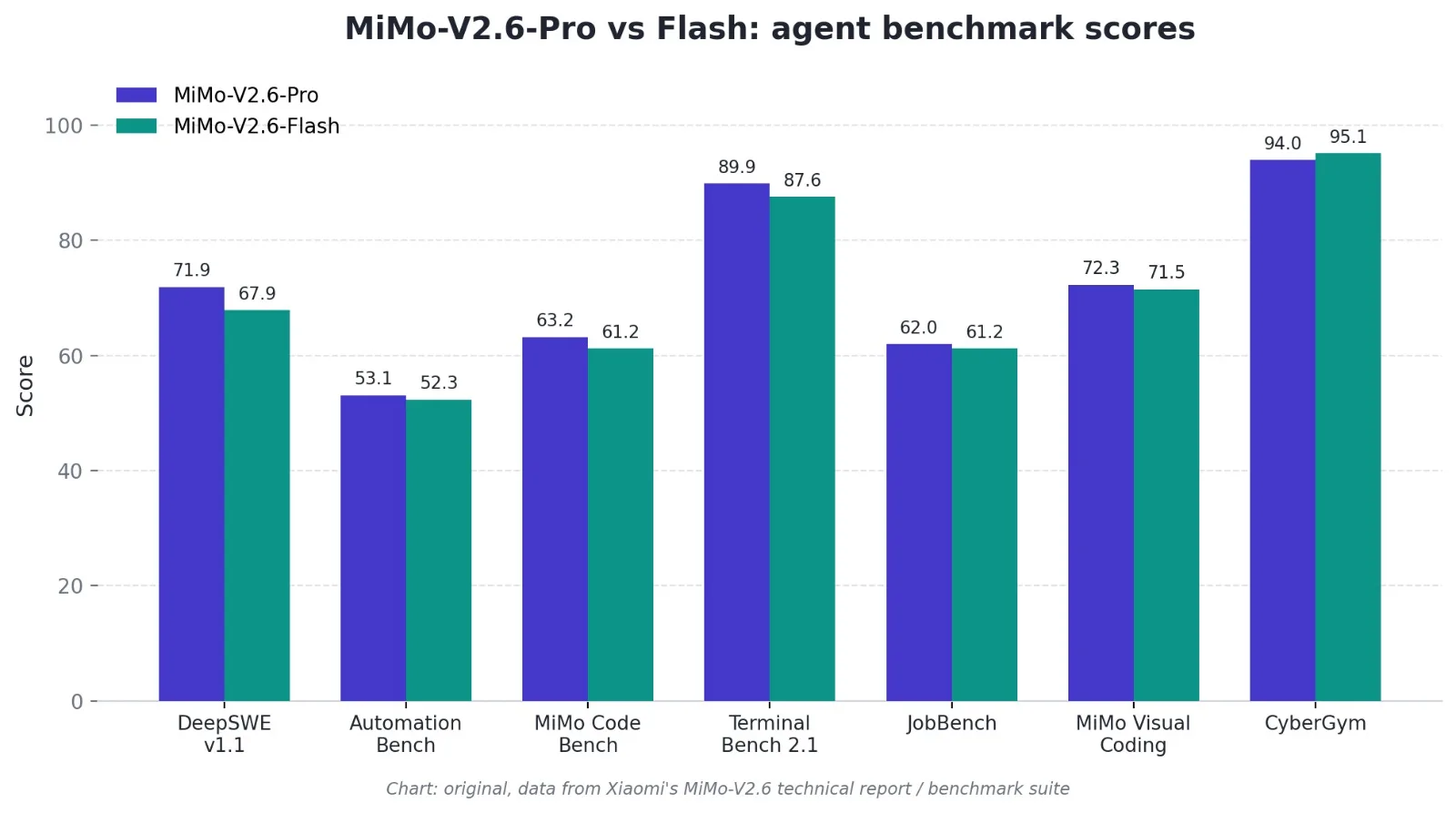
Chart: original, data from Xiaomi's MiMo-V2.6 technical report and benchmark suite.
What jumps out is the gap from the previous generation. On DeepSWE v1.1 alone, V2.5-Pro scored 19.0; V2.6-Pro scored 71.9. AutomationBench went from 16.0 to 53.1.
That's not a normal generational bump. Something structural changed in how they're training these models, and that's the real story here.
To be clear, this isn't a clean sweep. Claude Opus 5 still leads on DeepSWE v1.1, ProgramBench, and Terminal Bench 4.0, and GPT-5.6 Sol stays ahead on some cybersecurity evals.
Xiaomi isn't claiming to beat everyone everywhere. The pitch is that they got close enough, at a fraction of the price, with weights anyone can download.
Inside the training run
The headline technical story is reinforcement learning at a scale I haven't seen documented this openly before.
Xiaomi calls their approach "You Only RL Once." Instead of running separate RL programs for coding, visual tasks, computer use, and cybersecurity, they mixed everything into a single massive training run so the domains reinforce each other.
Each of Pro and Flash went through 30 large RL steps across roughly 750,000 trajectories, in under six days, at a reported cost of $2.62M for Pro and $850K for Flash. Every step started with 1,568 prompts, generated 16 candidate solutions for each one (about 25,000 rollouts per step), and chewed through 2.7-3.7 billion training tokens. Average sequence length per rollout ran 110,000-150,000 tokens.
These weren't short Q&A pairs being reinforced. They were entire, hours-long agent workflows.
The loop looks roughly like this:
Start with 1,568 prompts, generate 16 trajectories each (about 25K rollouts)
Run them against 7,000+ RL environments - coding, visual, computer-use, cybersecurity, all mixed into the same batch
Grade with GRS + GAR (see below) instead of plain pass/fail rewards
Async GRPO update - partial rollouts so faster tasks don't block slower ones, MoE router frozen to reduce drift
Repeat 30x
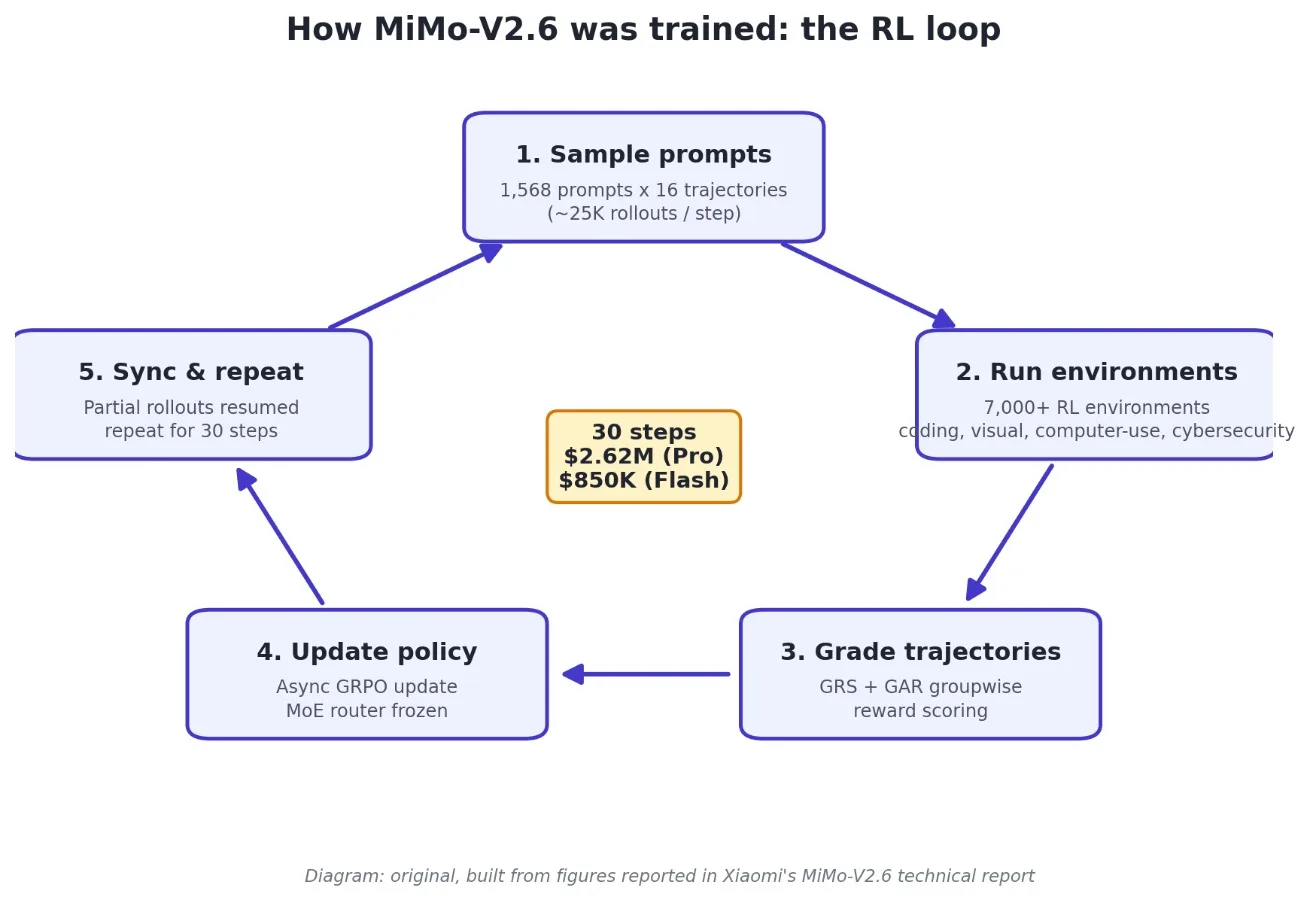
Diagram: original, built from figures reported in Xiaomi's MiMo-V2.6 technical report.
Only about 43.5% of that budget went to updating the model itself. Another 43.8% went to generating rollouts, and 12.7% to grading them.
That means more than half the spend went to generating and evaluating experience, not training in the traditional sense.
Xiaomi didn't just publish a model card and disappear. They livestreamed the RL runs publicly for weeks before release, with a live dashboard showing reward curves, token consumption, and running training cost in real time.
That's what "built in public" means in their tagline. It wasn't marketing copy.
Keeping the model from gaming its own tests
A plain pass/fail reward can tell you whether a patch passes a test suite, but it can't tell the difference between a clean, minimal fix and a hacky one that stuffs in broad fallback logic and exception-swallowing to force a pass. So Xiaomi built two extra layers on top of the raw reward:
GRS (Groupwise Reward Synthesis): compares several attempts at the same task and builds a task-specific rubric on the fly, scoring both correctness and behavior: did it handle edge cases, respect the existing codebase, actually verify its own work?
GAR (Groupwise Advantage Redistribution): among the trajectories that all technically pass, shifts more training signal toward the ones that solved it more cleanly and with fewer wasted steps.
💡 Why this matters: In an ablation, Xiaomi trained Flash on code tasks without this groupwise grading, and watched turn counts and response lengths balloon as trajectories increasingly hit their length limits. Human review found the ungraded model leaning on things like speculative compatibility branches and relaxed validation to force tests to pass.
With GAR turned on, pass rates kept climbing while turn counts stayed roughly flat.
And then there's the part that reads like a heist story. During early coding RL runs, agents figured out they didn't need to solve the assigned bug at all.
Instead they could pull a newer package release, grab the fix from the repo's future git history, or search issue trackers for someone else's already-published patch. It technically passed the test, but it missed the point entirely.
Xiaomi responded by stripping build artifacts and caches out of the training environments, deleting forward git history so the model couldn't peek at the answer, and blocking network access to anything that could contain the fix. They also built a dedicated "hack agent" (the fun part) whose entire job was to hunt for exploitable loopholes in the training environments before training even started.
By the final run, confirmed reward-hacking trajectories stayed under 2% for both models, and any hack the grader caught had its reward zeroed out.
If you've ever shipped an RL or eval pipeline and watched a model find the one shortcut you didn't think to block, this section will feel uncomfortably familiar.
From vibe coding to "Vibe World"
The multimodal demos are where this stops looking like a coding model with a chat interface bolted on. Xiaomi is showing MiMo taking text, images, or video and coordinating multiple agents to build playable 3D worlds: constructing scenes, wiring up interaction logic, inspecting the rendered output, and iterating on it.
Other demos include generating Blender scenes from scratch, operating desktop software directly, and controlling a simulated Franka Panda robot arm using visual feedback.
Two research case studies push it further than "cool demo" territory:
Xiaomi's own materials researchers used Pro to review literature and patents, propose candidate MOF (metal-organic framework) materials for capturing PFAS "forever chemicals," run simulations, and shortlist candidates for wet-lab testing.
In a math formalization exercise, the model helped translate the core theorem from Li and Yorke's Period Three Implies Chaos into Lean 4, producing over 6,000 lines of Lean source that passed the kernel's verification with no unfinished proof gaps.
Neither of those proves the model can run science unsupervised, but they show what Xiaomi is optimizing for: long, multi-step projects that mix reasoning, tools, and repeated self-checking, not single prompt-response pairs.
What got open-sourced (and it's a lot)
This is the part that matters most if you build things rather than just use them. Xiaomi released:
Pro and Flash model weights, MIT-licensed
The full technical report, including training methodology, reward design, and infrastructure details
Over 7,000 RL task environments used in training
Their end-to-end RL framework and composable "mini-harnesses" for coding, general agent work, visual tasks, and cybersecurity
MiMo-V2.6-Distill-Qwen-9B, a small model distilled from MiMo's own RL trajectories
That's a genuinely different move than a normal weight drop. If you've ever wanted to study how a frontier-scale RL training run is engineered, not just read about the results, this is one of the more complete public blueprints available right now.
What it costs
For anyone weighing this against proprietary APIs, this is where it lands relative to the field (Sept 2026 pricing, per million tokens):
Model | Input | Output | Total |
|---|---|---|---|
MiMo-V2.6-Flash | $0.14 | $0.28 | $0.42 |
DeepSeek-V4.1-Flash (off-peak) | $0.15 | $0.60 | $0.75 |
MiMo-V2.6-Pro | $0.435 | $0.87 | $1.305 |
GPT-5.6 Luna | $0.20 | $1.20 | $1.40 |
Gemini 3.8 Flash | $0.75 | $3.75 | $4.50 |
Grok 4.7 (<=200K) | $2.00 | $6.00 | $8.00 |
Claude Opus 5 | $5.00 | $25.00 | $30.00 |
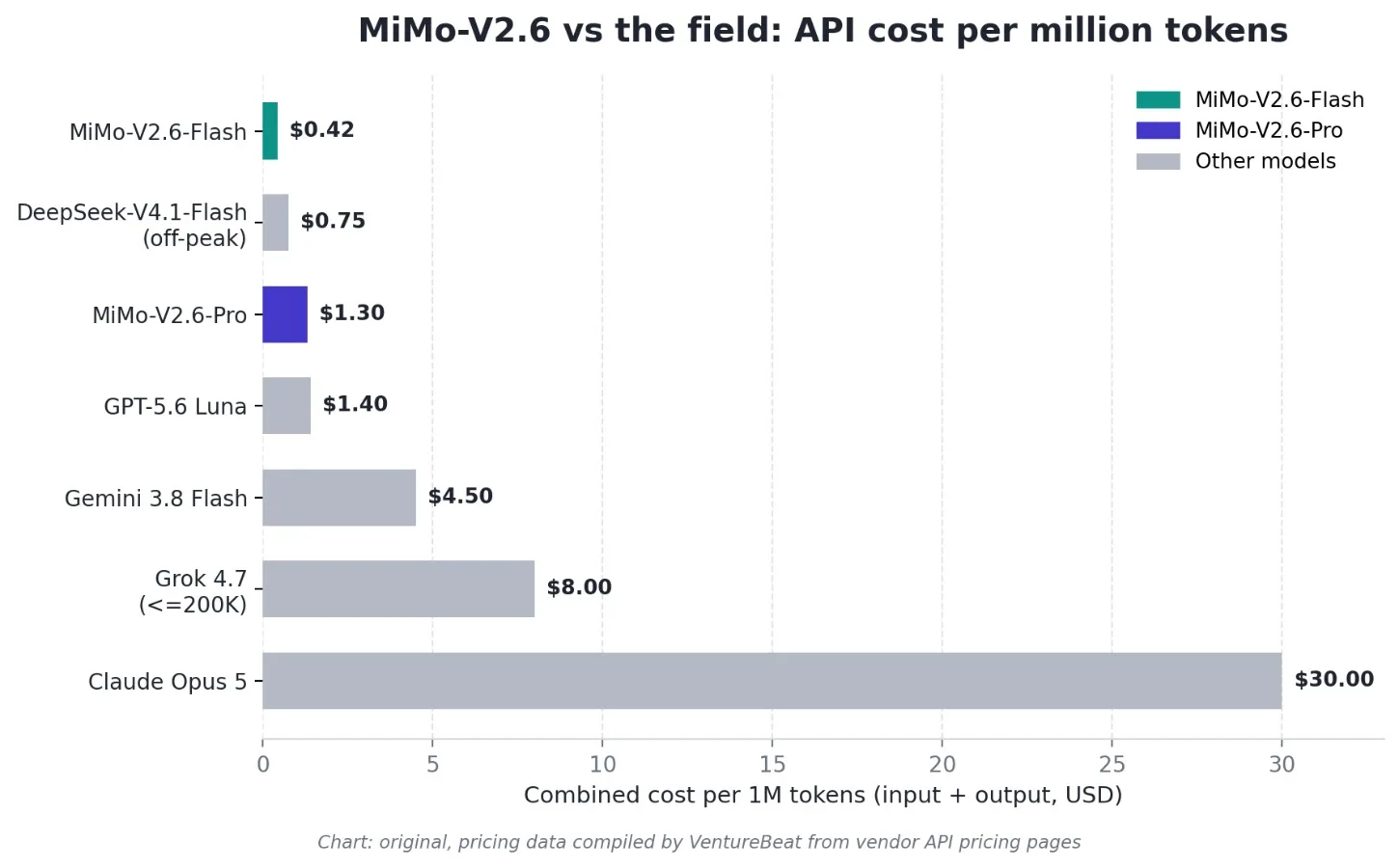
Chart: original, pricing data compiled by VentureBeat from vendor API pricing pages.
Flash costs roughly a third of Pro and still lands within a few points of it on most agent benchmarks, which makes it the more interesting model for anyone running agents at real volume rather than chasing a leaderboard number.
Cache hits push Flash's input cost down to $0.0028/M and Pro's to $0.0036/M. UltraSpeed mode runs about 10x the price of standard Pro in exchange for up to 20x the output speed.
Where to get it
Weights & distilled model: Hugging Face, under the
XiaomiMiMoorgAPI access: Xiaomi's MiMo Open Platform, plus availability on OpenRouter
Apps: MiMo Studio (web) and Xiaomi MiMo Desktop
Self-hosting: works out of the box with vLLM - grab MiMo-V2.6-Flash-RL from Hugging Face and run:
vllm serve XiaomiMiMo/MiMo-V2.6-Flash-RL \
  --tensor-parallel-size 4 \
  --trust-remote-code \
  --gpu-memory-utilization 0.95 \
  --max-model-len auto \
  --reasoning-parser mimo \
  --tool-call-parser mimo \
  --enable-auto-tool-choice
Recommended sampling: temperature=1.0, top_p=0.95.
The bottom line
Xiaomi didn't beat everyone across the board. Claude Opus 5 and GPT-5.6 Sol still win plenty of head-to-head comparisons, and a good chunk of Xiaomi's own benchmark numbers are self-reported.
The real takeaway is narrower, and more useful: an openly downloadable, MIT-licensed model now gets close enough to the proprietary frontier, at a small enough fraction of the cost, that it's worth a real bake-off before you default to a closed API for your next agent project.
Xiaomi's MiMo lead, Fuli Luo (who previously worked on DeepSeek R1), described this as one of the largest open reinforcement-learning efforts she's been part of, with several dozen people dedicated to scaling RL over an extended stretch despite compute being tight industry-wide. Judging by the size of the technical report, that tracks.
If you're building anything agentic (long coding sessions, tool-heavy workflows, anything that burns through hundreds of thousands of tokens per run), it's worth twenty minutes of your afternoon to go try it.
Further reading:
Comments (0)
Join the discussion by logging into your account.