
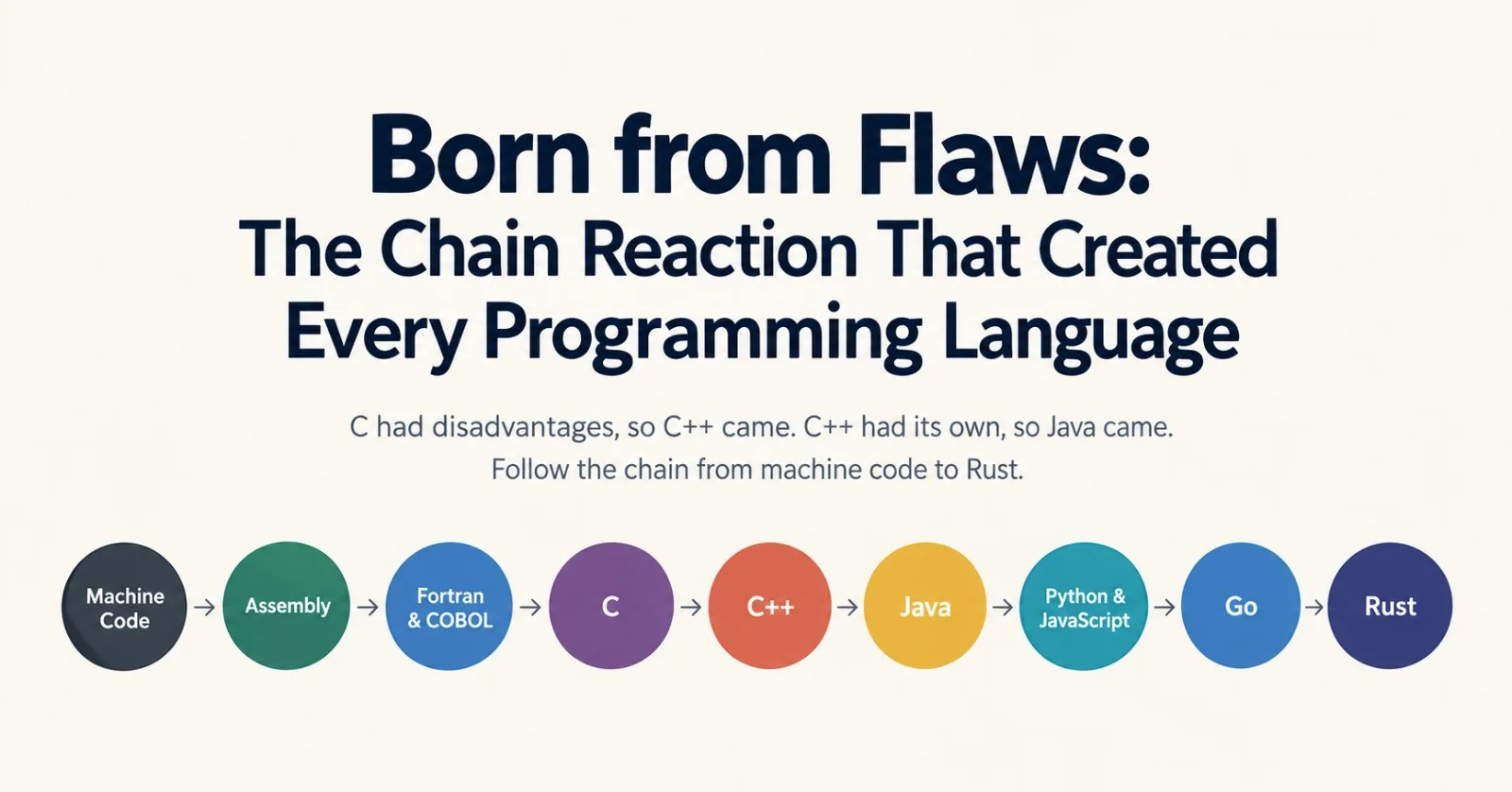
Every programming language you have heard of exists because an older one hurt. Someone hit a wall, got annoyed, and built a way around it. The new language solved the old problem and brought problems of its own, and the next person got annoyed about those. That is the entire history of programming, and it works like a chain reaction.
Here is the chain, with each language's disadvantages spelled out and the language that came to fix them.
Machine code and assembly: where it all started
Computers only understand numbers, so the first programmers wrote machine code: binary patterns, one for every instruction. Assembly (late 1940s) was the first improvement. It replaced the numbers with short names like ADD and MOV, which a program called an assembler translated back into binary.
Disadvantages
Painful to read and write. One wrong digit broke the program silently. The word "bug" earned its legend in 1947, when operators of Harvard's Mark II found a real moth stuck in a relay.
Tied to one machine. Every processor had its own instructions, so moving a program to another computer meant rewriting it from scratch.
Slow to write. Even a simple calculation took pages of tiny steps.
The fix: languages that let people write in human terms and leave the translating to a compiler. That brought Fortran and COBOL.
Fortran and COBOL: writing in human terms
In the early 1950s, Grace Hopper built one of the first compilers, a program that translates friendly text into machine code. Colleagues reportedly told her computers could only do arithmetic. She proved otherwise. Fortran (1957) let scientists write formulas that looked like formulas, and COBOL (1959) let businesses and governments write logic in something close to English. The same program could now run on different computers.
Disadvantages
Narrow focus. Fortran was for science and COBOL was for business, and neither was a general-purpose language.
Weak hardware access. They were a poor fit for operating systems, which were still written in assembly and still rewritten for every new machine.
Tangled logic. Programs leaned heavily on GOTO jumps, which created spaghetti code that was hard to follow and easy to break.
The fix: a language that was portable like Fortran but close enough to the hardware to write an operating system. That language was C.
C (1972): the language that built the modern world
Dennis Ritchie created C at Bell Labs, and Unix was rewritten in it. For the first time, an entire operating system could move from one machine to another. C was fast, small, and gave programmers direct access to memory through pointers. Operating systems, databases, phones, and the firmware in cars still run on it.
Disadvantages
Manual memory. You allocate and free memory yourself. Forget to free it and the program leaks. Free it twice, or use it after freeing, and it crashes.
No safety checks. Nothing stops you writing past the end of an array. That one mistake, called a buffer overflow, powered the Morris worm in 1988 and the same family of flaw sat behind the Heartbleed bug in 2014.
No structure at scale. C has no built-in way to bundle data with the code that works on it. Programs of a few hundred thousand lines became webs where any function could touch anything.
Primitive strings. Text is just an array of characters that you manage by hand, which makes it another easy place to go wrong.
The fix: keep C's speed but give programmers a way to organize big programs. That is what C++ set out to do.
C++ (1985): C with objects
Bjarne Stroustrup knew both sides of the problem. As a PhD student he loved Simula, a language built around objects, but found it too slow. At Bell Labs he used C, which was fast but offered no structure. In 1979 he began adding objects to C, first calling it "C with Classes". Released as C++ in 1985, it bundled data with the functions that work on it, hid internals from the rest of the program, and allowed code reuse through inheritance. Later additions such as templates gave programmers reusable building blocks without a speed penalty. Because it stayed compatible with C, existing code and skills carried straight over, and games, browsers, and trading systems still run on it.
Disadvantages
Still C underneath. Manual memory and raw pointers remained, so the same leaks, crashes, and security holes remained too.
Huge and complicated. Decades of added features left several ways to do almost everything. A joke in the field says nobody knows the whole language.
Slow builds. Large C++ programs can take a long time to compile.
Platform-specific. Programs are compiled separately for each operating system, so moving them often means rebuilding and reworking parts.
The fix: a language that is safer, simpler to use, and able to run anywhere without rebuilding. That language was Java.
Java (1995): safe and run-anywhere
Java began as a failure. In the early 1990s a team at Sun Microsystems led by James Gosling designed a language called Oak for interactive TV boxes, and the TV market never showed up. Then the web arrived, and a language built to be safe on small, unreliable devices was exactly what the internet needed. Java removed the things that hurt most in C and C++: a garbage collector freed memory automatically, raw pointers were gone, and every array access was checked. Instead of compiling to one machine's code, it compiled to bytecode that runs on a virtual machine, so the same program ran on any system. The slogan was "write once, run anywhere". Banks, retailers, and airlines adopted it, and much of their software still runs on Java today.
Disadvantages
Slower and heavier. The virtual machine uses extra memory and takes time to start up.
Garbage collection pauses. Automatic cleanup can freeze a program at unpredictable moments, which is a problem for real-time work.
Verbose. Even small tasks traditionally needed a lot of boilerplate code, and the jokes about it became a genre.
Not for low-level work. Writing drivers or squeezing out every bit of performance is a poor fit.
The fix: lighter languages that let people get things done with far less ceremony. They arrived as Python and JavaScript.
Python and JavaScript (1991, 1995): less ceremony
Guido van Rossum started Python as a hobby project over the Christmas holidays of 1989 and named it after Monty Python, not the snake. Its goal was to read almost like plain English. In 1995, Brendan Eich built JavaScript at Netscape in roughly ten days to make web pages interactive. A task that took a page of Java now took a few lines, and that speed of writing made these languages the favorites of the web, and later of data science and AI.
Disadvantages
Slower. They run noticeably slower than C, C++, or Java.
Errors show up late. Types are checked while the program runs, so a typo in a rarely used corner can surface in front of a user, months after you wrote it.
Fragile at scale. Big codebases become hard to change safely without strong discipline.
Far from the hardware. They are a poor fit for operating systems, drivers, or anything that must be tiny and fast.
The fix, part one: keep the comfort and add guard rails. TypeScript (2012) bolted a type checker onto JavaScript. Kotlin (2011) trimmed Java's verbosity and made missing values something the compiler forces you to handle, and C# (2000) and Swift (2014) did similar work for Microsoft's world and Apple's.
The fix, part two: the hardware had changed. Processors were gaining cores instead of speed, and the old languages made using them painful. That pushed people back toward the machine, and toward Go and Rust.
Go and Rust (2009, 2015): back to the metal, with lessons learned
The story goes that Go began in 2007 at Google, when engineers sketched it while waiting for a huge C++ program to build. Rob Pike, Ken Thompson, and Robert Griesemer wanted a small language with near-instant compiles and easy concurrency. Docker and Kubernetes, two engines of cloud computing, are written in it.
Disadvantages of Go
Deliberately minimal. It leaves features out on purpose, which some developers find limiting.
Garbage collected. That keeps it away from the most timing-critical work.
Rust went after the oldest problem of all. Graydon Hoare started it as a personal project in the mid-2000s, and as he has told it, the spark was an elevator in his apartment building that had crashed because of a software bug. Mozilla adopted it, and version 1.0 arrived in 2015. The motivation was serious: Microsoft and the Chrome team have each reported that roughly 70 percent of their serious security bugs were memory-safety problems. Rust tracks who owns every piece of memory and refuses to compile code that could misuse it, so it is as fast as C++ with no garbage collector, and the same rules catch data races in concurrent code.
Disadvantages of Rust
Steep learning curve. The compiler argues with you until your code is right.
Long compile times. All that checking takes time on big projects.
The fix: there is no final one. Somewhere, someone is already frustrated with Rust, Go, or Python.
The whole chain at a glance
Language | Main disadvantages | Fixed by |
|---|---|---|
Assembly | Unreadable, tied to one machine | Fortran, COBOL |
Fortran, COBOL | Narrow focus, weak hardware access | C |
C | Manual memory, no safety checks, no structure at scale | C++ |
C++ | Still unsafe, complex, platform-specific | Java |
Java | Heavy, garbage collection pauses, verbose | Python, JavaScript |
Python, JavaScript | Slow, errors found late | TypeScript, Kotlin, Go, Rust |
Go | Minimal, garbage collected | Rust, for the tightest work |
Rust | Steep learning curve, long compiles | Whatever comes next |
Read down the middle column and you have the real history of programming. Every disadvantage on this list is the reason the next language exists. That is why we have so many of them, and why the old ones refuse to die: each still does something its successors cannot.
So when you pick a language, you are not choosing the best one. You are choosing which set of disadvantages you can live with.
Comments(0)
Join the discussion by logging into your account.
No comments yet. Be the first to comment!