
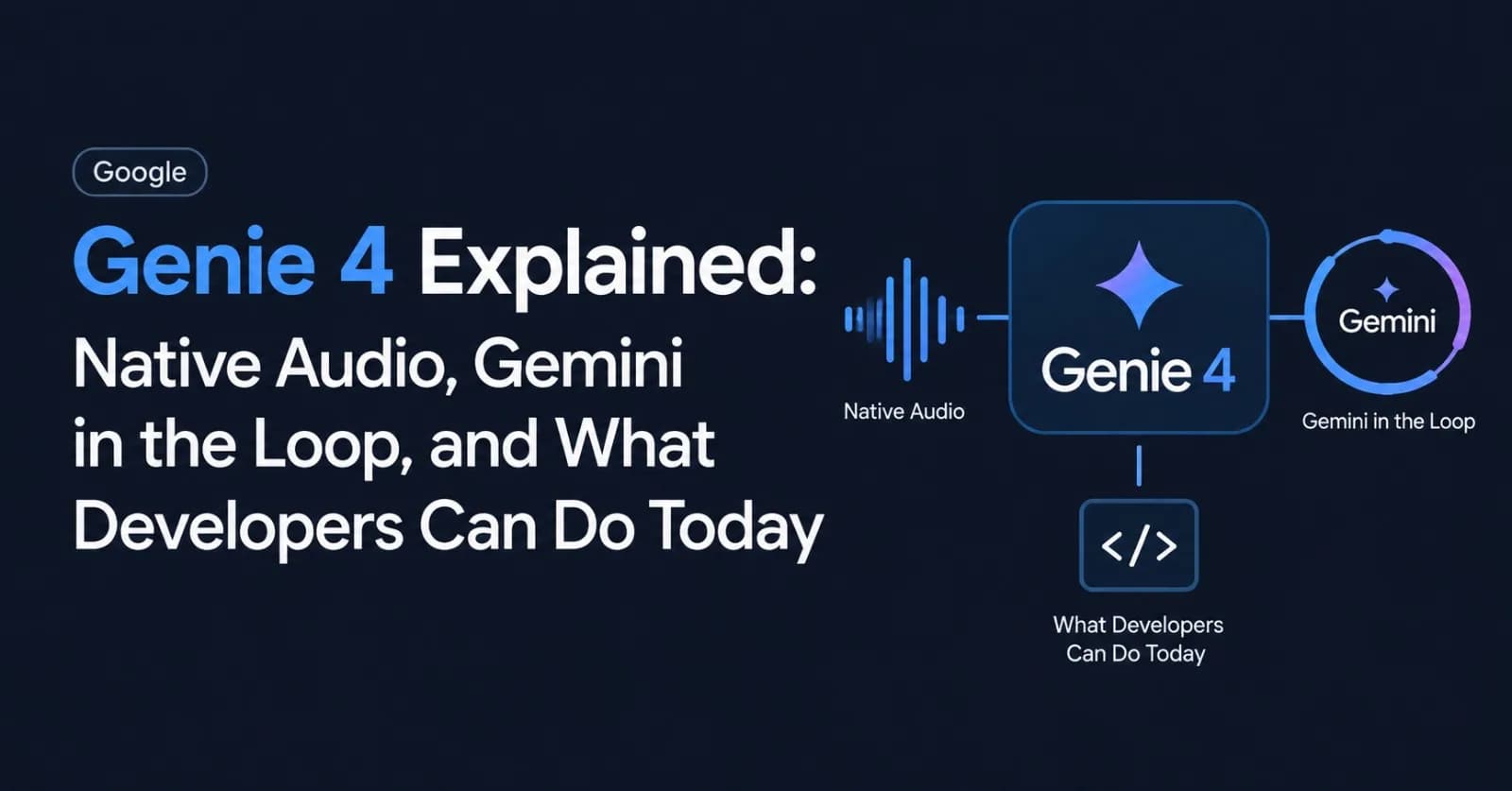
Google DeepMind announced Genie 4 on October 27, 2026. It is a world model: a network that generates an interactive environment in real time while you steer it, instead of playing back a fixed clip. The headline change is sound, because DeepMind calls it its first real-time world model to generate audio natively. This post separates what DeepMind has confirmed from what it has left unpublished, then ends with concrete steps for developers who want to be ready when access opens.
Who can use it right now
Almost nobody, yet. DeepMind describes Genie 4 as a research preview for trusted testers. Wider access is listed as coming soon, starting with Google AI Ultra subscribers in Project Genie and early access partners of the Gemini API and Google AI Studio. TechCrunch puts that rollout in the coming weeks, while DeepMind gives no date. A waitlist for Project Genie is open. The announcement says nothing about pricing, rate limits or API documentation, so any integration plan today is speculation.
What changed from Genie 3
Genie 3, announced in August 2025, is the baseline. The table puts the published figures side by side. The gaps are deliberate: they mark numbers DeepMind has not released for Genie 4.
Area | Genie 3 | Genie 4 |
|---|---|---|
Audio | Not described | Native: ambient sound, music, dialogue |
Resolution | 720p | Not published |
Frame rate | 24 fps | Not published |
Realism | Not quantified | Not quantified; DeepMind calls it its most realistic and interactive world model yet, with better physics and more natural human motion |
Consistency | A few minutes (DeepMind), visual memory back to about one minute | A few minutes of continuous interaction (DeepMind, same wording); up to 2 minutes of consistent scene per TechCrunch |
Steering | Promptable world events via text | Text steering, with Gemini adapting prompts to the scene |
Gemini role | None described | Gemini Omni for appearance, Gemini 3.8 Flash as in-loop agent |
Launch access | Limited preview for academics and creators | Trusted testers, then AI Ultra and API partners |
Genie 3 figures come from DeepMind's Genie 3 post. Genie 4 entries come from DeepMind's Genie 4 post and TechCrunch's report.
The session length row needs care. TechCrunch reports that Genie 4 holds a consistent scene for up to two minutes, double its predecessor's limit. But DeepMind's Genie 3 post gives no session figure either, only a few minutes plus visual memory reaching back about one minute, and its Genie 4 limitations list uses almost the same wording.
So do not read the two cells as Genie 4 being shorter. Treat two minutes as press-reported until DeepMind documents a number. The same caution applies to resolution and frame rate, which matter if you plan to analyze output frames programmatically.
How Gemini sits inside the loop
DeepMind says Genie 4 builds on the Gemini family. Gemini Omni grounds how the world looks and behaves, while other Gemini models supply the reasoning that keeps a scene coherent over time. A second role is more concrete: Gemini 3.8 Flash runs as a guiding agent in the loop. It observes the scene continuously, breaks goals into steps, reviews incoming frames to confirm each step worked, and revises its plan when the world shifts or the user intervenes.
Typed prompts pass through Gemini too. When you ask to change the weather or add a person or object, Gemini adapts the request to fit the surrounding scene. Between your inputs it monitors the world and nudges it so events keep progressing sensibly.
flowchart LR
    A[User: keyboard and text prompts] -->|navigation and camera| B[Genie 4: frames and audio]
    A -->|text prompts| C[Gemini 3.8 Flash: guiding agent]
    C -->|adapted prompts and plan steps| B
    B -->|frames to review| C
The diagram is a simplified reading of DeepMind's description, not an official architecture. DeepMind says Gemini adapts typed prompts and steers the scene, but it does not say prompts route specifically through Gemini 3.8 Flash, so that edge is my reading. DeepMind has not described how Genie 4 itself generates frames, so claims about its internals are unverified.
DeepMind frames this as an early step toward hybrid world models, where code and language models handle structure and a pixel-level simulator handles the sensory side. TechCrunch quotes research director Tejas Kulkarni describing a future where Gemini writes code and text that Genie turns into simulated reality at different levels of abstraction. For developers the pattern is familiar: a planner that emits short text instructions, a renderer that executes them, and a verification pass on the output.
Reading the robotics demo carefully
DeepMind paired Genie 4 with a model it calls Gemini 4 Argon to simulate Apptronik's Apollo humanoid playing checkers. Argon splits a user-instructed task into steps, and those steps reach Genie 4 as text captions while the simulation renders, so the scene adapts as the task progresses. TechCrunch describes this as a possible way to test robot scenarios in simulation before they happen in reality.
What the announcement does not include is any measurement of how well simulated outcomes predict real robot behavior. It is a demonstration video, not a benchmark.
Prompting and preparation
DeepMind's prompt guide is written for Genie 3 (its browser title says Genie 3, and its on-page headline says just Genie). It recommends describing an environment and a character separately, keeping sentences short and declarative, evoking mood through sensory detail, and using Gemini to refine drafts.
The showcase prompts on the Genie 4 model page look different. Many are long, some keep the environment and character split, and several include negative constraints such as no text or no CGI look. Five include an explicit audio line, for example wingbeats, wind and embers for a dragon ride, while others are a single sentence.
That suggests audio direction belongs in the prompt, but it is an inference from examples, not documented behavior. Test both short and long prompt styles once you have access.
Two documented limits translate directly into prompt rules. DeepMind says legible text is often generated only when it appears in the input world description, so write any on-screen text into the prompt. It also says object permanence can drift after longer runs, multiple complex prompt edits, or a lot of navigation, so keep sessions short and avoid stacking edits.
Three things are worth building before access arrives. These suggestions are analysis, not DeepMind guidance. First, a small evaluation harness that records every session and checks fixed landmarks at set intervals, so you measure drift instead of eyeballing it. Second, a caption schema for planner output with one short action per caption, mirroring the step-by-step pattern in the robotics demo. Third, a provenance step, since all Genie 4 video and audio will include SynthID and your product should expect that marking.
Known limitations
DeepMind lists six limits on its model page. Visual details and object permanence drift over time. Modeling complex interactions among users, multiple agents and shared environments is an open research problem. Real-world locations are not simulated with perfect accuracy. Text is often legible only if it was in the prompt. Continuous interaction lasts a few minutes, not extended sessions. Real-time audio accuracy is still being improved.
TechCrunch adds that DeepMind's Diego Rivas stressed it is early days and that it is not yet clear what the end-to-end product experience will be.
Where it sits in the market
Genie 4 lands in a crowded and consolidating field. TechCrunch notes that Runway released its second world model, GWM Worlds 2, a couple of months ago, that Fei-Fei Li's World Labs is being acquired by AMD, that Amazon is reportedly in talks to buy Decart, and that Rivian acquired Third Dimension to bring self-driving simulation in-house.
On the use-case side, DeepMind says its trusted testers are exploring filmmaking previsualization, turning archival photographs into explorable scenes, going from an initial idea to an explorable game prototype, and enterprise scenario generation.
What to watch next
Confirmed: native audio, Gemini steering and a trusted-tester preview. Not yet published in DeepMind's launch materials: resolution, frame rate, latency, pricing, public API access or documentation, and a technical report on how the model works.
The signals worth tracking are the Project Genie rollout to AI Ultra subscribers, early API documentation, and independent tests of drift and audio accuracy. Until those land, Genie 4 is best treated as a strong demonstration of where interactive simulation is heading, not something to design a product around.
Sources
Google DeepMind, Genie 4: A new generation of world simulation, October 27, 2026
Google DeepMind, Genie 4 model page
Rebecca Bellan, TechCrunch, Google's Genie 4 world model adds audio, more realistic worlds, and real-time steering, October 27, 2026
Google DeepMind, Genie 3: A new frontier for world models, August 5, 2025
Google DeepMind, How to create effective prompts with Genie
Comments(0)
Join the discussion by logging into your account.
No comments yet. Be the first to comment!