
You don’t need to wait for a major launch or a breakthrough project to write something useful. Many strong technical articles begin with smaller moments: a bug that took an afternoon to understand, a command you had to look up twice, or a design decision your team debated.
The hard part is rarely finding something to write about. It’s building a routine that helps you notice those moments, capture them, and turn them into clear explanations without making writing feel like a second job.
Capture the problem while it’s fresh
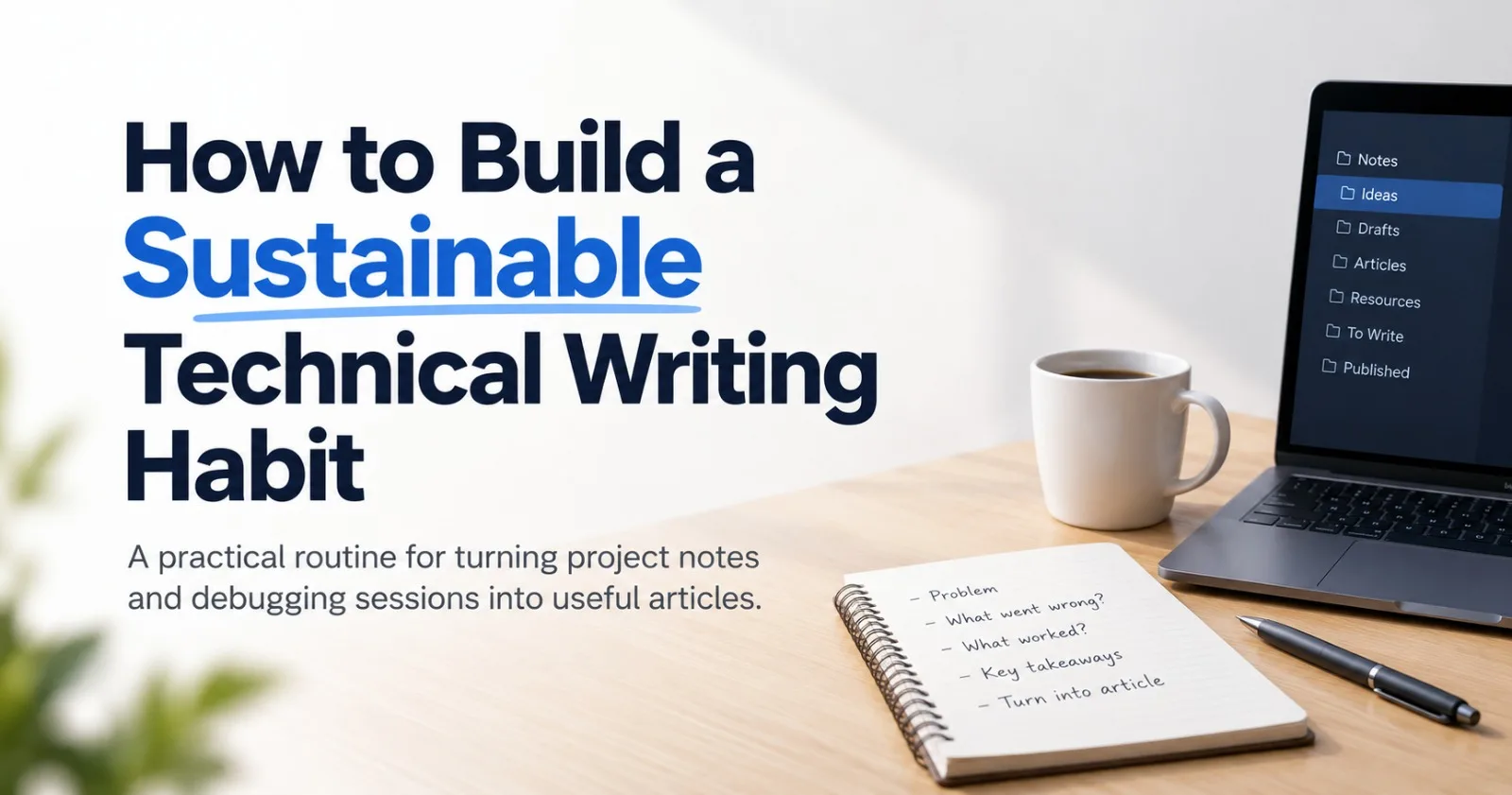
When you solve something tricky, leave yourself a short note before moving on. A few bullets are enough:
What were you trying to do?
What went wrong?
What did you expect to happen?
What finally worked?
What would you tell someone facing the same problem?
Don’t try to write the article yet. Record the details that are easiest to forget: the error message, the command that exposed the issue, the version you were using, or the small change that fixed it.
A plain text file, a notes app, or a folder in your project can all work. The best system is the one you’ll actually use.
Keep a small idea backlog
Set aside a place for writing ideas and add to it as you work. An idea doesn’t need a polished title. “Why the cache didn’t update after deployment” is a perfectly good starting point.
Once a week, scan your notes and choose one idea that meets at least one of these criteria:
You had to search several places to find the answer.
The solution has a surprising or easily missed step.
You can explain what you tried and why it failed.
Someone on your team is likely to encounter the same problem.
Picking one topic keeps the backlog from becoming another source of guilt. It’s a menu, not a list of overdue assignments.
Turn one problem into one article
A technical article doesn’t need to cover an entire tool or field. It can answer a single question well.
A useful outline is:
The situation: What were you building or trying to fix?
The obstacle: What made the problem confusing?
The investigation: What did you check, and what did you learn?
The solution: What worked, with enough detail for a reader to follow?
The takeaway: What should the reader remember or do differently?
This shape helps you avoid writing a long project diary. Keep the details that help readers understand or reproduce the solution. Leave out the detours that don’t.
Write in short, repeatable sessions
You don’t need a free weekend. Try a 30-minute writing block:
5 minutes: Choose a note and clarify the reader’s problem.
15 minutes: Draft the explanation without editing every sentence.
10 minutes: Check the technical details and improve the structure.
If the draft isn’t finished, leave a note about the next step and stop there. Returning to a draft with a clear next action is easier than reopening a blank page.
Regular, modest sessions are usually more sustainable than waiting for a perfect stretch of uninterrupted time.
Make accuracy part of the routine
Readers rely on technical writing to make decisions and change code. Before publishing, revisit the parts that could be wrong:
Run the commands or code samples where possible.
Include relevant versions, configuration, or assumptions.
Check that links still point to useful documentation.
Separate what you verified from what you suspect.
Ask someone else to review a claim if the consequences of getting it wrong are significant.
You don’t have to explain every edge case. You do need to make the boundaries of your advice clear.
Publish a useful article, not a perfect one
A first article can feel more consequential than it is. Aim to help one reader solve one problem. Publish when the explanation is accurate, understandable, and complete enough to be useful.
Keep the source in Markdown or another portable format so you can revise it later. If you publish to multiple platforms, make sure readers can find the version you consider authoritative. Tools such as ZyVOP can publish Markdown and distribute articles to supported platforms, which can reduce the repetitive work after the writing is done.
Let the work create the habit
After publishing, add a short note to your backlog: what took longer than expected, what readers asked about, and what you’d change next time. Then return to your normal work and keep collecting ideas.
A sustainable writing habit doesn’t depend on feeling inspired every week. It comes from noticing useful problems, saving the details, and giving yourself a small, repeatable path from notes to a finished article.
Comments(2)
Join the discussion by logging into your account.
Lê Đức Minh
The 5/15/10 split is realistic, and leaving a next-step note before stopping is a great trick for restarting a draft.