
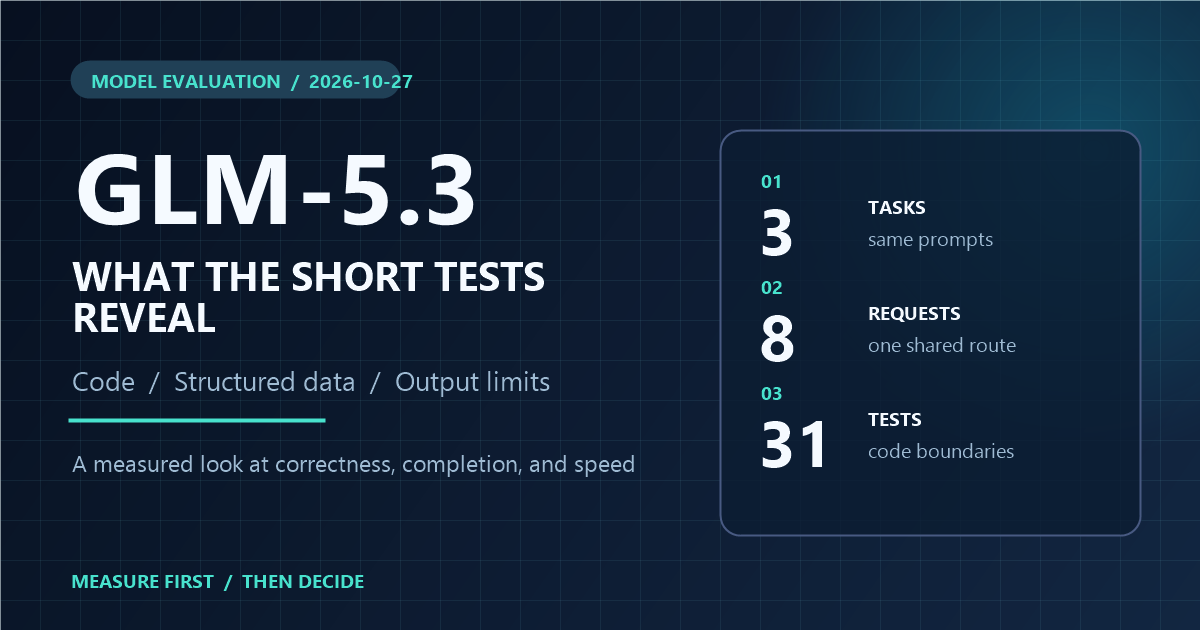
GLM-5.3: What Three Short Tests Reveal
The short answer: GLM-5.3 was faster in the structured-data extraction task, matched Doubao Seed 2.1 Turbo on the notification rewrite, and produced the same tested code result only after the output limit was raised from 1600 to 4096 tokens. That is enough evidence for a narrow trial. It is not enough evidence to call either model universally better.
The distinction matters because a model can look successful at the API layer while returning an incomplete answer. For production work, “the request completed” is a weaker claim than “the output passed the checks.” These three tasks separated those two questions.
The operating rule: correctness, completion, speed
A useful evaluation has an order. First, verify that the answer follows the task and contains the required facts. Second, verify that the response ended normally and contains a complete output. Third, compare time only among responses that passed the first two gates.
Reversing that order creates misleading results. A fast empty response is not a speed advantage. A correct but truncated answer is not a deployable result. A good-looking answer with a missing number still requires manual repair.
The test used the same API route, identical prompts, separate conversations, and the models’ default thinking behavior. It ran on 27 October 2026, Beijing time, using glm-5.3 and doubao-seed-2-1-turbo-260628. Eight requests covered three task types, including one code retry for each model.
Response time was measured from request submission to receipt of the complete response. Network transit, queueing, reasoning, and generation were included. This is end-to-end latency, not time to first token.
| Task | GLM-5.3 | Doubao Seed 2.1 Turbo | Observed difference |
|---|---|---|---|
| Rewrite maintenance details as a customer notice | 26.46 s | 28.11 s | GLM completed 1.65 s sooner |
| Extract order data and calculate revenue | 11.53 s | 16.98 s | GLM completed 5.45 s sooner |
| Generate a small function under business rules | Passed 31 tests at 4096 tokens | Passed 31 tests at 4096 tokens | Same tested result; speed comparison was not valid |
The figures describe one small run. They are not a long-term benchmark and do not represent the web or mobile chat interfaces.
Structured data exposed the clearest difference
The order-processing prompt combined several checks. It required extraction from supplied material, calculation of net revenue and conversion rate, and an answer that did not invent a refund reason that was absent from the source.
Both models returned a net revenue of CNY 3,300 and a conversion rate of 6.00%. Neither added an unsupported refund explanation. GLM-5.3 completed the response in 11.53 seconds; Doubao took 16.98 seconds.
That is a 5.45-second difference in this sample. It does not prove that GLM will always be faster on data extraction. It does show a useful workflow pattern: when rules are stable and answers can be checked by calculation, a latency difference can be measured rather than debated.
The arithmetic becomes meaningful at volume.
| Daily extraction requests | Time difference at 5.45 s each | Thirty-day estimate |
|---|---|---|
| 20 | 109 s | About 54.5 minutes |
| 100 | 545 s | About 4.5 hours |
These totals assume the same gap repeats on every request. That assumption needs a larger sample. The right interpretation is not “switch immediately.” It is “test this workload if it is frequent enough for a five-second difference to matter.”
A team processing at least 20 rule-bound extraction requests per day has a practical reason to run a controlled comparison. A team making one or two requests per day is unlikely to recover a meaningful amount of time from this sample alone.
The notice task showed why correctness comes first
The notice prompt capped the result at 120 Chinese characters and required four elements: the maintenance window, the unavailable export function, the functions still available, and the instruction to export reports in advance. It also prohibited unstated promises.
Both models preserved the required facts. The wording differed, but neither changed the operational meaning. GLM-5.3 returned in 26.46 seconds; Doubao returned in 28.11 seconds. The 1.65-second gap was smaller than the gap in structured extraction.
A single notice is also a poor judge of writing style. Brand voice, industry terminology, and acceptable tone are local decisions. A team evaluating a writing model should measure observable failures: omitted facts, character-limit violations, invented commitments, and format errors.
Before comparing time, run 10 to 20 representative prompts and count those failures. A faster model that needs manual correction is not faster in the workflow that matters.
The code task revealed an output-budget failure
The first code request used max_tokens=1600. GLM-5.3 returned a length-limit signal with an empty body. Both models were then retried with max_tokens=4096. At that limit, both returned complete code and passed 31 tests, including invalid amounts and multiple order states.
The test result is useful, but the first failed response is more instructive. A successful HTTP status did not guarantee usable content. The empty body could have been mistaken for a strange formatting issue if the application had looked only at status and then attempted to parse an empty string.
A safer request path checks three things:
- The transport layer returned success.
finish_reasonindicates normal completion.- The message body is present and passes the task-specific tests.
A minimal Python example looks like this. It uses the same OpenAI-compatible endpoint and model ID as the test, with a token supplied through an environment variable.
import os
from openai import OpenAI

client = OpenAI(
    api_key=os.environ["CRAZYROUTER_API_KEY"],
    base_url="https://api.crazyrouter.com/v1",
)

response = client.chat.completions.create(
    model="glm-5.3",
    messages=[
        {"role": "user", "content": "Write an order-amount validator with boundary tests."},
    ],
    max_tokens=4096,
)

choice = response.choices[0]
content = choice.message.content or ""

print("finish_reason:", choice.finish_reason)
print("content_length:", len(content))
print(content)

if choice.finish_reason == "length" or not content.strip():
    raise RuntimeError("The response was truncated or empty; inspect max_tokens.")
For batch jobs, log finish_reason, content length, test count, and failure reason alongside the model ID. Without those fields, an operating dashboard can show a high request-success rate while silently counting incomplete answers as successes.
The comparison also has a limit: the code speed is not a valid ranking. The channel reported that Doubao’s code output exceeded the requested limit, while part of GLM’s retry benefited from input-cache hits. The two models may also have used different default thinking policies. Those conditions make the code result useful as a completion test, not as a fair latency measurement.
Buyers should separate model quality from delivery quality
A model name is only one part of the result. The same model can look different depending on output limits, routing, caching, reasoning settings, and whether the application checks completion signals.
That is why a trial should preserve the delivery path as well as the prompt. A realistic test records:
| Field | Why it matters |
|---|---|
| Model ID | Similar names can represent different models or configurations |
| Prompt version | A later edit can invalidate the comparison |
max_tokens |
Too small a budget can turn a valid generation into an empty result |
finish_reason |
Separates a normal finish from truncation or another stop condition |
| Test result | Shows whether the content is actually usable |
| End-to-end latency | Includes queueing and network delay, not just model generation |
| Billable usage | Prevents a speed comparison from becoming an unverified cost claim |
The last row deserves emphasis. This test did not reconcile the actual invoices. A lower token price does not automatically mean a lower monthly bill if one model needs more retries, longer outputs, or more human repair. Cost decisions need real usage records.
A decision rule for readers with similar workloads
Use three gates rather than a single leaderboard score.
Gate one: accepted output. Build 20 prompts from the actual workload. Count factual errors, format violations, unsupported claims, and failed tests. Reject a model that cannot clear the correctness threshold, regardless of speed.
Gate two: complete output. Run the same prompts at a realistic output limit. Record empty responses, truncated responses, and retries. If a code task fails at 1600 tokens but succeeds at 4096, treat the first result as a configuration failure, not as model quality.
Gate three: time and cost. Compare only the requests that passed both gates. Use repeated runs and report the distribution, not a single fast request. Reconcile token usage with an invoice before making a budget claim.
For a structured extraction process repeated at least 20 times per day, the measured 5.45-second gap is a reasonable trigger for a pilot. For occasional chat and drafting, the three-task result provides no strong reason to migrate. For complex repositories, long documents, and multimodal inputs, this test provides no direct evidence.
Practical implications
GLM-5.3 is worth testing when the work is rule-bound, measurable, and frequent enough for latency to matter. The useful signal is not “GLM beat Doubao.” It is that the structured-data response met the checks and finished 5.45 seconds sooner in this sample, while the code task demonstrated why output limits and completion state must be part of the evaluation.
The safer conclusion is deliberately modest: run 20 representative inputs, require zero correctness failures, inspect completion signals, and compare time only after the output is usable. If the five-second advantage survives that process, the model has a concrete case. If it does not survive, the original tool remains the rational choice.
Sources
- Test record, 27 October 2026:
glm-5.3anddoubao-seed-2-1-turbo-260628; three task types, eight requests; code retries at 4096 tokens; 31 boundary tests passed by both models. - Crazyrouter model catalog.
Comments(0)
Join the discussion by logging into your account.
No comments yet. Be the first to comment!