
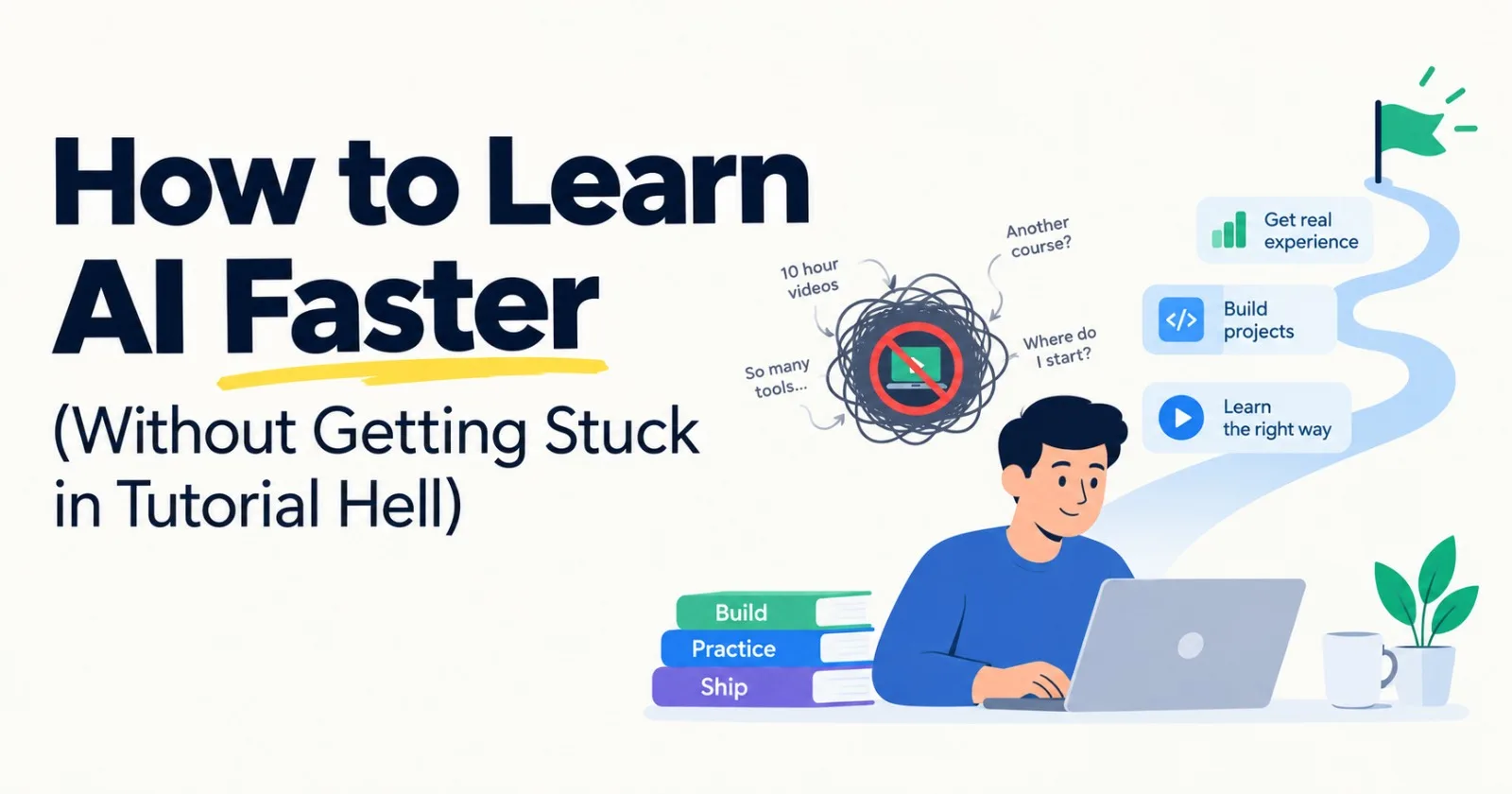
Most people don't give up on AI because it's too hard. They give up because they got stuck in something I'll call tutorial hell, and they never noticed.
Here's how it goes. You watch a six-hour course. Everything makes sense while the instructor types. You nod along, you feel smart, you finish the last video. Then you open a blank file and can't write a single line.
If that sounds familiar, good news: it's fixable, and this post is how.
Why tutorial hell happens
Watching someone do something and doing it yourself use different parts of your brain. When you watch, you recognize. When you build, you recall, and recall is the thing you need on the job. Recognizing the answer is easy. Producing it from nothing is hard, and that hard feeling is exactly what makes you learn.
So the rule for this whole series is simple: if it feels a little uncomfortable, it's working.
1. Build something every week
After every post, make something small that isn't the example in the post. Change one thing about it.
The post builds a token counter? You build one that also tells you the cost. The post calls an API to summarize text? You point it at your own notes. The goal is not a great project. The goal is making decisions that nobody made for you.
Keep it small enough to finish in a few hours. A finished ugly project beats a beautiful one that's never done.
2. Type the code, don't paste it
When you copy and paste, your hands move but your brain checks out. Type it, even when it feels slow. You'll make typos, and fixing those typos teaches you more than you'd think.
And when you hit a bug, give yourself about 20 minutes to fight it before asking for help. That struggle is where the learning lives. After 20 minutes with no progress, ask. Don't suffer for hours.
3. Use AI as a tutor, not a ghostwriter
This one matters a lot, since you're learning to build AI and you also have AI to help you learn. It's an incredible tutor. It's also an easy way to fool yourself into thinking you learned something.
Good ways to use it:
"Quiz me on Python generators, one question at a time. Don't give me the answer until I've tried."
"Here's my code. Don't fix it. Just tell me which part to look at."
"Explain this like I'm new to it. Then give me one harder follow-up question."
"Here's how I understand it. Where am I wrong?"
Not so good ways:
Asking it to write the whole project, then pasting the result.
Accepting an answer you don't understand, just because it sounds confident.
Two more things to keep in mind. First, AI can be confidently wrong. This happens most with new library versions and fast-changing tools, which is a lot of what we'll use. So always run the code, and check the official docs when something matters. Second, here's a simple test of whether you learned or just copied: tomorrow, can you rebuild it with nothing open? If yes, you learned it. If not, go back.
4. Explain it back
After you learn something, try to explain it in your own words, out loud or in writing, as if to a friend who knows nothing about it. Anywhere you stumble is a gap in your understanding, and now you know where to look.
It sounds too simple to be useful. It's one of the most reliable tricks there is.
5. Build in public
This sounds scarier than it is. It doesn't mean going viral. It means leaving a trail.
Push your code to GitHub as you go.
Write one short note a week about what you learned or what broke.
Share it somewhere: a blog, LinkedIn, a dev community, even a private repo at first.
You don't need an audience. Having anyone in mind, even an imaginary reader, makes you finish things and explain them clearly. And down the line, that trail becomes your portfolio. A hiring manager scrolling through a year of honest weekly notes learns more about you than any resume could show them.
A great post doesn't have to be impressive. "Week 6: I wrote my first async script, it broke in three different ways, here's what I learned" is a perfectly good post.
6. Keep a bug diary
Every time something breaks, write down three lines: what happened, what caused it, how you fixed it. In a few months you'll have a personal handbook of the exact mistakes you tend to make. You'll also notice you're making fewer of them, which is a nice thing to see on paper.
7. Review a little, often
Memory fades. That's normal, not a sign you're bad at this. Once a week, spend 15 minutes looking back at something from a few weeks ago. Re-read your notes, redo a small exercise, or have an AI tutor quiz you. Seeing something again right when you're about to forget it is what makes it stick.
Common mistakes
Collecting courses. Bookmarking five more courses feels like progress. It isn't. Pick one resource per topic and finish it.
Switching tools constantly. A new framework appears every week. Ignore most of them while you learn the basics.
Waiting until you feel ready. You won't feel ready. Start before you do.
Comparing yourself to people online. You're seeing their best moments, at their current level, after years of work you can't see.
Avoiding the math completely. It's less scary than it looks, and we'll take it slowly in Phase 2.
Marathon weekends followed by silence. Regular beats intense.
What "faster" really means
It doesn't mean cramming. It means wasting less time: less time watching without doing, less time stuck alone, less time re-learning things you forgot. A steady five hours a week beats twenty hours once a month, every time.
Try this today (20 minutes)
Create a GitHub account if you don't have one.
Make a new repository called
ai-engineer-journey.Add a README with your start date, your goal, and the weekly study slots you picked in the last post.
Make your first commit.
You've now started building in public, and you did it before writing a single line of code. The streak starts today.
Previous: Post 2, The 12-Month Roadmap
Next in the series: Post 4, Python Fundamentals, where we start writing real code.
Comments(0)
Join the discussion by logging into your account.
No comments yet. Be the first to comment!