79 posts in two tracks. The Programming Track (Phase 1) is deep and optional for experienced developers. The AI Track (Phases 2 to 9) is the core.
Tags used in Phase 1: (core) = everyone reads it, (skippable) = skip if you already know it, (optional) = nice to have.
Phase 0: Orientation
What Is an AI Engineer in 2026? AI engineer vs ML engineer vs data scientist vs research scientist
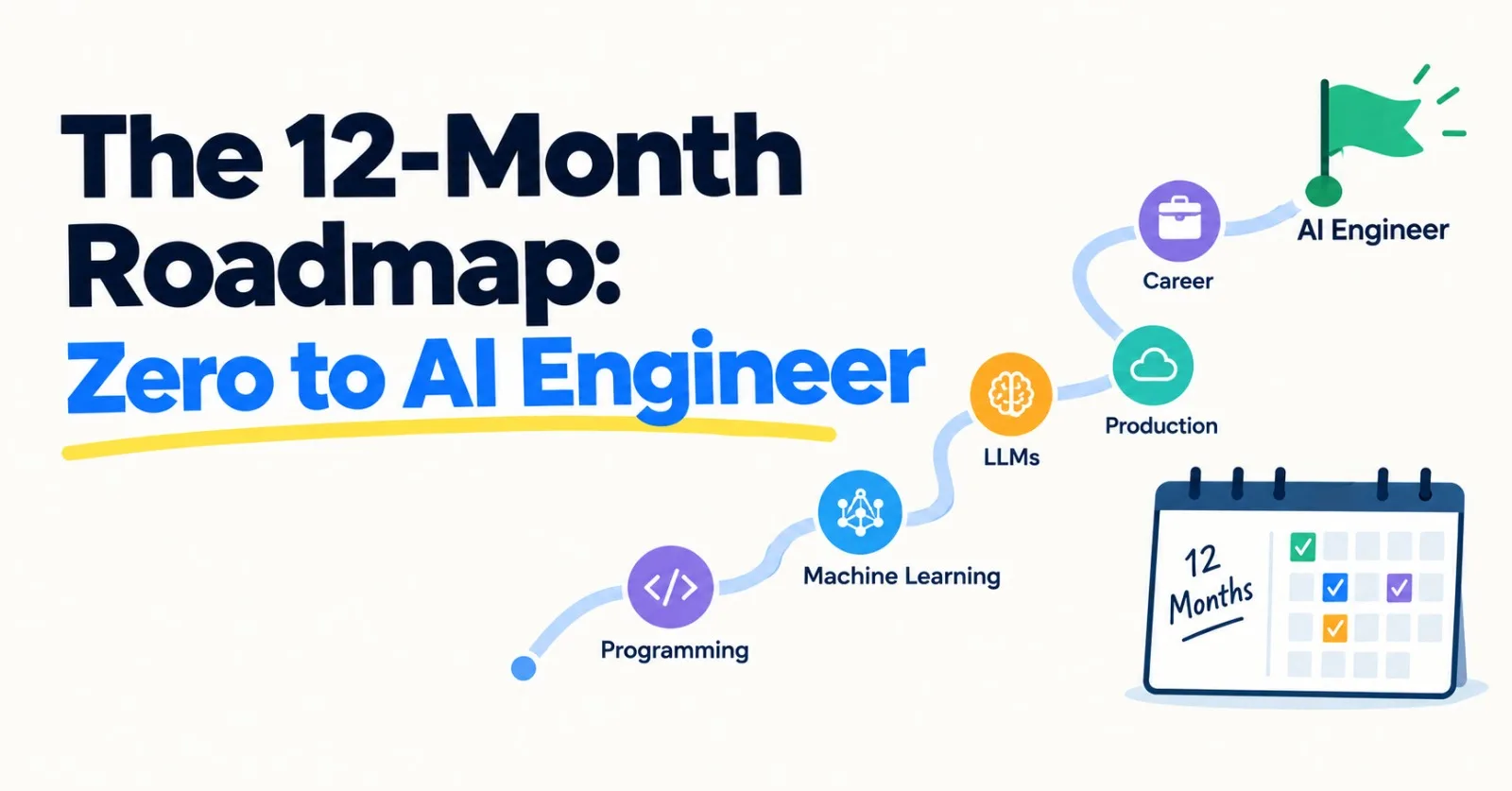
The 12-Month Roadmap: the whole series at a glance, with reading paths and a week-by-week plan
How to Learn AI Faster: using AI as a tutor, building in public, avoiding tutorial hell
Phase 1: Programming in Depth
Track A: Python, Properly
Python Fundamentals: variables, types, control flow, how Python executes code (skippable)
Built-in Data Structures: lists, dicts, sets, tuples, and their time complexity (skippable)
Functions in Depth: scope, closures,
*args/**kwargs, lambdas, higher-order functions (core)Iterators, Generators & Comprehensions: the backbone of data pipelines and streaming LLM output (core)
Decorators & Context Managers: how FastAPI and PyTorch use them (core)
OOP the Practical Way: classes, dataclasses, composition vs inheritance, protocols (core)
Type Hints & Pydantic: why modern AI code is typed, and how structured outputs depend on it (core)
Errors, Logging & Debugging: exceptions, retries, pdb, reading stack traces (core)
Packaging & Environments: modules,
pyproject.toml, uv/pip (core)Testing with pytest: fixtures, mocking LLM calls, property-based testing (core)
Concurrency: threads vs processes vs
asyncio, the GIL, and why LLM apps are async-heavy (core)Performance & Memory: profiling, vectorization, how Python manages memory (core)
Track B: Computer Science Fundamentals
Data Structures for AI Engineers: arrays, hash maps, trees, graphs, heaps (skippable)
Algorithms You'll Actually Use: sorting, searching, recursion, dynamic programming, top-k, beam search (skippable)
Big-O Without the Fear: why complexity matters for vector search and batching (core)
How Computers Work: CPU vs GPU, memory hierarchy, processes, OS basics (core)
Networking & the Web: HTTP, REST, WebSockets, Server-Sent Events (how streaming works) (core)
Databases in Depth: SQL, indexes, transactions, Postgres, and when NoSQL makes sense (core)
Track C: Engineering Craft
Git & GitHub Workflows: branching, PRs, code review (core)
Linux, Shell & Docker: the daily toolkit (core)
Clean Code & Design Patterns: readability, refactoring, SOLID without the dogma (core)
TypeScript for AI Engineers: most AI products have a web frontend, and many agent SDKs are TypeScript-first (core)
Intro to C++/Rust: only what you need to read performance-critical AI code (optional)
Phase 1 Projects
Mini Project 1: a CLI tool, such as a markdown note searcher
Mini Project 2: a REST API with tests, Docker, and CI
Capstone: a small Python library published on PyPI
30-Day DSA Practice Plan: and an honest take on how much LeetCode you actually need
Phase 2: Math & Data for AI
Linear Algebra with Intuition: vectors, matrices, dot products, and why embeddings work
Calculus & Gradients: derivatives, the chain rule, gradient descent
Probability & Statistics: distributions, Bayes, expectation, and why loss functions look the way they do
NumPy in Depth: broadcasting, vectorization, memory layout
Pandas & Polars: cleaning, joins, group-bys, and when to pick which
EDA & Data Visualization: Matplotlib and plotting that answers questions
Project: an end-to-end data analysis notebook published on GitHub
Phase 3: Machine Learning & Deep Learning
Classical ML in a Weekend: scikit-learn, regression, trees, cross-validation, metrics
Neural Networks from Scratch: backprop in pure NumPy
PyTorch Crash Course: tensors, autograd, training loops
Why Your Model Isn't Learning: a debugging checklist for overfitting, bad data, and learning rates
Project: an image or text classifier, trained and evaluated
Phase 4: Transformers & LLMs Under the Hood
Tokenization Explained: build a BPE tokenizer
Attention, Line by Line: implement self-attention yourself
Build a Mini-GPT from Scratch: a nanoGPT-style walkthrough
How LLMs Are Trained: pretraining, SFT, preference tuning (RLHF/DPO), RL with verifiable rewards
Reasoning Models & Test-Time Compute: what changed and why it matters
KV Cache, Context Windows, and MoE: the concepts behind inference behavior
Phase 5: Building with LLMs (the core of the job)
Your First LLM App: API calls, streaming, structured outputs
From Prompt Engineering to Context Engineering
Tool Use & Function Calling
Embeddings & Vector Search: how they work, not just which database to pick
RAG from Scratch
Advanced RAG: chunking, hybrid search, reranking
Build an Agent Loop Without a Framework
MCP Explained: build your own MCP server
Agent Memory & Multi-Agent Systems: when they help and when they're overkill
Voice & Multimodal Apps: vision, speech, real-time
Project: a deployed RAG or agent app with a public demo
Phase 6: Evaluation, Safety & Reliability
Evals: The Most Underrated AI Engineering Skill: build a test set, track regressions
LLM-as-Judge: where it works, where it lies
Observability & Tracing for AI Apps
Prompt Injection & Security: guardrails, sandboxing, least-privilege agents
Phase 7: Customizing Models
Prompt vs RAG vs Fine-Tune: a decision framework
Fine-Tune an Open Model with LoRA/QLoRA (hands-on)
Synthetic Data & Distillation: getting small models to punch above their weight
Intro to RL Fine-Tuning for Reasoning and Agents
Phase 8: Production & Scale
Shipping LLM Apps: FastAPI, queues, caching, rate limits, cost control
Inference Optimization: quantization, batching, vLLM, speculative decoding
GPU & CUDA Basics for AI Engineers: what to know without becoming a kernel engineer
Cloud, Kubernetes & CI/CD for AI: versioning prompts, models, and evals
Phase 9: Career & Becoming Top-Tier
10 Portfolio Projects That Actually Get You Hired
Resume, GitHub & LinkedIn for AI Engineers
AI Engineering Interviews: coding, ML fundamentals, and AI system design
How to Read Research Papers and reproduce one
Contributing to Open Source: your first PR to an AI library
Choosing a Specialization: agents, evals, inference infra, applied research, AI safety
Junior to Senior to Staff: tradeoff thinking, product sense, and owning ambiguity
Staying Current Without Burning Out: a sustainable weekly learning routine
Reading Paths
(for post 2)
Reader | Path |
|---|---|
Complete beginner | Posts 1 to 79, in order |
Can already code | Posts 1 to 3, skim 10, 13, and 14, then jump to 31 |
Already knows ML | Posts 1 to 3, skim 11 and 14, then jump to 43 or 49 |
Extras
Standalone bonus posts: "AI Engineer Salary & Job Market Report," "Best Free Resources Ranked," "Mistakes I Made Learning AI," "Open vs Closed Models: How to Choose."
Post template: the problem, the concept, the code, a mini-project, and a "next in series" link. This helps SEO and keeps readers moving.
Freshness: teach concepts first, and keep tool-specific posts (49 to 56, 68, 69) clearly dated and easy to update, since tools and model names change every few months.
 Pradeep Kumar