
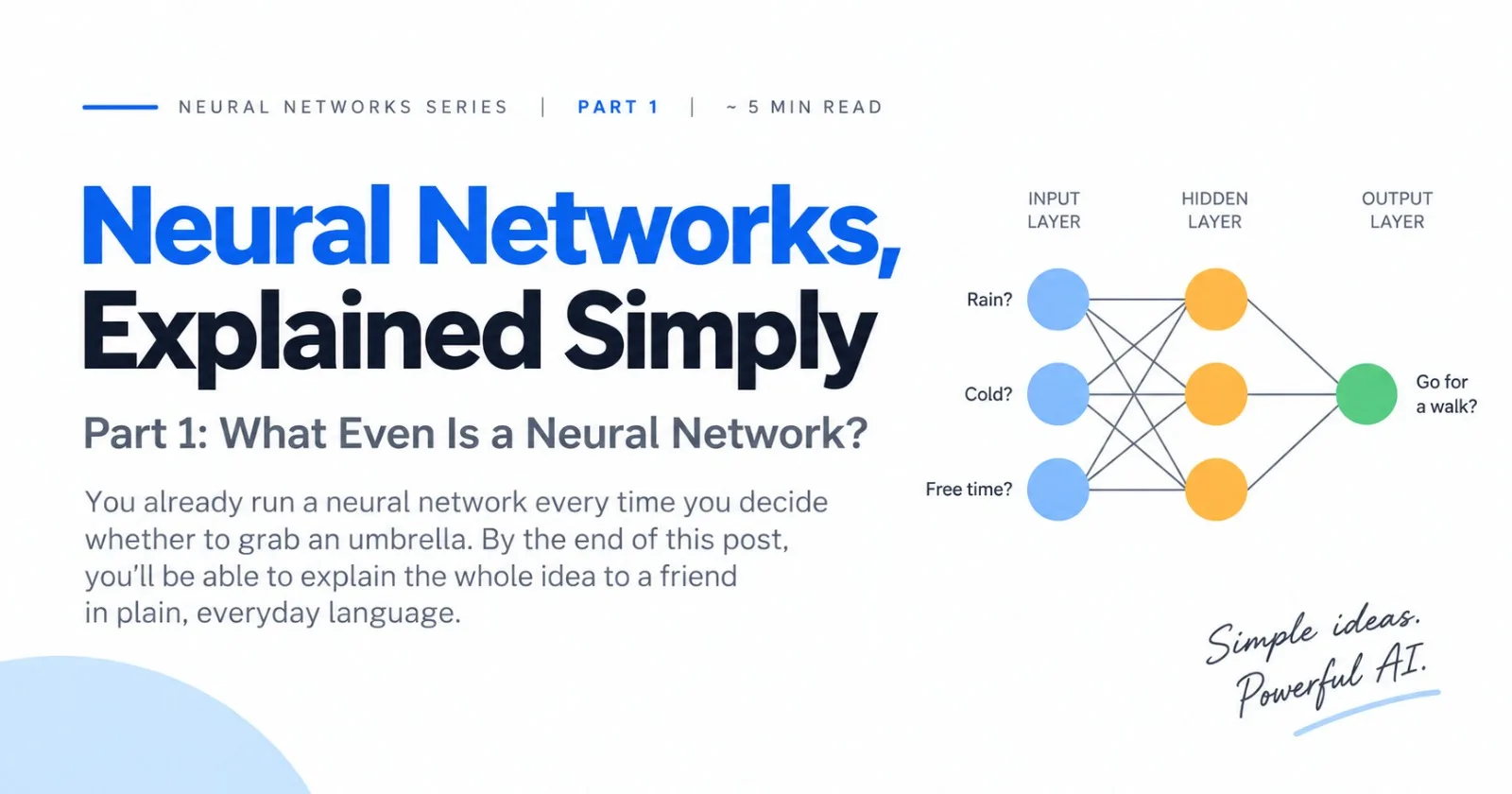
Neural Network Series · Part 1 · ~5 min read
You already run a neural network every time you decide whether to grab an umbrella. By the end of this post, you'll see exactly how — and be able to explain the whole idea to a friend in plain, everyday language.
TL;DR: Picture a tiny voting system — each input gets a say, some inputs count more than others, and if the votes add up high enough, the answer is yes. A neural network is just thousands of these tiny voters connected together.
The problem neural networks solve
Say you want a computer to tell a cat photo from a dog photo. Easy for you — you just look. But writing that as strict rules is a nightmare: cats have pointy ears, but so do some dogs; cats are small, but Chihuahuas exist. Every rule has an exception.
Neural networks exist for exactly this kind of fuzzy problem. Instead of hand-writing rules, we show the computer thousands of examples and let it work out the pattern itself.
Start with one decision, not a whole brain
Forget "network" for a second. Let's build the smallest piece: a single artificial neuron.
Here's a decision you make all the time: should I go for a walk today? Some things matter more to you than others — rain might cancel your walk instantly, but "a little cold" alone won't stop you. In other words, some factors carry more weight than others.
Score each factor 1 (yes) or 0 (no), and give each a weight for how much it matters:
Factor | Value | Weight |
|---|---|---|
Not raining | 1 | × 3 |
Not too cold | 1 | × 1 |
Have free time | 0 | × 2 |
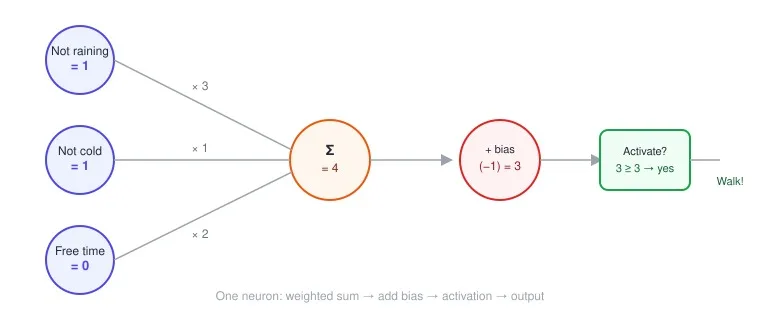
Multiply and add: (1×3) + (1×1) + (0×2) = 4.
One more ingredient: bias. Real neurons also add a fixed number before deciding — think of it as personal tendency, added no matter what the weather's doing (some people need less convincing to skip a walk than others). Say our bias is −1: 4 + (−1) = 3.
Now the neuron compares that total to a threshold — this comparison step is called activation. If the rule is "3 or higher means go," then 3 ≥ 3 fires: go for a walk.
That's the whole trick:
weighted sum → add bias → compare to a threshold → decision
(One simplification worth flagging: real networks usually swap the hard yes/no cutoff for something smoother that allows a range of outputs, not just on/off. Same job either way — turning a raw number into a signal the next layer can use — we'll dig into exactly how later in the series.)
Every neuron in every neural network — spam filters, image recognizers, ChatGPT-style models — is a version of this same move, repeated millions of times.
From one neuron to a network
A neural network is many neurons connected in layers, where one neuron's output feeds the next layer's input:
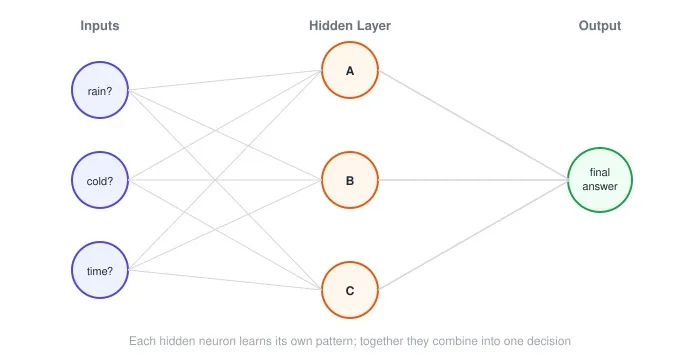
Each hidden neuron learns to notice a different pattern — maybe one becomes sensitive to "rain," another to "weekends," another to a combination no human would think to program directly. Stack enough layers, and the network captures genuinely complex patterns, like the difference between a cat and a dog photo.
Where do the weights come from?
Great question — it's the whole subject of Part 2. Short preview: the network starts with random, bad weights and improves a little every time it's shown an example and corrected. That process is training, which is why neural networks need so much data: they're not programmed, they're practiced into being good.
Quick recap
A neuron multiplies each input by a weight, adds them up, adds a bias, then checks the result against a threshold (activation).
A neural network is layers of neurons, so simple decisions combine into complex ones.
Weights and biases aren't hand-coded — they're learned through training (next post).
Try it yourself
Let's run one more example together — this time, you plug in the numbers.
Decision: Should I order coffee right now?
Factor | Your value (1 or 0) | Weight |
|---|---|---|
Feeling tired | ? | × 3 |
It's before noon | ? | × 1 |
Already had one today | ? | × −2 |
Bias: −1. Threshold: 2 (2 or higher = order it).
One new wrinkle: that last weight is negative. If "already had one today" = 1, that piece works out to 1 × −2 = −2 — instead of adding to the total, it subtracts, pulling the decision toward "no." That's how a network can end up saying no just as easily as it says yes.
Now try it with your own 1s and 0s: do the math (weighted sum + bias) and check it against the threshold.
Next up: How Neural Networks Actually Learn — where we open up training and demystify backpropagation. Follow along so you don't miss it.
Comments (0)
Login to post a comment.