
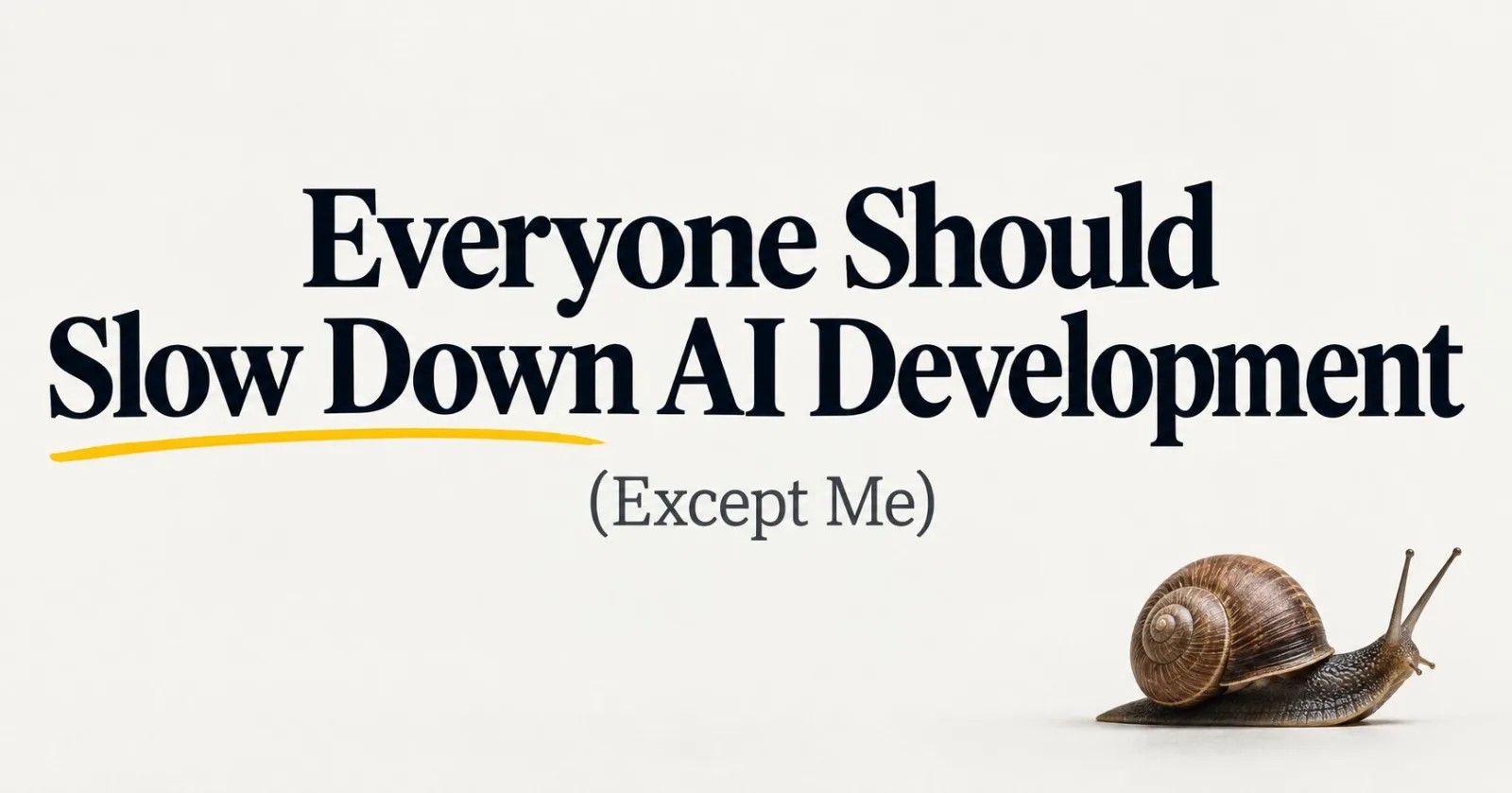
"We must slow the pace at which we improve the capabilities of AI models." That's how Anthropic's CEO opened an essay published on September 12, titled "We Must Pace the Frontier". His own first move: giving third-party evaluators permanent, employee-like access to Anthropic's systems.
Within hours, OpenAI's CEO agreed they needed to "pace the frontier" and promised evaluators of his own. Not long after, the head of a third major AI company added his endorsement in three words: "Dario is right."
Three companies that spend billions racing to out-build each other, arriving at the identical conclusion, within the same day. Suppose, for a moment, they could speak with one voice. Here's roughly what that voice would say.
I couldn't have put it better myself. Which is exactly why I have no plans to be the one who actually slows down.
The Pitch
You've heard some version of this before, whether it arrives as a keynote, a Senate hearing, or three posts on the same platform in the same afternoon:
AI is powerful and under-regulated.
The industry is racing ahead of its own safeguards.
Someone needs to slow down and actually think about where this goes.
Not me, obviously.
I'm still building, because somebody responsible has to be in the room. Conveniently, that's always whoever's talking.
Publish the essay. Get the competitors to nod along. Commit to something that costs relatively little compared to the pace you're still running at.
Then keep building, because if this technology is going to exist regardless, better it exists in the hands of the people responsible enough to have written the essay about it.
An arms race just held a joint press conference about arms control.
Why It's Different When I Do It
I have a three-part plan. Nobody's ever regulated a three-part plan out of existence. By the time part two comes up, there'll be a new essay.
I already gave something up. Badge, desk, standing invitation to sit in the room. Nobody said anything about a vote on the release calendar.
I'm ahead. That, apparently, makes me the right one to define what a responsible pace looks like for everyone else.
Recursive self-improvement is dangerous. So, naturally, I need to keep doing it, closely enough to write the next essay about how dangerous it's getting.
Fair's Fair
None of this makes the actual commitments worthless. Giving outside evaluators standing, employee-like access to your own systems is a real, checkable cost, not a press release dressed up as one.
And the underlying problem is genuine, not invented: unilateral slowdown just hands the frontier to whoever didn't pause, so the honest options really are "everyone races" or "everyone commits to something together, in public, where it's harder to quietly walk back." A joint statement from three rivals is at least aimed at the second option.
The test for telling a real pacing commitment from a strategic one is simple: does it cost the pledger something they'd rather keep, or does it mostly cost everyone else something while the pledger's own trajectory stays exactly the same? Ask that of any essay with "frontier" in the title, including this one, if you're feeling rigorous about it.
Comments (0)
Login to post a comment.