


Pearson used to be the sort of company that could make a corporate history lesson feel like a pub quiz.
At different points it owned the Financial Times, half of The Economist, Penguin Books, Madame Tussauds, a vineyard in Bordeaux and a stake in Lazard. Today, it describes itself much more simply: a learning company.
Getting from one version to the other was not simple at all.
Pearson spent years selling businesses, restructuring operations and moving away from printed textbooks towards digital courseware, assessments and online learning. For a long time, investors were asked to be patient while the company rebuilt itself. Digital transformation is always described as exciting in presentations. In practice, it often means a decade of reorganisations and several PowerPoint slides containing the word journey.
The latest numbers suggest Pearson may finally be reaching the useful part of that journey.
The immediate news was that Tom ap Simon, Pearson's President of Higher Education and Virtual Learning, sold 119,624 American Depositary Receipts on 10 August 2026. The transactions were completed on the New York Stock Exchange at prices between $16.33 and $16.40, producing an aggregate value of $1,955,217.38.
That is a large sale, obviously. It also arrived after Pearson's shares had risen by almost 20% during the year, according to the Financial Times.
But the sale is not the most interesting part of the story.
The interesting part is why the shares had performed so well in the first place.
The sale tells us less than the headline suggests
Executive transactions attract attention because they look like access to private conviction. If someone close to the business sells nearly $2 million of stock, the natural reaction is to wonder what they know.
That reaction is understandable, but it can become lazy analysis very quickly.
The regulatory disclosure tells us how many ADRs Tom ap Simon sold, the price range, the date and the venue. It does not explain his reason for selling. Executives sell shares for all kinds of ordinary reasons: diversification, taxes, personal spending, estate planning or simply because a trading window is open.
Without knowing the size of his remaining holding or the personal reason behind the transaction, one sale cannot honestly be treated as a secret forecast for Pearson's future.
The timing was favourable. That is fair to say. Anything beyond that would be guesswork wearing a tie.
It is also worth keeping the scale in perspective. Pearson completed a £350 million share buyback during the first half of 2026 at an average price of 998p per share. The company was returning a substantial amount of capital to shareholders while one executive sold a much smaller personal position. Those two facts can coexist without creating a corporate conspiracy.
So I would not ignore the transaction, but I would not build the entire investment case around it either.
The numbers behind Pearson's recovery
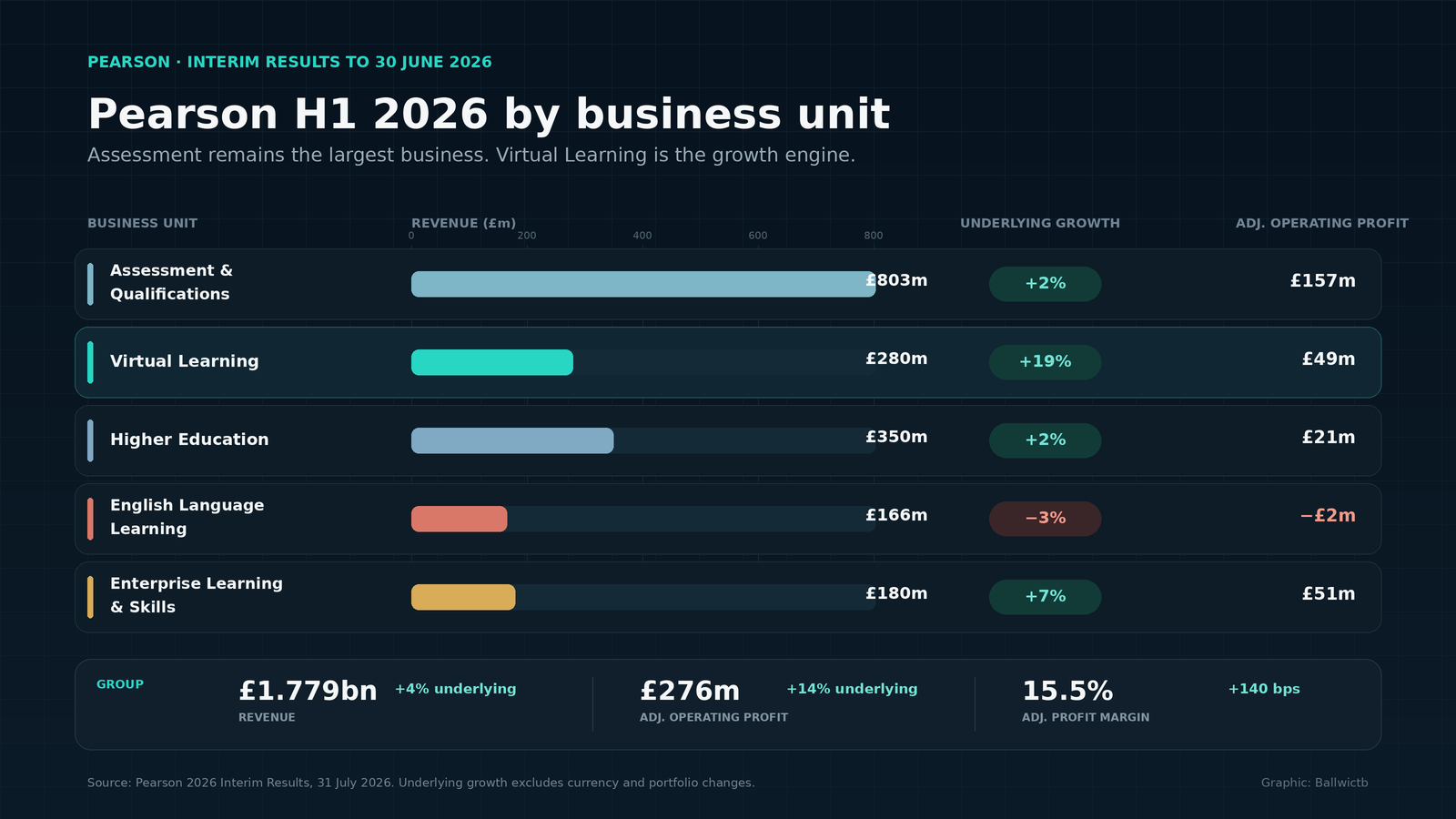
Pearson reported £1.779 billion in revenue for the first half of 2026, representing underlying growth of 4%. Adjusted operating profit increased 14% to £276 million, while the adjusted margin expanded by 140 basis points to 15.5%.
That relationship matters. Revenue grew, but profit grew much faster.
This is what a successful transformation is supposed to produce eventually: not simply more digital products, but a business capable of serving additional customers without its cost base rising at the same speed.
The performance was not equal across every division.
Business unit | H1 2026 revenue | Underlying revenue growth | Adjusted operating profit | Underlying profit growth |
|---|---|---|---|---|
Assessment & Qualifications | £803m | +2% | £157m | -6% |
Virtual Learning | £280m | +19% | £49m | +31% |
Higher Education | £350m | +2% | £21m | Not meaningful* |
English Language Learning | £166m | -3% | -£2m | Not meaningful* |
Enterprise Learning & Skills | £180m | +7% | £51m | +18% |
Group total | £1.779bn | +4% | £276m | +14% |
*Higher Education moved from a £3 million adjusted operating loss to a £21 million profit. English Language Learning reduced its loss from £7 million to £2 million. Pearson therefore reports those growth percentages as not meaningful.
Underlying growth removes currency movements and portfolio changes, so it is useful for seeing how the operating businesses themselves changed. The actual reported revenue increase was 3%.
Free cash flow also rose from £156 million to £259 million, although Pearson noted that some working-capital timing benefits should reverse during the second half. That caveat matters because exceptionally strong half-year cash generation is less exciting if part of it is simply money arriving earlier than usual.
Virtual Learning is doing the heavy lifting
The standout division was Virtual Learning.
Its underlying revenue increased 19% to £280 million, while adjusted operating profit rose 31% to £49 million. Enrolment growth accelerated to 15% during the spring semester, Pearson renewed all ten of its long-term contracts and expects five new schools to take its network to 46 schools across 32 US states for the 2026/27 academic year.
Those figures are more useful than a generic claim that digital learning is growing.
They show three things happening together:
More students are enrolling.
Existing institutional customers are renewing.
Profit is growing faster than revenue.
That third point is the one I would watch most closely. Virtual schools require teaching support, technology, curriculum, regulatory compliance and local operating relationships. They are not a downloadable PDF with a login screen. If Pearson can add enrolments while improving margins, the division becomes evidence that the company has built something operationally difficult to copy.
The word digital is no longer the selling point by itself. Nearly everything is digital now. The advantage has to come from the system around it: distribution, recognised content, school relationships, assessments, outcomes and trust.
AI is both the threat and the sales pitch
Pearson has an awkward relationship with artificial intelligence, which makes its strategy more interesting.
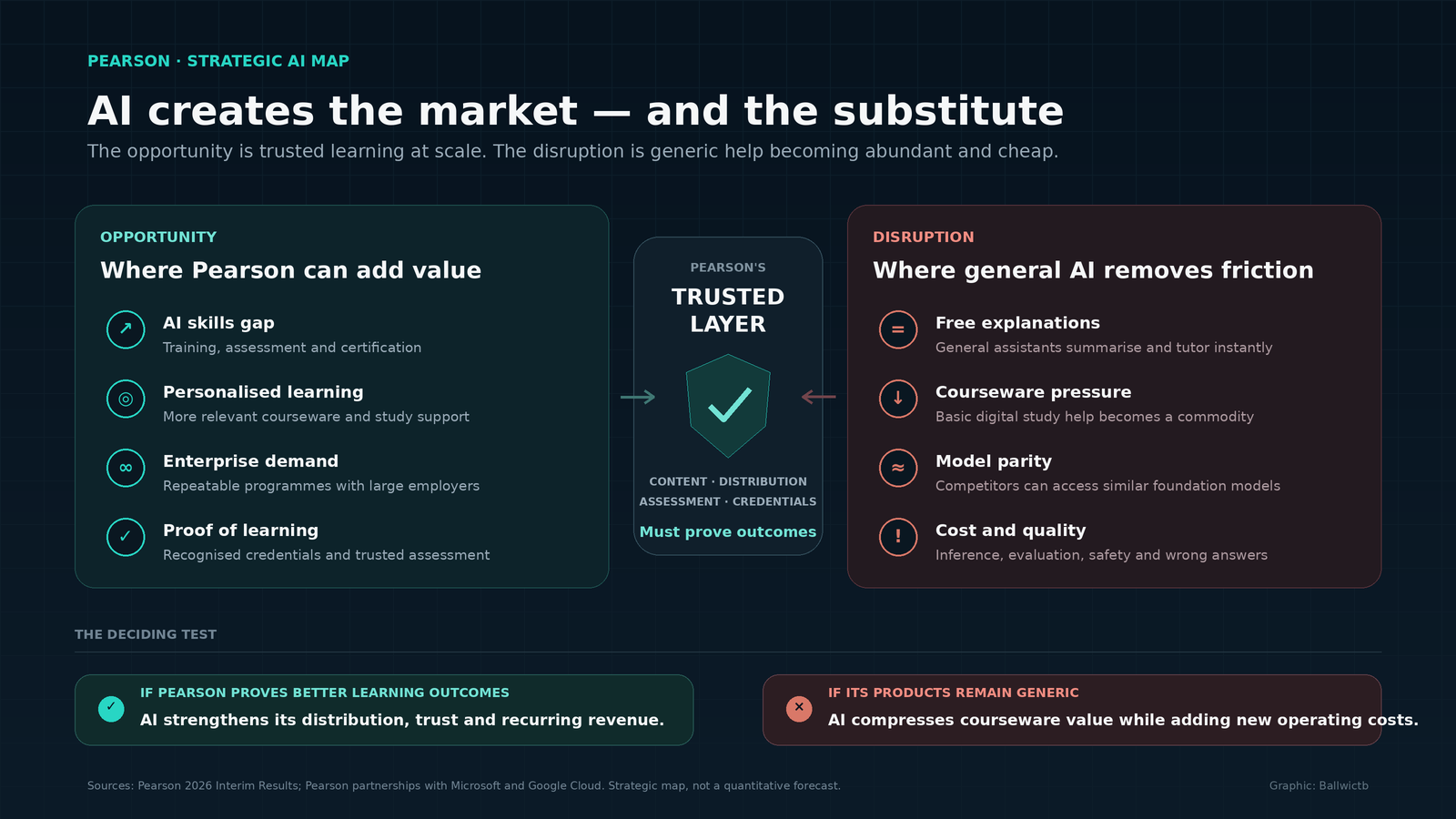
Generic AI can explain a difficult concept, summarise a chapter, generate practice questions and help a student prepare for an exam. Those are activities for which education companies have traditionally charged money.
If a learner can open a general-purpose assistant and receive a good-enough explanation in seconds, some parts of conventional digital courseware become easier to replace. Pearson cannot protect an old product merely by placing a chatbot next to it. Nobody needs another chatbot wearing a university lanyard.
At the same time, AI creates demand for exactly the things Pearson already knows how to provide:
Structured learning programmes
Trusted assessments
Professional certifications
Skills diagnostics
Institution-ready content
Evidence that somebody has actually learned something
This gives Pearson two possible AI businesses.
The first is AI inside education products. Pearson says its study tools are increasing engagement and supporting revenue, particularly in Higher Education. Its partnership with Google Cloud is intended to develop more personalised tools for students and educators, while its Microsoft agreement combines Pearson's learning and assessment services with Azure and Microsoft's AI ecosystem.
The second is education about AI. Companies are buying software faster than their employees are learning how to use it. Pearson can sell training, assessment and credentials into that gap. The company has reported enterprise AI-skilling work involving Microsoft, Amazon Web Services and Google Cloud, alongside a new global certification agreement with a leading AI laboratory.
That second opportunity may be less glamorous than building a frontier model, but it could be a better fit for Pearson.
The model companies sell capability. Pearson can sell the proof that a person knows what to do with it.
Pearson's moat is trust, not the model
The worst version of an education AI strategy is easy to imagine.
A company takes the same general model everybody else can access, adds a branded interface, calls it a tutor and produces a launch video involving a suspiciously enthusiastic student.
That is not a durable advantage.
Pearson's stronger position is not that it can create text with AI. So can thousands of developers. Its position comes from the material surrounding the model:
Content mapped to specific courses and qualifications
Relationships with schools, universities and employers
Assessment infrastructure
Regulatory and accreditation experience
Large sets of learning interactions and outcome data
Credentials that institutions already recognise
In education, a fluent answer is not automatically a correct answer, and a correct answer is not proof that learning happened.
Pearson needs to demonstrate that its tools improve understanding, completion, retention or exam performance. Engagement is useful, but engagement alone is a slippery metric. A student can be deeply engaged with an AI tool that is confidently teaching nonsense.
The company therefore has to compete on measurable learning outcomes, not on how quickly it can add the latest model to a product page.
If it succeeds, AI strengthens Pearson's existing distribution and trust. If it fails, generic tools could reduce the value of some of its content while Pearson absorbs the extra development cost.
That is the real AI bet.
Not every division is celebrating
The group results were good, but they were not clean enough to justify pretending every part of Pearson is now a growth machine.
Assessment & Qualifications, still the largest division, recorded underlying revenue growth of 2% but adjusted operating profit fell 6%. The business returned to revenue growth in the second quarter, although the loss of a New Jersey student-assessment contract continued to affect the comparison.
English Language Learning revenue declined 3%. Institutional sales grew, but weaker demand for the Pearson Test of English pulled the division backwards. Immigration rules and international student movement can directly affect demand for English testing, which means this part of Pearson is exposed to political decisions it cannot control.
Higher Education delivered only 2% underlying revenue growth, although the improvement from a £3 million loss to a £21 million adjusted operating profit was significant. Pearson's Inclusive Access model - where course materials are distributed digitally through institutions - grew 20% and now represents half of its core US Courseware business.
That distribution model is important, but it also sits close to the part of education most exposed to general AI. Students will still need structured courses and recognised materials. They may be less willing to pay for basic explanations, summaries and study assistance that can be generated elsewhere.
Pearson is growing, but it is also replacing vulnerable revenue while it grows. Those are not the same job.
What I would watch next
Pearson reiterated its 2026 guidance for mid-single-digit underlying revenue growth, adjusted operating profit between £640 million and £685 million, and free-cash-flow conversion of 90% to 100%.
The guidance is useful, but the next phase should be judged using more specific questions.
Does Virtual Learning keep its operating leverage?
Nineteen per cent revenue growth is strong. Thirty-one per cent profit growth is better. The test is whether that relationship survives as new schools open and the business has to support more students.
Do the AI partnerships produce recurring revenue?
Partnership announcements are easy to publish. The important distinction is whether Pearson earns repeatable revenue from certifications, subscriptions and enterprise programmes, or mostly collects short-term implementation fees.
Can Pearson prove better learning outcomes?
The strongest defence against generic AI is evidence. If Pearson can show that students using its tools learn more effectively, complete more work or achieve better results, it has something more valuable than a model wrapper.
Can the weaker divisions stabilise?
Virtual Learning should not have to hide permanent weakness elsewhere. Assessment margins, English testing demand and international Higher Education all deserve attention.
Does AI improve margins after its costs are included?
AI features require inference, data work, evaluation, safety controls and continuous development. Revenue attributed to AI sounds impressive, but the useful number is the profit left after operating the system.
A better transformation story than the headline
The executive share sale is a clean headline because it has a person, a date and a large number attached to it.
Pearson's transformation is messier.
The company spent years moving from a collection of famous assets and printed products towards a focused learning platform. It now has a fast-growing virtual-school business, improving group margins, digital distribution at scale and a plausible way to earn money from the AI-skilling boom.
It also has divisions growing slowly, an English testing business facing difficult market conditions and products that general AI may make less valuable.
That mixture is exactly why the company is worth watching.
Pearson does not need to win the race to build the smartest model. It needs to own the trusted layer between models, institutions, employers and learners. It needs to turn AI capability into structured learning and then prove that the learning worked.
The first half of 2026 suggests the old digital transformation is finally producing financial results. The next question is whether Pearson can complete a second transformation before AI changes the market underneath it again.
No pressure, then.
Sources
This article is an analysis of Pearson's business and public disclosures. It is not financial advice or a recommendation to buy or sell shares.
If it annoys you twice, turn it into a tool.
See you in the next build.
Ballwictb
Comments(2)
Join the discussion by logging into your account.
Igor Ganapolsky
The "prove the learning worked" line is the part with real engineering behind it. If you're building that layer, the hard problem isn't content delivery, it's evidence you can defend later: store each assessment attempt as an immutable event (prompt version, item bank version, rubric version, learner response, grader output) rather than only the final score, and make the credential point at that event id. Otherwise the first time an employer or accreditor asks "what exactly did this person demonstrate in March," you're reconstructing it from a score column that has since been re-scaled. Same reason a rubric change should bump a version and re-score a sample rather than silently overwrite history — that's what makes the trusted-layer claim auditable instead of just branding.