
For most of the AI boom, every major model launch followed roughly the same script.
The new model was smarter. It scored higher on a collection of benchmarks. It had a larger context window, better reasoning, stronger coding, or some new ability that apparently changed everything before lunch.
The price was usually a footnote.
That script is beginning to break.
I recently read a Financial Times report about OpenAI and Anthropic cutting prices while Chinese competitors such as DeepSeek and Moonshot gain ground. My first reaction was not surprise that AI was becoming cheaper. It was surprise that it took this long for price to become one of the main battlegrounds.
Because once companies move from experimenting with AI to running it across real products, customer support, coding workflows, document processing, and internal automation, a model is no longer just a clever demo.
It is a bill.
And bills have a wonderful ability to make everyone suddenly care about efficiency.
The numbers are no longer a footnote
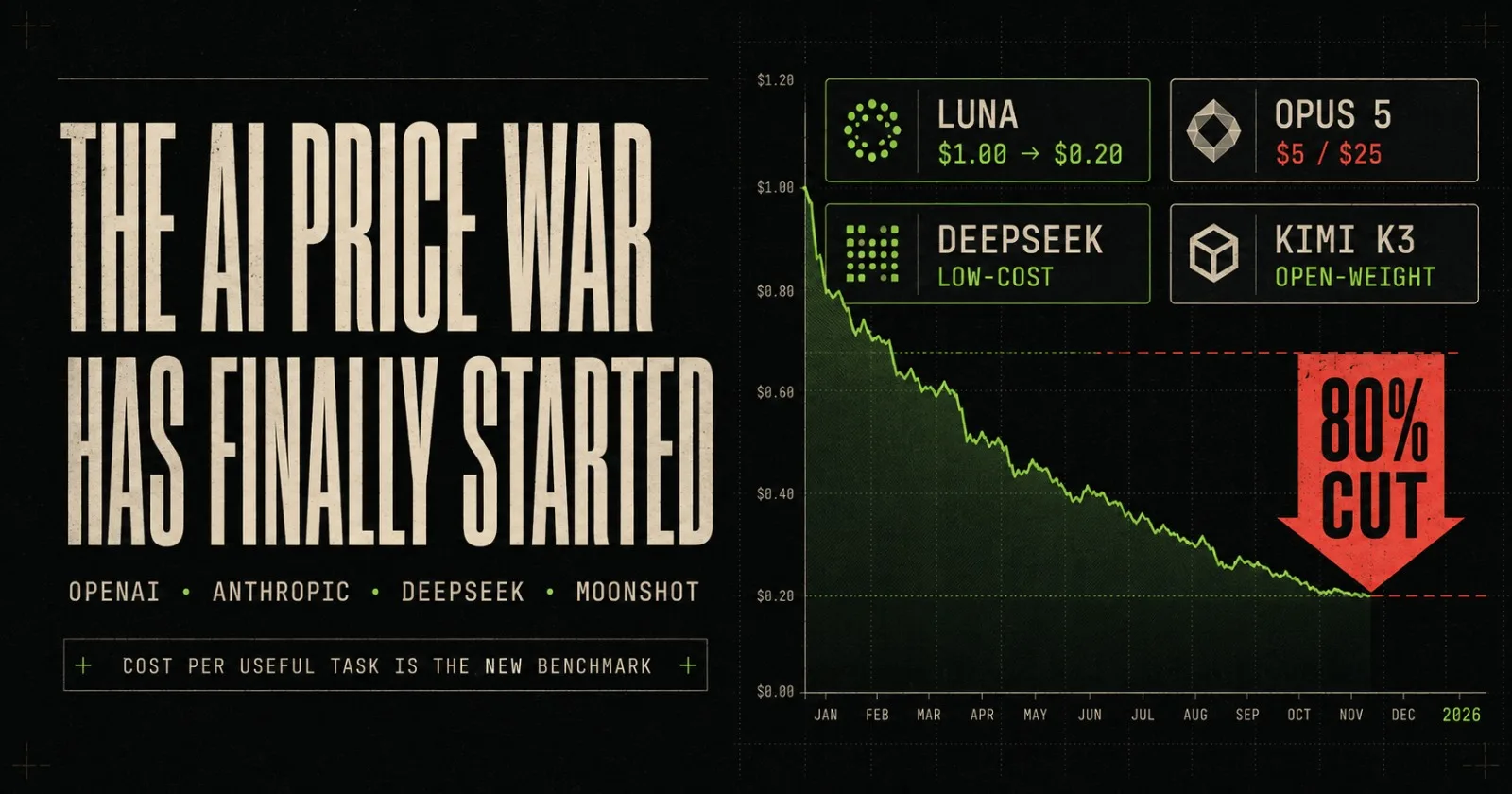
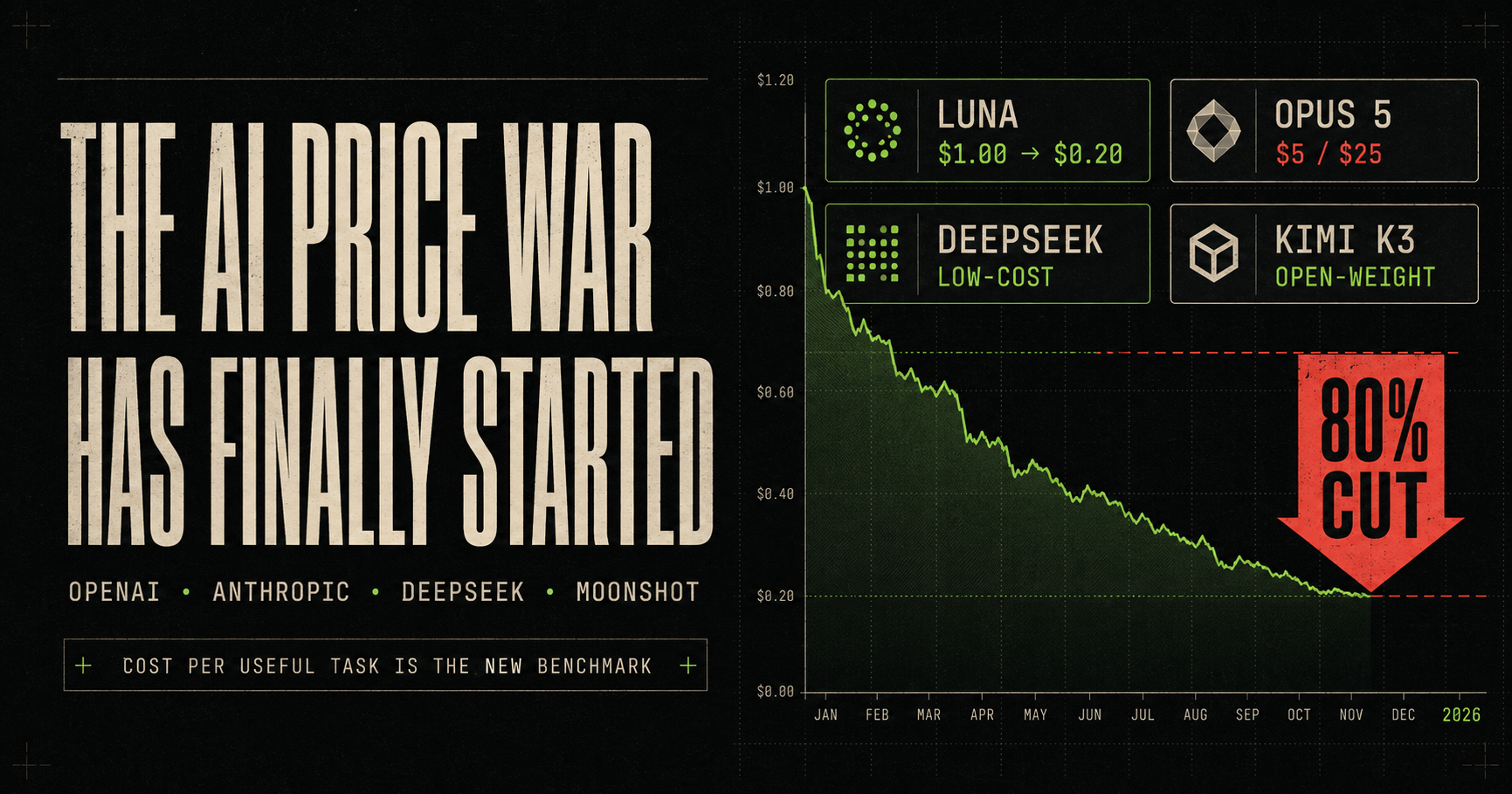
OpenAI reduced the API price of GPT-5.6 Luna by 80 percent. According to OpenAI's announcement, Luna now costs $0.20 per million input tokens and $1.20 per million output tokens, down from $1 and $6.
Anthropic launched Claude Opus 5 at $5 per million input tokens and $25 per million output tokens. That is half the price of Claude Fable 5, according to Anthropic's model pricing. Anthropic also cancelled a planned September increase for Sonnet 5 and kept its $2 input and $10 output pricing.
These are not tiny promotional discounts. They change which models can be used for high-volume work without making the finance team slowly develop a hatred of tokens.
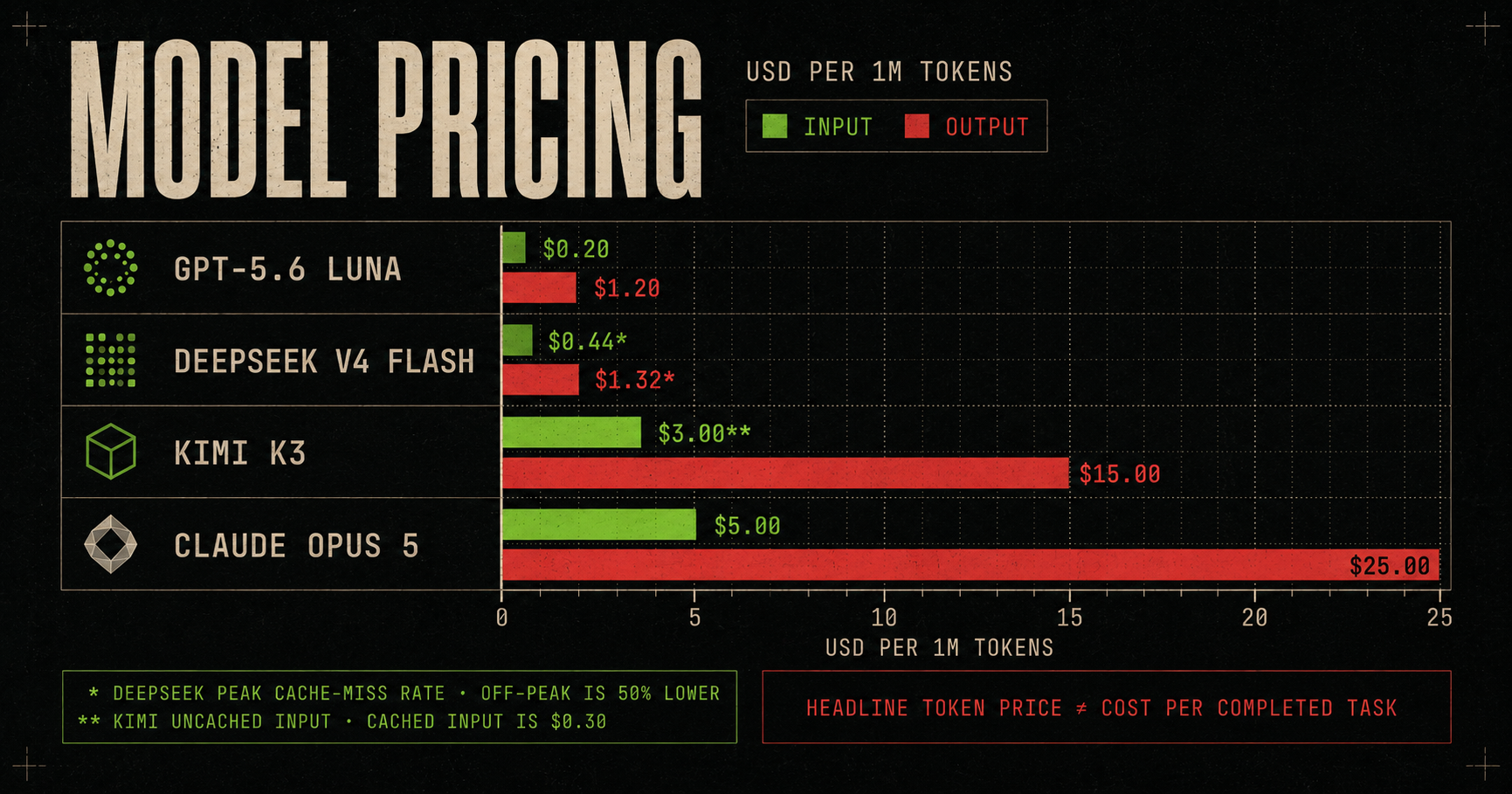
Model | Input per 1M tokens | Output per 1M tokens | Position |
|---|---|---|---|
GPT-5.6 Luna | $0.20 | $1.20 | High-volume closed model |
Claude Opus 5 | $5.00 | $25.00 | Frontier Anthropic model below Fable pricing |
Kimi K3 | $3.00 uncached | $15.00 | Open-weight flagship with cheaper cached input |
DeepSeek V4 Flash | $0.44 peak | $1.32 peak | Low-cost open model; off-peak rates are lower |
The Kimi figures come from Moonshot's official pricing. DeepSeek uses separate cache-hit, cache-miss, peak, and off-peak rates, so its pricing page deserves more than a quick glance before making a direct comparison.
And that leads to the first important point: the cheapest number in a pricing table is not automatically the cheapest model to operate.
China did not need to win every benchmark
For a while, the conversation around Chinese AI models was framed almost entirely around whether they could beat the strongest American systems.
That was probably the wrong question.
They did not need to win every benchmark. They only needed to become good enough that switching from a US model stopped feeling like a reckless experiment.
DeepSeek and Moonshot have narrowed the performance gap while offering open-weight models and aggressive API pricing. That gives companies two forms of leverage at the same time: a cheaper hosted service and the possibility of running or adapting the model elsewhere.
Open weights are not automatically better. Self-hosting introduces infrastructure, security, monitoring, scaling, and maintenance costs. Sometimes paying a closed provider is still the cheapest and least painful option.
But an alternative does not need to be perfect to affect the market. It only needs to be credible.
If a procurement team can point to a capable Chinese model and ask why its current provider costs several times more, the conversation changes. The alternative becomes negotiating power—even if the company never completes the migration.
This is why the latest reductions matter. They are evidence that competition is moving from theoretical benchmark charts into actual invoices.
Price per token is a terrible final metric
Token prices are easy to compare because they fit nicely into a table. Unfortunately, production systems do not pay for tables. They pay for completed work.
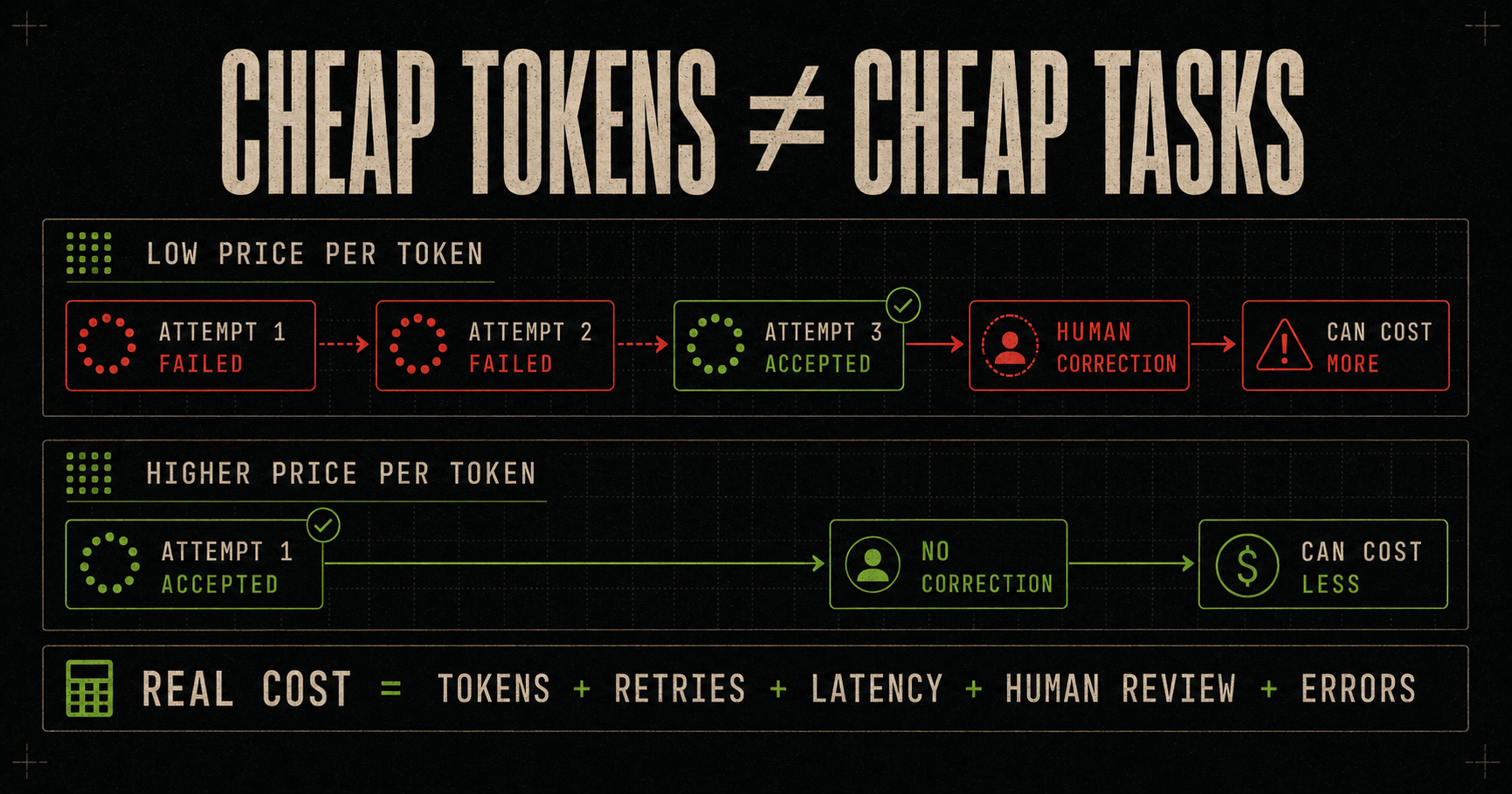
A model with a lower output price may produce longer answers. A cheaper model may need two attempts where a more expensive one succeeds on the first. One model may use prompt caching effectively while another repeatedly processes the same context. Higher reasoning settings can improve accuracy while quietly multiplying the amount of computation used.
The metric that matters is closer to this:
Total cost per useful, accepted task.
That includes:
Input, cached-input, and output tokens
Reasoning or effort level
Retries and failed tool calls
Latency and infrastructure overhead
Human review and correction time
The cost of errors that reach production
A model that costs twice as much per token but completes the task in half the attempts may be the cheaper model. A fast low-cost model that handles 90 percent of requests and escalates the difficult 10 percent to a frontier model may beat both.
This is where AI architecture becomes more interesting than simply choosing the model at the top of a leaderboard.
A small price cut becomes huge at scale
The new Luna pricing provides a simple example.
Imagine a product processing 100 million input tokens and generating 20 million output tokens each month.
GPT-5.6 Luna pricing | Input cost | Output cost | Monthly total |
Previous price | $100 | $120 | $220 |
New price | $20 | $24 | $44 |
The workload has not changed. The application has not been redesigned. The monthly model bill simply falls by $176.
Now multiply that by thousands of workflows, agents that run continuously, or enterprise products serving millions of users. An 80 percent reduction can turn a feature from “interesting but expensive” into something that can be enabled by default.
This is why cheap intelligence often creates more usage rather than merely reducing costs. When every request becomes less expensive, developers stop guarding model calls like they are the last biscuits in the office kitchen.
They try more things.
The middle is being cut. The top is being protected.
One line in the Financial Times report summarised the strategy perfectly: US labs have “cut the middle and are defending the top.”
That distinction matters.
The strongest flagship models are still expensive because the providers believe customers will pay a premium for the hardest coding, research, reasoning, and agentic tasks. The sharpest competition is happening below them, where a model does not need to solve an unsolved mathematics problem. It needs to classify a ticket, extract a document, write a test, summarise a meeting, or complete a predictable step inside a workflow.
Those tasks produce enormous volume.
OpenAI can keep GPT-5.6 Sol positioned as a premium system while making Luna cheap enough to compete across everyday automation. Anthropic can defend Fable 5 at the top while offering Opus 5 and Sonnet 5 at more aggressive prices.
It is less a race to make every model cheap and more an attempt to create a pricing ladder:
A cheap model for routine volume.
A balanced model for work that needs more reliability.
A premium model for tasks where failure costs more than inference.
The interesting question is whether customers will continue paying the top-model premium when the middle becomes good enough for more of their workload every few months.
What this changes for developers
For developers, the price war creates opportunities—but only if we stop treating model choice as a permanent architectural decision.
Model routing should become normal
Sending every request to the strongest available model is the AI equivalent of using a chainsaw to open a packet of crisps. It works, but the operating costs become difficult to defend.
A better system can route simple tasks to a fast, inexpensive model and reserve frontier intelligence for complex requests. The classifier itself can be rule-based, model-based, or driven by confidence and retry signals.
Provider abstraction becomes more valuable
If model prices can drop by 80 percent in one announcement, hard-coding an entire product around a single provider becomes an expensive form of loyalty.
That does not mean building a perfect universal abstraction for every feature. Different providers expose different tool-use behavior, caching systems, reasoning controls, and response formats. Pretending they are identical usually creates the world's most disappointing common denominator.
It does mean separating business logic from provider-specific calls where practical, storing evaluation cases, and making switching possible without rebuilding the application from zero.
Your own evaluation set matters more than public rankings
Public benchmarks are useful for discovering candidates. They cannot tell you which model handles your customers, your codebase, your documents, or your definition of an acceptable answer.
The winning setup may not use the model with the highest general score. It may use the model that passes 98 percent of your real cases at one fifth of the cost.
Lower prices can unlock better product design
Cheaper inference does not only improve margins. It makes previously wasteful ideas reasonable: background classification, multiple candidate generations, automatic verification, richer personalisation, and agents that can spend more time checking their own work.
Some of the best features may arrive not because a new model can do something impossible, but because an existing capability has finally become affordable enough to use everywhere.
Enterprises are discovering that AI has a meter
Flat subscriptions made the first wave of enterprise adoption easy to understand. Buy access, give employees accounts, and try to estimate whether productivity improved.
Usage-based billing is less forgiving.
When the cost follows every token, long context, retry, agent loop, and generated report, experimentation becomes visible on the monthly invoice. Some companies mentioned in the FT report have introduced usage limits or tested cheaper models after their bills increased.
That pressure is healthy in one sense. It forces teams to measure whether an AI feature creates enough value to justify its cost. It encourages caching, shorter prompts, sensible routing, and fewer agent loops that spend twenty minutes thinking about a task a normal function could solve in three milliseconds.
The danger is that companies respond with blunt usage caps instead of better architecture. Cutting every employee's access may reduce the bill, but it can also remove the workflows that were actually valuable.
The goal should be cost visibility, not AI austerity.
Who wins this price war?
Developers and customers are the obvious winners at the beginning. We get stronger models at lower prices, more viable providers, and better negotiating power.
Chinese labs gain legitimacy and distribution. Open-weight models become harder to dismiss as side projects for people with too many GPUs and not enough sleep.
The large US labs may also benefit. Lower prices can expand usage quickly enough to offset reduced margins, especially if cheaper models pull more companies into their platforms and premium models remain protected.
The pressure falls on providers that offer neither frontier performance nor a meaningful cost advantage. “We are almost as good and roughly the same price” is not a particularly inspiring product strategy.
Still, cheaper AI does not mean free AI. Training and serving frontier models remains extraordinarily expensive. Prices can also rise once providers establish stronger market positions, change rate structures, or move more features behind premium tiers.
Enjoy the discounts. Architect as if they are not a constitutional right.
This is the more mature phase of AI
The first stage of the generative AI race was about possibility. Could a model write code, reason through a document, use tools, or operate as an agent?
The next stage is about economics. Can it do the job reliably, quickly, and cheaply enough to run millions of times?
That may sound less exciting than another benchmark record, but it is the part that turns impressive technology into sustainable products.
The price war does not mean the model race is over. It means the market has started asking a better question.
Not simply: Which model is smartest?
But: Which model creates the most value for every euro, token, second, and human review it consumes?
That is a much harder contest—and a far more useful one for the people actually building with this technology.
Sources and further reading
Financial Times: OpenAI and Anthropic in price war as Chinese AI rivals gain ground
OpenAI: Advancing the price-performance frontier with GPT-5.6
If it annoys you twice, turn it into a tool.
See you in the next build.
— Ballwictb
Comments (3)
Join the discussion by logging into your account.
Pradeep Kumar
Which model you are using ?