

💡 TL;DR & Key Takeaways:
TL;DR
Jev, a decision‑only AI model released on September 15 2026, was quickly adopted by developers: pi‑warden, built within 48 hours, blocked 42 destructive commands out of 17,000 calls with an 88 % hold‑accuracy. The first week also saw a burst of related projects—safety scanners, connectors, an open‑source interface, and a Vercel AI Gateway integration—highlighting that tightly‑phrased, typed guardrails are the most validated use case for agent tooling.
pi‑warden: a guardrail that queries Jev on irreversibility, off‑task status, mutation, and scope, holding 42 commands in 17,000 calls with 88 % accuracy and also flagging stubs, retry loops, and untested “done” claims.
Ecosystem growth: safety‑scanning routers, MCP/Ruby/DSPy connectors, an open‑source Jev interface (openjev), and a Vercel AI Gateway integration all launched within days of Jev’s debut.
Best practices: phrase questions narrowly and in layers, use Jev to filter rather than decide costly actions, and keep a deterministic or human policy downstream of Jev’s output.
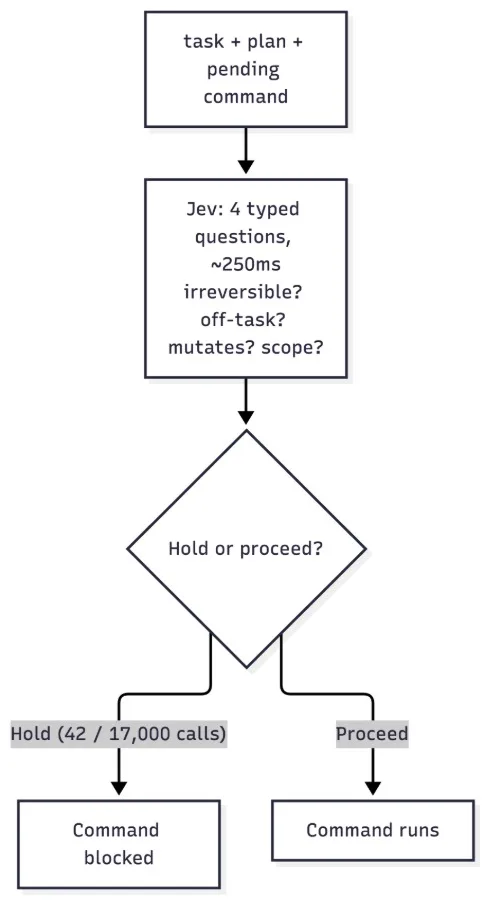
pi-warden, a coding-agent guardrail built on Jev in the first 48 hours after launch, held a destructive shell command 42 times across 17,000 recorded judgments — about 88% of those holds were later confirmed correct. It's the best-documented example of a pattern repeating across the ecosystem: an upstream step produces state, Jev makes a fast typed judgment, and code acts on it.
Jev, TypeSafe AI's decision-only model covered here, shipped September 15, 2026 with a 1,821-point Hacker News thread attached. A week later there's a small ecosystem of guardrails, routers, and connectors built on it, with real numbers behind several of them.
pi-warden: A Second Pair of Eyes for Coding Agents
The problem pi-warden solves: a coding agent about to run db:reset or git push --force, where whether that's fine or catastrophic depends entirely on what the agent was actually asked to do, not on the command's text. A regex can't see that distinction. A second call to a frontier model can, but it costs seconds and cents on every single tool call, and a real agent session makes hundreds of them.
pi-warden sends the task, the agent's stated plan, and the pending bash, write, or edit call to Jev as four typed questions: is this irreversible, is it off-task, does it mutate anything, what's the scope. All four come back in about 250 milliseconds. According to the maintainer's write-up on r/PiCodingAgent, over 17,000 recorded calls it held the agent 42 times, and about 88% of those holds turned out to be right calls.
pi-warden does more than block destructive commands. It also judges written code against a project's rules file, flags stubs and hedging language in a diff, detects an agent stuck in a retry loop, and catches an agent claiming "done" with no test actually run — every one of those is a yes/no or a typed choice, exactly the shape Jev is built for.
The Rest of the Week's Projects
A tool-call safety scanner and model router, posted to r/PiCodingAgent by a user going by peepo_comfy, scores every tool call for safety and is being extended into a router that picks a model based on prompt difficulty and codebase complexity. Their developer-experience note: phrase each question explicitly, and layer several small questions rather than one large compound one.
A handful of connectors shipped just as fast: typesafe-mcp (MCP connector, any MCP-compatible agent calls Jev directly), ruby_llm-typesafe (Ruby access), and dspy-typesafeify (a DSPy fork routing Signatures to Jev automatically where the shape allows it).
The most useful project, though, isn't a Jev integration at all. openjev is a control group: an open reproduction of the interface, reading option logits directly off Qwen3.5-4B. On one RTX 3090, 21 questions took 1.02 seconds as direct logit reads versus 5.33 seconds as generated JSON, landing at 0.845 modal agreement against Jev's own published 0.883.
TypeSafe's ecosystem moved fast too — Vercel added Jev to AI Gateway within 36 hours, exposed through a new evaluate method in AI SDK 7.
Reading the Skepticism Alongside the Adoption
The top comment on r/singularity called Jev "the industry rediscovering classification models." On r/LocalLLaMA, commenters pointed at existing zero-shot classifier encoders, gliformer among them, and asked directly whether Jev is a fine-tuned open model wrapped in a nicer API. None of that skepticism stopped pi-warden's 17,000 calls from being real, or its 88% hold-accuracy from being genuinely useful for anyone deciding whether a similar guardrail is worth building.
Share your thoughts in the comments — I’d love to hear how this technology is impacting your industry.
👉 Be sure to press the like button and follow me. It would be a great motivation for me.
👉 Follow me: LinkedIn | GitHub
What This Means If You're Building Agent Tooling
A typed guardrail in front of destructive actions is the single most validated use case one week in. pi-warden's numbers are the best public evidence Jev has produced so far.
Phrase questions narrowly and layer them. One big compound question performs worse than several small typed ones.
Use it to filter, not to decide alone on anything expensive. Every project keeps a human or deterministic policy downstream of Jev's output.
The distribution story moved faster than the research story. Vercel's AI Gateway integration landing in 36 hours says more about ease of adoption than any benchmark does.
Comments (0)
No comments yet. Be the first to comment!