
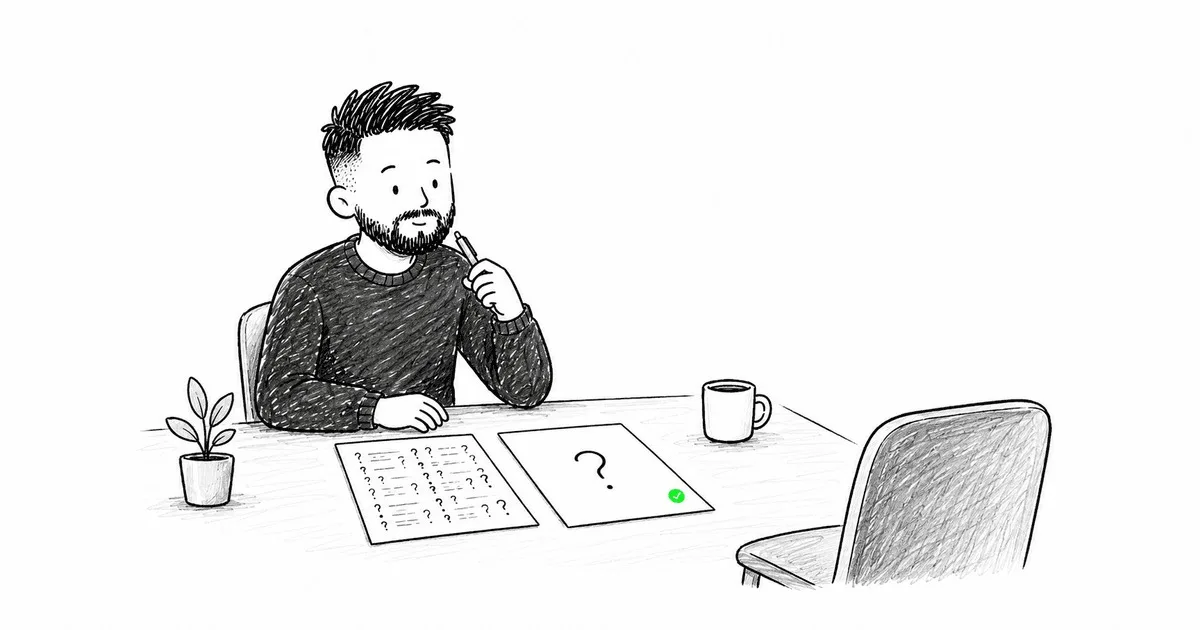
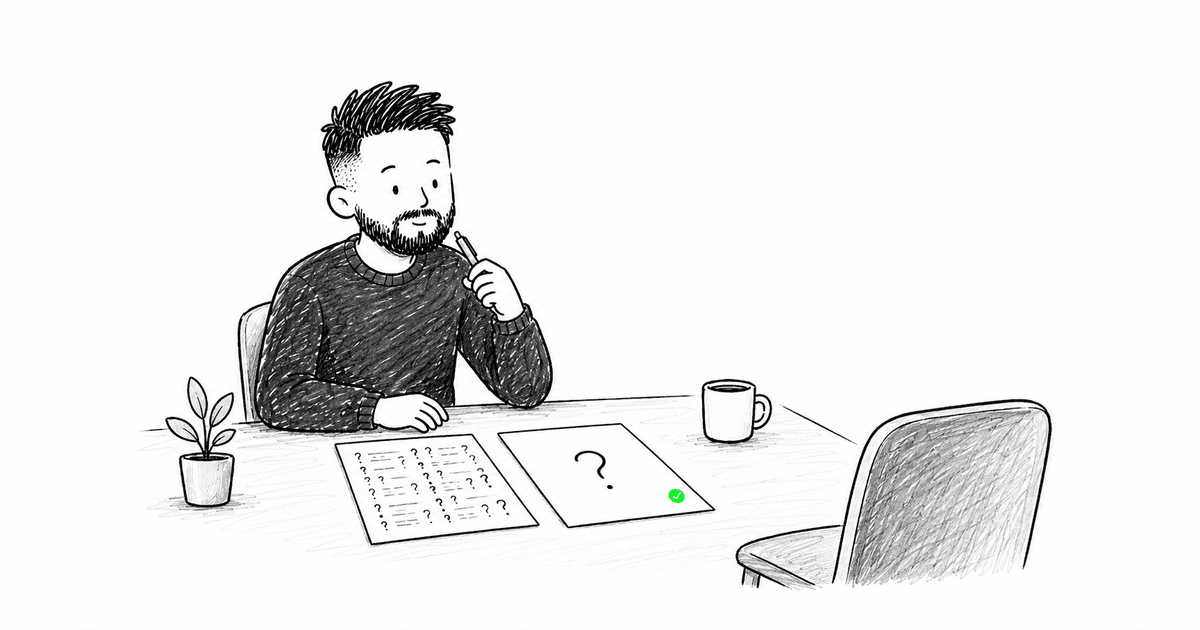
I recently wrote a detailed article on this topic. It came out long because I wanted to cover every nuance — the full story, detailed interview examples, the AI angle, common mistakes, and practical formats. But I realize not everyone has 15 minutes to spare, so here is the short version covering only the essentials.
The Problem
Experienced engineers fail interviews. Not because they lack skill — because the interview tests the wrong thing.
I have over a decade of production frontend experience. TypeScript, React, enterprise products, design systems, team leadership. And I have failed interviews because I could not recall the exact behavior of Promise.allSettled under pressure or write a tree traversal algorithm from memory. These are things I almost never do by hand in real work.
The trivia-based interview format creates false negatives (rejecting experienced builders who do not drill interview prep) and false positives (passing candidates who memorized answers but cannot make architecture decisions). It tests recall under stress — a scenario that never occurs in actual engineering work.
What Works Instead
Talk to the candidate like a colleague. Ask about real scenarios and follow up on every answer.
The best interview I ever had was with a guy named John at a large Canadian company in the automotive industry. Two hours. No algorithms, no trivia. Just questions like:
- "You inherit a React app with 200+ components and no design system. What is your first week like?"
- "Two teams depend on the same component library but ship on different schedules. How do you handle versioning?"
- "A junior on your team writes overly abstract code. How do you handle that conversation?"
Every answer led to a follow-up: "What if the team pushes back?" "What if the deadline is two weeks?" He was mapping how I think, not checking what I have memorized.
I got the job and stayed for three years. No whiteboard session would have predicted that outcome better.
How Simple Questions Reveal Deep Expertise
You do not need complex scenarios. Start simple and follow the thread.
Example: "Your team needs to support dark mode across the product. How do you approach it?"
A junior talks about CSS variables. A senior asks: "How big is the product? Is there a design system? Does design have dark mode tokens ready? Is this a gradual rollout?" Then follow up: "Design only covers 40% of components — the rest is on you." Then: "A senior dev wants to refactor all CSS first. What do you do?" Then: "Product wants to A/B test with 10% of users."
One question. Fifteen minutes. You see problem decomposition, ambiguity handling, leadership instincts, and technical depth. No algorithm required.
Example: "Users say the app feels slow. No specific page, just... slow. What do you do?"
A senior starts with: "Before I touch code — what does slow mean to users? Initial load? Navigation? Interactions? Do we have metrics? Is it all users or specific segments?" Then you push: "Mainly mobile users on slow networks." Then: "VP wants a fix in two weeks for a board meeting." Then: "Backend says APIs are fine, it is purely frontend."
Two questions. Thirty minutes total. You know how this person operates in the real world.
Ask About AI
In 2026, skipping AI in a senior interview means missing critical signal. Some seniors write ten lines by hand per week and orchestrate AI agents for the rest. Others barely use AI. Both can be effective.
The issue: candidates will not volunteer their AI usage honestly unless you make it safe. There is still stigma.
Ask openly:
- "Walk me through how you built the last feature you shipped — tools, process, everything."
- "When you use AI-generated code, what is your review process?"
- "A developer submits a PR that is entirely AI-generated. They understand it, but did not write it by hand. How do you feel as a reviewer?"
You are evaluating judgment about tools and quality — not whether they use AI.
Where This Breaks
Requires skilled interviewers. You cannot run this from an answer sheet. The interviewer needs domain depth and the ability to improvise follow-ups.
Consistency is hard. Different interviewers, different questions, different evaluations. Shared rubrics and calibration sessions are essential.
Charisma bias. Open conversations favor articulate, sociable candidates. Evaluate substance of answers, not delivery style.
Takes more time. You need 60–90 minutes. This does not work for high-volume initial screening — use it in final rounds.
Common Mistakes
- Having a "correct" answer in your head. You are evaluating reasoning, not checking solutions.
- Being too casual. "Just a chat" produces no signal. You need evaluation criteria.
- Not following up. The first answer is surface level. Push with "why?", "what if?", "what could go wrong?"
- Not calibrating across interviewers. Without shared rubrics, you get incomparable evaluations.
- Treating AI usage as a red flag. The right follow-up to "I use AI for 80% of code" is "how do you ensure quality?" — not a concerned look.
Quick Recommendations
Interviewers: Build 5–8 scenario questions from real team challenges. Write a rubric with clear dimensions (problem decomposition, trade-off awareness, communication, technical depth, collaboration, leadership). Run calibration sessions quarterly. Ask about AI openly.
Candidates: When you do not remember an API detail — say so and explain the concept. Prepare stories about real projects, not rehearsed definitions. Be honest about your AI workflow. Ask your own questions aggressively — they signal seniority more than your answers do. If the interview feels like an exam, that is a signal about the culture.
Summary
Senior interviews should test judgment, not recall. Simple scenario questions with deep follow-ups reveal more about an engineer's real capability than any algorithm or trivia quiz. It takes better interviewers and more time, but you hire people who can actually do the job. In an era where AI handles routine code generation, the quality of decisions is what makes a senior engineer valuable. Test for that.
For the full deep-dive with complete interview formats and extended examples, read the long version.
If you have thoughts on this or want to share your own interview experience — reach out.
Comments (0)
Login to post a comment.