
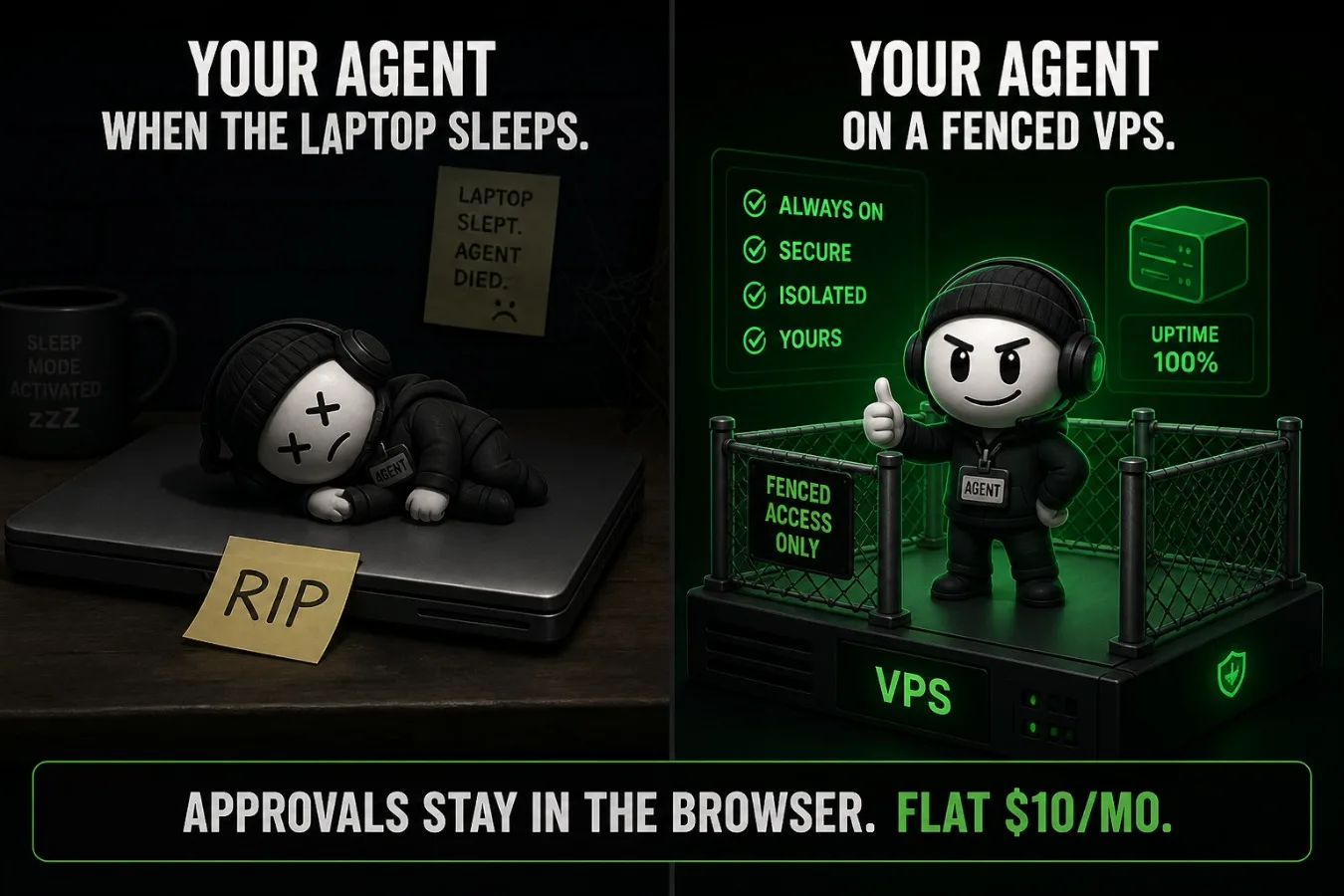
You leave an agent running. You close the lid. In the morning the terminal is gone, the gateway is gone, and the last log line is from the second the machine slept.
This is not a model failure. The process was killed by sleep.
What actually dies
Anything bound to that user session: local gateways, in-memory pairing codes, open SSE streams, a "still running" UI that was just a live socket.
Files on disk usually survive. In-flight tool calls, browser-sidecar state, and one-shot pairing codes usually do not.
Checklist before you trust an overnight job
Confirm the machine will not sleep. On macOS,
caffeinate -dimsfor the run, or disable lid-sleep while plugged in. On Linux, wrap the process withsystemd-inhibit --what=sleep. A closed lid is not "background."Do not put a long-lived key in a QR code or a screenshotable URL. Use a one-time pairing code, single use, short TTL, exchanged over a network you control.
Keep the approval gate in a browser you can open from another machine. If the only place to say yes is the sleeping laptop, the run is already stuck.
Log a heartbeat to disk every few minutes. If the heartbeat stops, you know it was the host, not the model.
If the job has to outlive the laptop, run it on a host that does not sleep — a fenced VPS, not the lid you closed.
If the laptop has to sleep
I run hosted Hermes that way: $10/mo on a fenced VPS, approvals stay in the browser at https://thumbgate.app. Cash from strangers is still $0 — this is the checkout, not a customer-count claim. If your overnight job keeps dying on lid-close, that is the page.
Comments (0)
Login to post a comment.