
The Numbers That Started a Panic
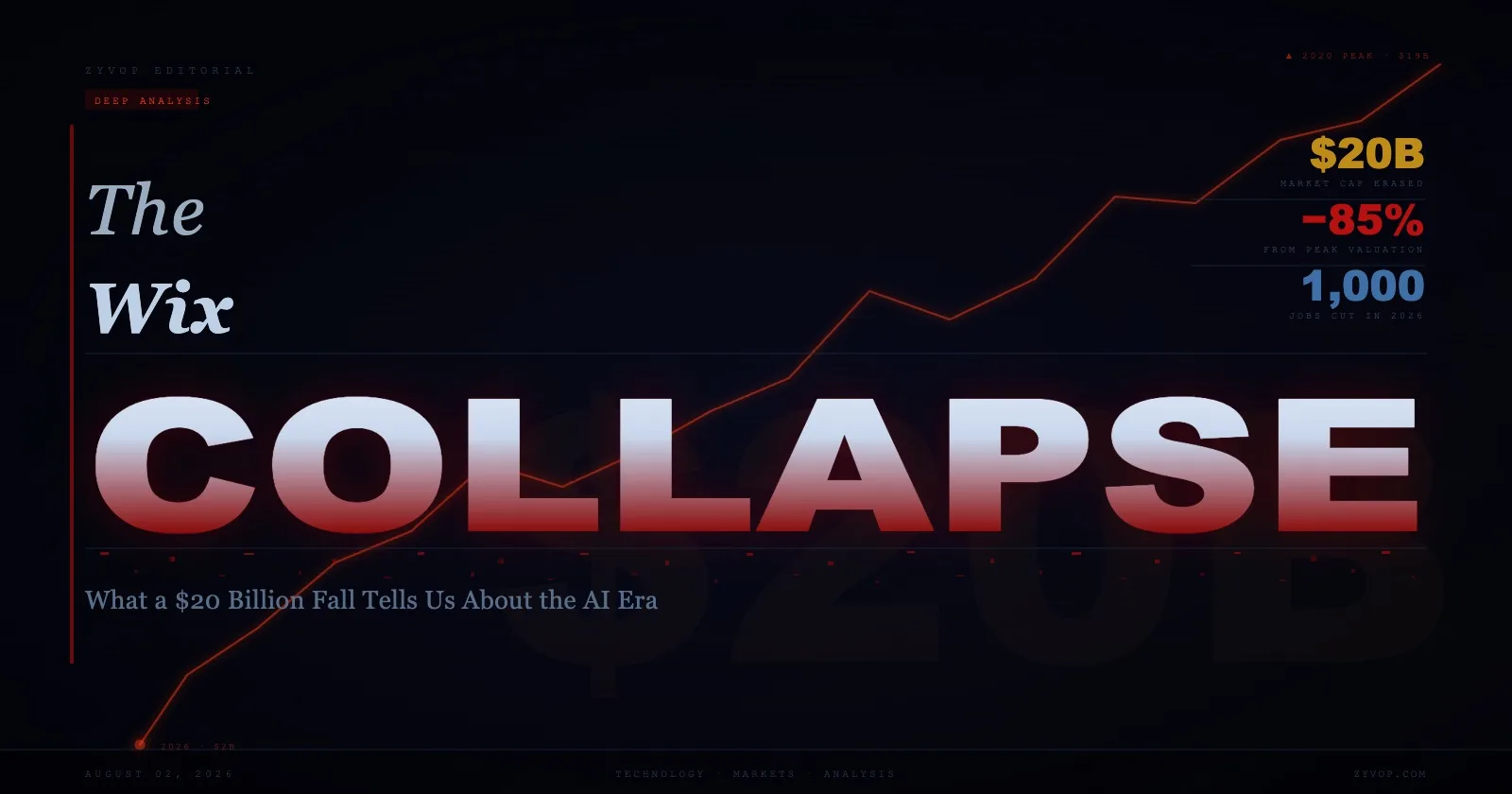
Wix is not broke. It is not losing customers. Its revenue grew 14% last quarter. And yet, by August 2026, the company's stock had collapsed 85% from its peak -- erasing roughly $17 billion in market value over less than six years. That gap between what the business is doing and what the market is pricing in is the whole story. It is worth understanding precisely, because Wix is not a one-off. It is a preview.
According to S&P Global Market Intelligence, Wix shares dropped 51.6% across all of 2025. Then, in the first half of 2026 alone, the stock fell another 56%. The company that once traded at a $19-20 billion market cap -- a peak reached in late 2020 during the COVID digitization wave -- now trades at roughly $2 billion. That is not a correction. That is a verdict.
How Wix Built Its Empire
Wix was founded in Tel Aviv in 2006 with a deceptively simple bet: let anyone build a website without writing code. It was not the first company to try. But the execution was clean, the distribution was aggressive, and by 2013 the company was public on Nasdaq. Over the next decade it layered in e-commerce, scheduling tools, email marketing, and a headless developer platform -- expanding from a consumer product into something closer to a small business operating system.
Then COVID happened, and Wix won the lottery. Physical businesses scrambled online overnight. Wix was frictionless, fast, and affordable. Subscriptions surged. Investors priced in a decade of compounding growth, pushing the stock to a peak valuation close to $20 billion by late 2020. That number implied a future where no-code platforms remained the dominant way non-technical founders built software. It was a reasonable bet -- until AI made it a debatable one.
The Narrative That Crushed the Stock First
Here is the most important thing to understand: for most of 2025, the Wix selloff was a story about fear, not facts. Wall Street began pricing in the possibility -- not yet the reality -- that AI-generated websites would make drag-and-drop editors obsolete. The thesis, now widely called the "SaaSpocalypse", holds that any product whose value lies in abstracting complexity for non-technical users is now competing directly with AI agents that can do the same job through plain English.
Tools like Claude Code, Bolt, and Lovable can generate a working site from a sentence. That capability is not yet reliable enough to replace Wix at scale -- output quality is inconsistent, and small business owners are not the demographic rushing to vibe-code their storefronts. But markets do not wait for disruption to be complete before pricing it in. Wix's stock began reflecting where analysts think the landscape settles in 2029, not 2026.
Q1 2026: When the Fear Got a Receipt
For most of 2025, Wix management defended the business well. Revenue was growing. Free cash flow was strong. User churn showed no alarming spike. Then Q1 2026 arrived and handed the critics something concrete.
The company posted a $57.5 million net loss -- its first loss in several consecutive profitable quarters. Revenue of $541 million grew 14% year over year, roughly in line with expectations. But adjusted EPS came in at $0.68, missing the consensus estimate of $1.22 by 44%. The stock fell 27% in a single session. It hit a 52-week low of $55.88.
The miss was not a revenue problem. It was a cost explosion. Operating expenses jumped 50% year over year, reaching $423 million -- equal to 35% of revenue, compared with 21% in Q1 2025. That 14-percentage-point swing, on a nearly $2 billion annual revenue base, obliterates profitability in one move.
Three things drove the surge: heavy marketing spend behind the Base44 acquisition, expanded AI computing infrastructure, and a $38 million milestone payment to Base44 founder Maor Shlomo, whose earnout was tied to hitting revenue targets fast. He hit them faster than anyone expected. That was great news for Base44. It was expensive news for Wix's income statement.
May 25, 2026: The Largest Layoff in Wix History
CEO Avishai Abrahami sent a letter to employees on May 25, 2026. The message: roughly 1,000 jobs were being cut -- about 20% of Wix's global workforce of 5,277 people. The largest layoff in the company's twenty-year history. The stated reason was direct: AI tools had taken over enough development and design work that several categories of role were no longer necessary.
More than 60% of Wix employees are based in Israel, so the scale of the cuts reverberated well beyond the company. Analysts noted publicly that Wix going first on a large AI-attributed layoff could remove the psychological barrier stopping other Israeli tech companies from making cuts they had already been internally considering.
The restructuring was projected to deliver $70 million in-year savings and $150 million annualized, at a one-time severance cost of $30-35 million. Alongside the announcement, Wix revised its free cash flow forecast upward to $420 million for the full year -- an attempt to show that this was a deliberate reset, not a distress signal.
Two Weeks Later, the Guidance Got Cut Too
Markets were still absorbing the layoff news when Wix hit them again. Less than two weeks after the workforce announcement, the company slashed its 2026 financial outlook. Bookings growth guidance dropped from 15-16% to 11-14%. Revenue growth was trimmed to a low-to-mid-teens range from a prior mid-teens forecast. The net impact: roughly $50 million less in expected bookings and $25 million less in expected revenue for the year.
The culprit, according to management, was an unexpected Partners business slowdown in late May and June. The Partners segment -- professional designers, agencies, and developers who sell Wix-built products to business clients -- accounts for about 38% of total revenue. It had already underperformed in Q1, growing 19% against higher analyst expectations. Then it deteriorated further.
Following the guidance cut, Wix shares fell roughly 12% in premarket trading. The stock had already lost about half its value since January. The double-blow of layoffs then a guidance cut within a fortnight made it look less like a managed transition and more like a company scrambling.
Base44: The Acquisition That Is Both the Cure and the Problem
No part of the Wix story is stranger than Base44. Wix acquired the Israeli AI startup for $80 million, and the product -- a vibe-coding platform that lets users build functional apps through natural-language prompts -- has grown faster than anything Wix has ever launched. Base44 hit $100 million in ARR ahead of internal targets, and by May 2026, that figure had climbed to $150 million, according to company disclosures. Wix even ran a Base44 ad during Super Bowl LX.
In one reading, this is exactly what a legacy platform is supposed to do: identify the next paradigm early, acquire the best team, and position the brand before the shift completes. In another reading, Base44 is the source of the crisis. Every dollar of Base44 ARR comes with AI inference costs that dwarf anything in Wix's traditional business. And the earnout structure meant that the faster Base44 grew, the more Wix owed Shlomo -- $38 million in Q1 milestone payments, with more expected later in the year.
The platform performing best is simultaneously the platform most responsible for the loss quarter. That is the knife edge Wix is currently balanced on.
The Shekel Nobody Is Talking About
Buried beneath the AI disruption narrative is a more prosaic problem: currency. Wix earns almost all of its revenue in US dollars. But the majority of its costs -- salaries, offices, contractors -- are denominated in Israeli shekels. The shekel strengthened against the dollar across 2025 and into 2026, inflating dollar-denominated operating costs with no offsetting revenue gain.
This matters for interpretation. Some of the profitability compression that reads as an AI cost story is, in accounting terms, a foreign exchange effect. A Wix with identical AI spend but better currency hedging would look materially different on paper. The shekel factor does not cancel the disruption narrative -- but it inflates the apparent severity of the cost problem.
Then there is a third headwind: geopolitics. TIKR.com noted that some partner product timelines were pushed out due to disruptions affecting Wix's Israel-based development teams because of the ongoing Middle East conflict -- a headwind management flagged as likely to persist through 2026. Three overlapping pressures, then. Not one.
The $1.7 Billion Buyback That Is Now a Nightmare
To signal confidence during the stock's slide, Wix authorized and executed a share repurchase program totaling approximately $1.6 to $1.7 billion. For a company whose market cap would later fall to roughly that same figure, that was an enormous bet on itself.
The timing was catastrophic. With the stock continuing to fall below the prices at which most buybacks occurred, Wix now sits on a paper loss of approximately $850 million on that program. Capital that could have funded AI infrastructure or further acquisitions is locked in a position that has destroyed value. The company still guides for $420 million in free cash flow in 2026 -- so this is not a liquidity crisis. But it is a decision that will take years to explain.
So Is This Actually a Downfall?
It depends on the unit of analysis. For shareholders who bought near the 2020 peak, the answer is an unqualified yes. A stock that fell from a $189.61 52-week high in May 2025 to the high $40s is not a correction. It is a wipeout. Investors who put in $1,000 at that peak are now looking at roughly $250, according to Yahoo Finance data.
For the operating business, the picture is more complicated. A business posting double-digit revenue growth while guiding for hundreds of millions in annual free cash flow is not a company in collapse. The Motley Fool noted that Wix now trades at under 10x trailing free cash flow -- a multiple that implies the market expects severe deterioration ahead, not a gradual slowdown. The stock has already priced in a bad future. Whether that future arrives is the open question.
The Partners business is the one to watch. If professional developers are shifting away from Wix-built products toward AI-native tooling for good, the segment that drives 38% of revenue will compress persistently. If the May-June slowdown was a short-term disruption -- geopolitical friction, Harmony product gaps, delayed rollouts -- then the guidance cut is a bump, not a structural fracture.
What the Next Twelve Months Decide
Two things will determine whether this is a downfall or a detour. The first is whether Base44 can anchor the Partners business. If developers find a genuine reason to stay on Wix -- because the AI tooling inside the platform is competitive with what they can get elsewhere -- the revenue story stabilizes. If Base44 remains a standalone product that does not pull the core platform forward, the structural bear case becomes very hard to argue against.
The second is market re-rating. The SaaSpocalypse narrative has hit companies like monday.com and NICE with similar severity, often regardless of their actual churn data. If AI-native tools prove slower to displace incumbents than the market has assumed, the multiple compression reverses. That would not restore 2020 valuations. But it could close a meaningful portion of the gap between what the free cash flow says Wix is worth and what the stock says.
What is not debatable is that Wix is at a genuine inflection point. The product model that built a $20 billion company is being challenged by a technology Wix itself is now racing to deploy inside its own platform. That tension -- between the legacy that generates the cash and the AI bet that consumes it -- is the defining pressure on every decision the company makes right now. Whether Avishai Abrahami threads that needle is a question 2026 alone will not answer. But 2027 almost certainly will.
Sources: S&P Global Market Intelligence via Motley Fool; Yahoo Finance -- Q1 results; Yahoo Finance -- H1 2026 collapse; Ynetnews -- layoffs and guidance cut; Ynetnews -- Base44 costs; CNBC -- CEO announcement; Calcalist / Ctech -- Partners business; Calcalist / Ctech -- Israeli tech context; FinalRoundAI -- acquisition breakdown; TIKR.com -- valuation and geopolitical headwinds; Startup Fortune -- operating cost analysis; The Next Web -- SaaSpocalypse framing.
Comments(0)
Join the discussion by logging into your account.
No comments yet. Be the first to comment!