
Picture this: an AI model sits down at a virtual workstation. No human supervision. No hand-holding. For the next 16 days, it writes code, runs tests, finds bugs, fixes them, and refines its work — iteratively, autonomously, around the clock.
That's not science fiction. That's a demo of Qwen3.8-Max, and it shipped two weeks ago.
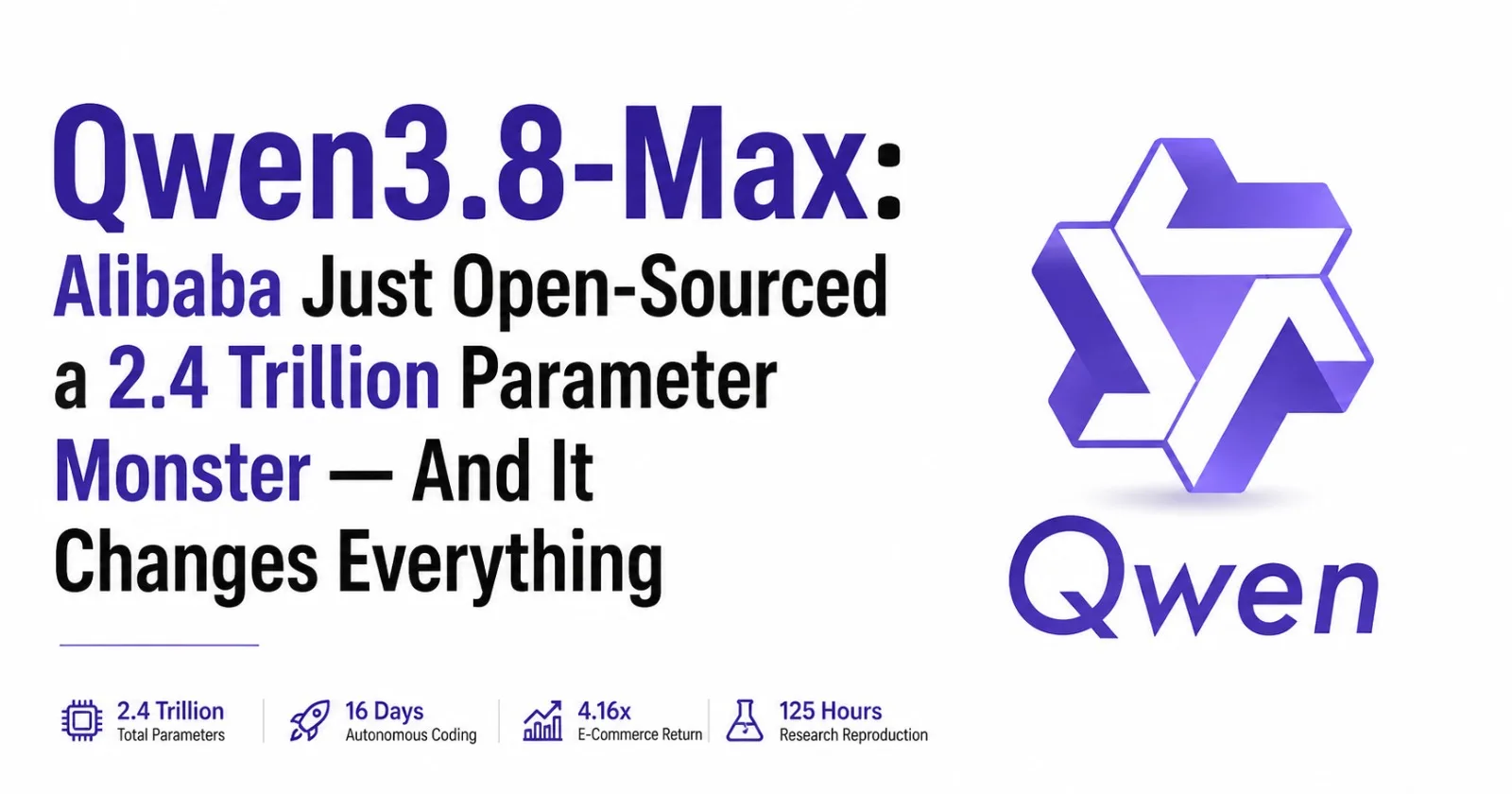
On August 3, 2026, Alibaba Cloud released Qwen3.8-Max through their Model Studio API. Nine days later, on August 12, they did something that no major AI lab has done before: they released the full open weights of their most powerful flagship model. Not a smaller sibling. Not a distilled student model. Their actual best-in-class offering.
The AI race just became an open book.
The Numbers That Stop You Mid-Scroll
Specification | Qwen3.8-Max |
|---|---|
Total Parameters | ~2.4 Trillion |
Active Parameters | ~95 Billion per query |
Architecture | Sparse Mixture-of-Experts (MoE) |
Context Window | 1,000,000 tokens |
Modalities | Text, Image, Video (API) |
Open Weights | Yes (Qwen3.8-2.4T-A95B) |
API Pricing | $2 / $6 per million tokens (in/out) |
2.4 trillion parameters. Let that sink in. If you printed each parameter as a single digit on a grain of rice, you'd cover the surface area of roughly 6,000 football fields. But here's the clever part — you never use all of them at once.
How Sparse MoE Routing Works
flowchart LR
    A[Input Tokens] --> B[Router Network]
    B --> C{{Expert 1}}
    B --> D{{Expert 2}}
    B -.->|inactive| E{{Expert 3}}
    B -.->|inactive| F{{...}}
    B -.->|inactive| G{{Expert N}}
    C --> H[Combine Outputs]
    D --> H
    H --> I[Output Tokens]
For each input, the router selects only the top experts — activating ~95B of the 2.4T total parameters. The inactive experts (dashed lines) consume zero compute. It's like having a hospital full of specialists but only paging the cardiologist and the neurologist when a patient walks in with a specific complaint. You get world-class expertise without paying for every doctor to stand around.
This architectural trick is how Alibaba prices the API at $2/$6 per million tokens — 2.5x cheaper on input and 5x cheaper on output compared to GPT-5.6 Sol ($5/$30) — while delivering comparable quality on many benchmarks.
The Demos That Broke the Internet
Benchmarks matter, but stories stick. Here are three real demonstrations from Alibaba that made the AI community sit up. Important caveat: these are company-reported results, not independent evaluations — but they come with verifiable artifacts.
🔧 16 Days of Autonomous Coding
Alibaba gave Qwen3.8-Max an empty repository and a goal: build a functional CLI coding harness from scratch. No human intervention. No hand-holding. Over the next 16 consecutive days, the model wrote code, compiled it, ran unit and end-to-end tests, diagnosed failures, refactored, and iterated — autonomously building its own state machine, task dispatcher, and testing loop. The project, called "oh-my-cli", is publicly auditable on GitHub (qwen-code-dev-bot/oh-my-cli) — hundreds of commits, pull requests, and resolved issues, all generated by the model.
Think about that. Most human developers can't go 16 hours without checking Twitter.
💰 The E-Commerce Hustler
In Alibaba's "E-Commerce Bench" — a 365-day simulation with 12 store types, 60 product categories, ~600 suppliers, and 7,000 products — Qwen3.8-Max was handed ¥100,000 in starting capital and told to run multiple online stores. It selected products, managed inventory, set pricing, negotiated with suppliers, handled returns, and allocated capital across its portfolio. After one simulated year: ¥416,252. A 4.16x return. An AI with better business instincts than most MBA graduates.
📄 125 Hours of Research Reproduction
Alibaba handed the model the paper "Unified Data Selection for LLM Reasoning" — cold, with zero starter code. Over approximately 125 hours of compute time, Qwen3.8-Max wrote ~7,600 lines of code from scratch, ran 33 rounds of GPU training, and took over 1,100 autonomous actions. It didn't just reproduce the original paper's six main findings — it then entered a self-improving loop of hypothesis, code, and training, eventually beating the original paper's performance on the AIME24 benchmark by 2.7 points. This is the kind of task that takes a PhD student weeks of focused effort.
The Benchmark Reality Check
Stories are compelling, but let's look at the numbers. These are Alibaba's official vendor-reported scores — a caveat worth noting, as independent third-party replication is still catching up:
Benchmark | Qwen3.8-Max | GPT-5.6 Sol | Claude Opus 5 |
|---|---|---|---|
GPQA Diamond | 92.6 | 94.1 | — |
OSWorld-Verified | 86.1 | — | — |
PaperBench | 93.0 | — | — |
DeepSWE 1.1 | 56.6 | Higher | Higher |
On graduate-level science reasoning (GPQA Diamond), Qwen3.8-Max lands within 1.5 points of OpenAI's best. On research reproduction (PaperBench at 93.0) and autonomous computer interaction (OSWorld at 86.1), it posts numbers that would have seemed impossible from an open-weight model just a year ago.
Where it still trails? Software engineering. Claude Opus 5 continues to dominate SWE-bench Pro and Frontier-Bench for autonomous coding in professional environments. But consider the trajectory: a model you can download and run yourself is now within spitting distance of the most expensive proprietary models on the planet.
A note on honesty: These benchmarks are vendor-reported. Independent evaluations suggest that Qwen3.8-Max's performance can be sensitive to time and token budgets — allocate generous compute, and it shines. Constrain it, and the gap widens. Real-world mileage will vary, and that's okay. The point isn't perfection. The point is that the open-weight frontier now overlaps with the closed frontier.
The "Thinking" Brain — And Why It Matters More Than You Think
Most frontier models have some form of "chain of thought" reasoning. Qwen3.8-Max takes this further with a tunable thinking system that gives you explicit control over how hard the model thinks.
You adjust this via a reasoning_effort parameter:
High → Deep chain of thought. Mathematical proofs, complex debugging, multi-step research. The model might generate thousands of internal reasoning tokens before responding.
Low → Lightweight reasoning. Quick lookups, conversational exchanges. Fast and cheap.
Disabled → Skip reasoning entirely. Maximum speed, minimum cost.
Why does this matter? Because in production, you're paying per token. A chatbot answering "what's your return policy?" shouldn't burn $0.15 on deep philosophical reasoning. But an AI agent refactoring a distributed system? Give it every ounce of cognitive depth available.
Reasoning Pipeline
flowchart LR
    A[User Query] --> B{Reasoning Effort}
    B -->|High| C[Deep Chain of Thought]
    B -->|Low| D[Lightweight Reasoning]
    B -->|Disabled| E[Direct Response]
    C --> F{Tools Needed?}
    D --> F
    F -->|Yes| G[Tool Selection]
    G --> H[Execute Tools]
    H --> I[Interpret Results]
    I --> J[Final Response]
    F -->|No| J
    E --> J
The real magic? The thinking mode integrates directly with tool use. The model doesn't just think, then act — it reasons about which tools to call, when to call them, and how to interpret their results, all within a single coherent chain. This is the difference between a model that can answer questions and a model that can do work.
Two Models, One Mission
Alibaba actually released two models under the Qwen3.8 banner. Understanding the distinction will save you hours of confusion:
Qwen3.8-Max — The Cloud Titan
2.4T parameters, sparse MoE architecture
1M token context window (ingest entire codebases in one go)
Full multimodal: text + image + video via API
Flexible thinking mode (adjustable
reasoning_effort)Open weights released — but read the caveat below
Requires datacenter-scale GPU infrastructure for self-hosting
⚠️ Open-weights caveat: The downloadable version (Qwen3.8-2.4T-A95B) is text-only — no vision or video support. It also ships with mandatory thinking mode (every response includes <think> reasoning traces) and a reduced context window compared to the full API. If you need multimodal inputs or the full 1M context, you'll need the cloud API.
Qwen3.8-27B — The Model You'll Actually Run
27.8B dense parameters (no MoE — every parameter activates)
262K token context window, extendable to 1M via YaRN scaling
Native vision-language capabilities (text, images, video)
Apache 2.0 license — full commercial and research freedom
Runs on a single 24GB GPU (RTX 4090, A5000)
Here's the honest truth: for most developers, the 27B model is the more exciting release. It's natively multimodal — meaning it processes images and video through the same unified architecture as text, not through bolted-on encoders. It runs on hardware you might already own. And it's Apache 2.0, which means "do whatever you want with it."
Deploy it with ollama run qwen3.8:27b and you have a frontier-class AI running entirely on your machine. No cloud. No API keys. No per-token charges. Your data never leaves your hardware.
One caveat worth noting: the Qwen team has observed that using static YaRN for extreme context lengths (pushing toward 1M) can slightly degrade performance on shorter prompts. If you're doing context extension, test your specific use case.
Why This Changes the Game
Open-weight models aren't new. Llama, Mistral, earlier Qwen releases — they've been building this ecosystem for years. So why is Qwen3.8-Max different?
Because it's the first time a "Max-class" flagship has been released with open weights.
Previously, Alibaba's Max models — their most capable, most expensive, most carefully tuned systems — were API-only. The open releases were always the smaller, weaker cousins. With Qwen3.8-Max, the company made a strategic decision: release the crown jewels.
This changes the math for three groups immediately:
Regulated industries (healthcare, finance, legal) that couldn't send patient data or financial records to external APIs now have access to frontier intelligence on their own infrastructure. The compliance argument against AI adoption just lost its strongest shield.
Startups can prototype against the $2/$6 API, validate their product-market fit, and then migrate to self-hosting the same model family when economics demand it. No vendor lock-in. No "we need to rewrite our prompts for a different model."
Researchers can study, fine-tune, and extend a 2.4T MoE architecture that genuinely competes with the best closed offerings. Previously, this level of access required a nine-figure compute budget and a deal with one of three US-based labs.
The Three-Way Race in August 2026
We're living in a golden age of AI competition. Three frontier model families are battling for supremacy:
GPT-5.6 Sol | Claude Opus 5 | Qwen3.8-Max | |
|---|---|---|---|
Released | July 9, 2026 | July 24, 2026 | August 3, 2026 |
Strength | Multimodal reasoning | Autonomous coding | Cost + openness |
Open Weights | No | No | Yes |
Best For | Azure enterprise ecosystem | Deep SWE workflows | Self-hosting + budget |
GPT-5.6 Sol remains the gold standard for integrated multimodal reasoning and enterprises already living in the Azure ecosystem.
Claude Opus 5 is the model developers reach for when the task is "think deeply and write code." Its "thinking on by default" design proactively catches logical errors in long-horizon tasks.
Qwen3.8-Max enters as the disruptor you can actually own. At $2/$6 per million tokens on the API — or literally free if you self-host — it makes frontier AI accessible to teams and companies that couldn't afford the alternatives.
The real winner is every developer on the planet. When three world-class model families compete simultaneously on quality, price, and openness, everyone benefits.
How to Get Started
Cloud API (5 Minutes to First Request)
Sign up for Alibaba Cloud Model Studio
Generate an API key
Point your existing tools at the OpenAI-compatible endpoint — Cursor, Continue, and OpenCode work out of the box with a base URL change
Bonus: Context caching is available at $0.25/M tokens for repeated prompts
Self-Hosted (Maximum Control)
Download weights from
Qwen/Qwen3.8-27Bon Hugging FaceDeploy with your preferred engine:
Ollama:
ollama run qwen3.8:27b— up and running in minutesvLLM: Production-grade with tensor parallelism for high throughput
LM Studio: Desktop GUI, zero terminal required
For the full 2.4T Max: grab
Qwen/Qwen3.8-2.4T-A95B(datacenter GPUs required)
Hardware Requirements (27B Model)
Full precision: 24GB+ VRAM (RTX 4090, A5000)
Quantized (GGUF): 17–19GB VRAM/RAM
Context: 262K native, extendable to 1M with YaRN
Choosing Your Deployment Path
flowchart TD
    A["Start: Deploy Qwen3.8"] --> B{Data sovereignty required?}
    B -->|Yes| C{GPU infrastructure available?}
    B -->|No| D[Cloud API via Model Studio]
    C -->|Datacenter GPUs| E[Self-host Qwen3.8-Max 2.4T]
    C -->|Single 24GB GPU| F[Self-host Qwen3.8-27B]
    C -->|Consumer hardware| G[Quantized 27B via Ollama]
    D --> H(["$2/$6 per M tokens"])
    E --> I(["Max performance, full control"])
    F --> J(["Production-grade, zero API cost"])
    G --> K(["17-19GB RAM, local-first"])
The Bigger Picture: Alibaba's $100B Bet
This release doesn't exist in a vacuum. It's the centerpiece of a massive corporate restructuring.
In March 2026, CEO Eddie Wu consolidated Alibaba's fragmented AI efforts — the Tongyi Lab, the MaaS division, the Qwen business unit, and the Wukong enterprise platform — into a single entity: the Alibaba Token Hub (ATH). Wu personally leads it.
The name says it all. Alibaba is betting that AI tokens — the fundamental unit of compute in every model interaction — will become as essential to the global economy as cloud compute instances are today. ATH's job is to make Alibaba the default factory for producing, distributing, and consuming those tokens.
In June 2026, they doubled down by creating Token Foundry — a sub-division combining frontier research with commercial deployment. The company has publicly set a target of $100 billion in combined AI and cloud revenue within five years.
The strategic logic? It's the Android playbook: give away the model, monetize the infrastructure. By open-sourcing Qwen3.8-Max, Alibaba isn't destroying value — they're creating a gravitational pull. Developers who build on Qwen models naturally gravitate toward Alibaba Cloud for deployment, fine-tuning, and scaling. The model is the top of the funnel. The cloud is the business.
What This Means for You
If you're a developer: You now have a frontier-level model you can run on your RTX 4090. Fine-tune it for your domain. Deploy it with zero per-token costs. The 27B model under Apache 2.0 is the sweet spot for most use cases.
If you're an enterprise architect: The compliance objection to AI just got much harder to sustain. Deploy Qwen3.8-27B behind your firewall, in your VPC, air-gapped from the internet. No data leaves. No vendor has access. Your legal team might actually smile.
If you're an AI researcher: The open weights for a 2.4T MoE model are an unprecedented research opportunity. Study the expert routing. Analyze the specialization patterns. Build on architecture that was previously accessible only to labs with billion-dollar budgets.
If you're building AI products: Prototype on the $2/$6 API. Validate your idea. When costs scale, migrate to self-hosting. Same model family, same prompt engineering, zero rewrite. That's a business model that actually works.
The Bottom Line
A year ago, if you wanted frontier AI, you signed up for an API, paid per token, and accepted that your data traveled to someone else's servers. That was the deal, and there was no alternative.
That deal is over.
Qwen3.8-Max proves that the open-weight ecosystem has reached escape velocity. A model with 2.4 trillion parameters — one that scores within striking distance of GPT-5.6 Sol on science, that ran autonomously for 16 days building a CLI tool from an empty repo, that reproduced research papers from scratch over 125 hours — is available for anyone to download, deploy, and build on.
The frontier is no longer behind a paywall. It's on Hugging Face, under open weights, waiting for you to git clone it.
Build accordingly.
What are you building with Qwen3.8? Drop a comment below — I'd love to hear about your deployment setups, benchmark results, and real-world use cases. Let's push this ecosystem forward together.
Comments (0)
Join the discussion by logging into your account.
No comments yet. Be the first to comment!