
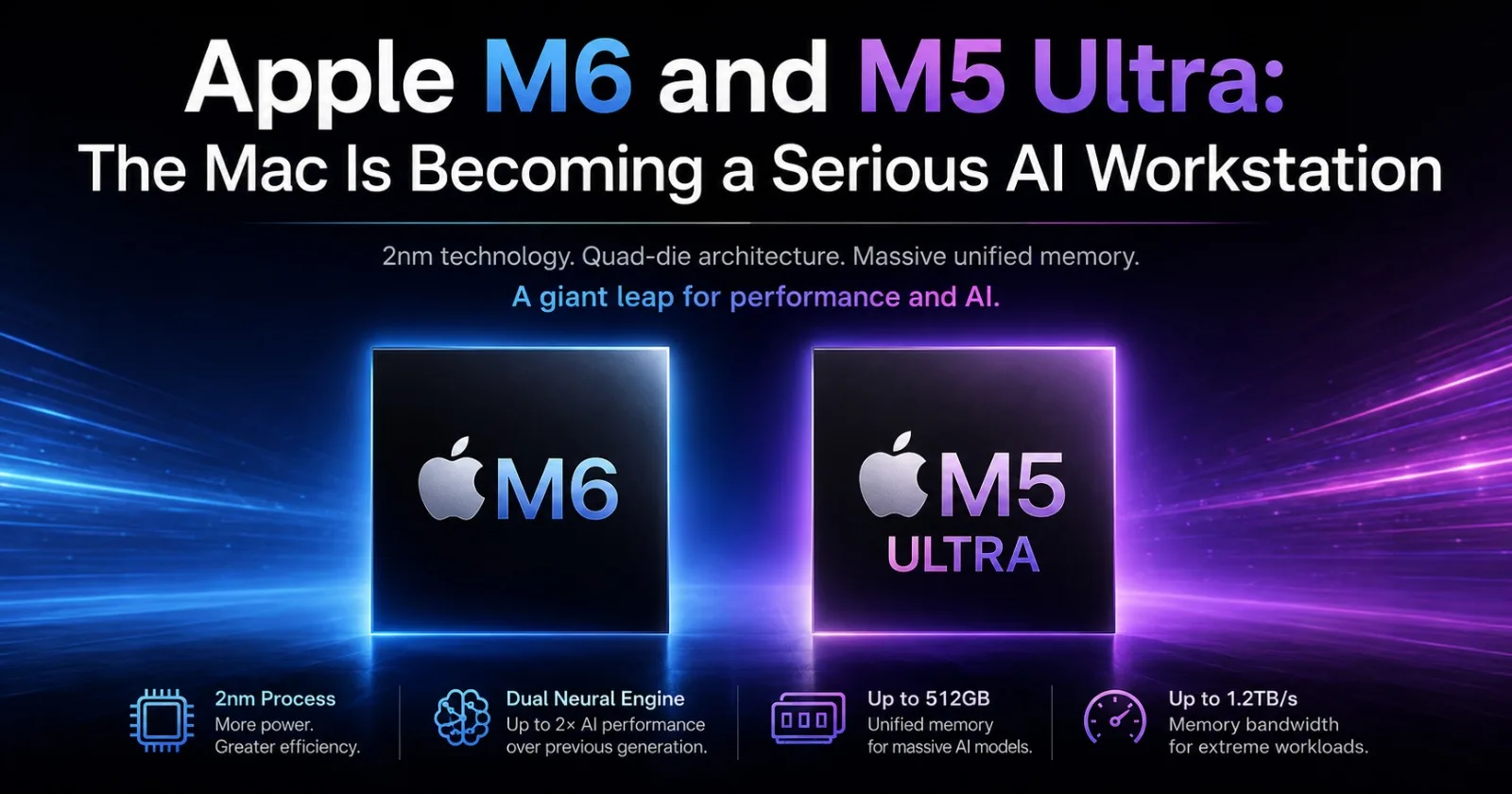
Apple has just pushed its Mac silicon strategy into a new phase.
The company has introduced M6 in the new Mac mini and M5 Ultra in the new Mac Studio, bringing major changes to both everyday computing and high-end AI workloads.
M6 is Apple's first 2-nanometer chip, with a new 12-core CPU, 12-core GPU, Dual 16-core Neural Engine, and up to 170GB/s of unified memory bandwidth.
M5 Ultra goes much further. It is Apple's first quad-die M-series chip, combining four compute dies through a new generation of UltraFusion technology. It scales to a 36-core CPU, 80-core GPU, up to 512GB of unified memory, and 1.2TB/s of memory bandwidth.
On paper, those numbers look impressive.
But the more important story is what Apple is building toward: a Mac where local AI is becoming a core workload rather than an experimental feature.

Image: Apple M6 and M5 Ultra
Image credit: Apple
Source: Apple Newsroom
M6: Apple's First 2nm Mac Chip
M6 is the first Apple silicon chip for the Mac built using a 2nm process.
Moving to a smaller process node gives Apple more transistor density and the potential for better performance and efficiency. Apple is using that additional silicon capacity across the CPU, GPU and AI hardware rather than concentrating it in a single compute block.
The M6 CPU has 12 cores:
2 super cores
4 performance cores
6 efficiency cores
That is two additional CPU cores compared with M5.
Apple claims up to 1.2× faster multithreaded performance than M5 and up to 2.4× faster than M1 in its selected benchmarks. Apple also describes M6 as delivering the world's fastest single-threaded performance.
These are Apple's benchmark claims, so they should not be interpreted as independent real-world measurements.
For developers, however, the potential benefits are straightforward: compiling projects, indexing large codebases, manipulating assets, running multiple development tools, and executing local agent workloads can all benefit from stronger CPU performance.
Apple specifically highlights code compilation, file indexing and agentic AI workloads as areas that benefit from M6.
The M6 Is Designed Around AI
The most interesting part of M6 may not be the CPU.
Its 12-core GPU contains a Neural Accelerator in every GPU core.
Apple says this produces nearly 30% higher peak GPU AI compute than M5 and more than 8× the peak GPU AI compute of M1.
M6 also features a Dual 16-core Neural Engine. Apple says system frameworks can use both engines simultaneously, providing up to 2× the peak compute of previous generations for suitable workloads.
That makes the architectural direction clear.
Apple is not relying on one dedicated AI block. The CPU, GPU and Neural Engine can all participate in AI workloads depending on what an application requires.
That becomes increasingly important as applications move beyond simple AI features toward:
Coding assistants
Local AI agents
Private assistants
Document analysis
On-device retrieval
Continuous inference
Automated development workflows
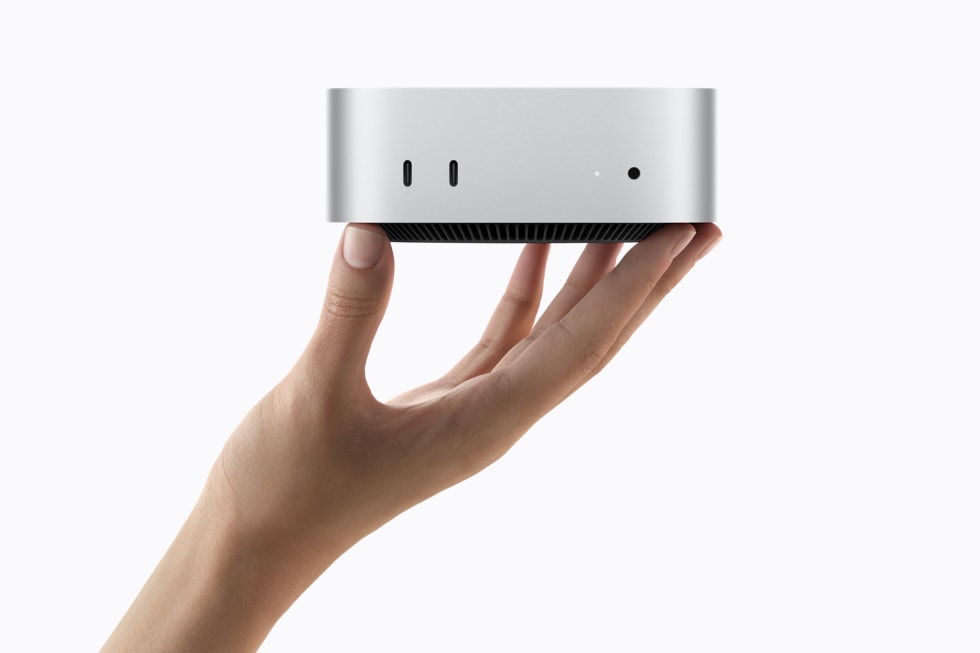
Image: M6-powered Mac mini
Image credit: Apple
Source: Apple Newsroom
Faster Unified Memory Matters More Than It Looks
M6 supports up to 32GB of unified memory with memory bandwidth of up to 170GB/s.
Apple says this is a 10% increase over M5 and 2.5× the bandwidth of M1.
This matters for AI because model execution can become a memory problem long before a developer expects it to.
Apple's unified-memory architecture allows the CPU and GPU to work from the same memory pool rather than constantly moving large datasets between separate CPU and GPU memory.
For smaller local models, embeddings, AI coding assistants and agentic applications, memory capacity and bandwidth can sometimes matter more than a headline CPU benchmark.
There is still an important limitation.
The maximum 32GB memory configuration means M6 is not intended to compete with M5 Ultra for the largest local models.
That is where Apple's high-end desktop silicon becomes much more interesting.
Then Apple Does Something Much Bigger With M5 Ultra
M5 Ultra is where Apple's architecture becomes particularly interesting.
Instead of simply creating one enormous die, Apple uses UltraFusion to connect two dual-die M5 Max chips, creating a quad-die architecture for the first time in Apple silicon.
The interconnect provides more than 4.4TB/s of inter-die bandwidth, while Apple says its connection density is more than six times higher than before.
The objective is to make the four dies behave like a single unified processor.
This is the key to understanding M5 Ultra.
Apple is effectively scaling its architecture horizontally without abandoning the unified-system approach that has defined Apple silicon.
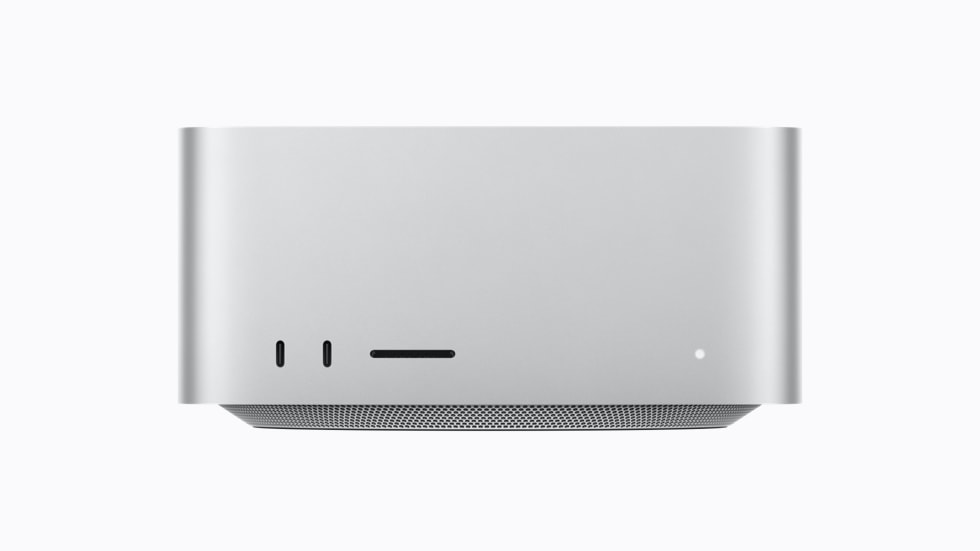
Image: M5 Ultra-powered Mac Studio
Image credit: Apple
Source: Apple Newsroom
36 CPU Cores and 80 GPU Cores
At the top end, M5 Ultra reaches 36 CPU cores, made up of 12 super cores and 24 performance cores.
Apple claims up to 1.25× higher single-threaded performance and up to 1.3× higher multithreaded performance than M3 Ultra.
The GPU scales to an enormous 80 cores.
And once again, every GPU core includes a Neural Accelerator.
Apple says M5 Ultra can deliver up to 4.5× the peak GPU AI compute compared with M3 Ultra, and more than 6× compared with M1 Ultra.
Apple also claims graphics performance of up to 40% faster than M3 Ultra in its selected benchmarks.
These figures are Apple-provided performance claims. Independent testing will ultimately determine how those improvements translate across different applications and AI workloads.
This puts M5 Ultra firmly into workstation territory.
But the most interesting specification is still the memory.
512GB of Unified Memory Changes the Conversation
M5 Ultra supports up to 512GB of unified memory with up to 1.2TB/s of memory bandwidth.
Apple says the bandwidth is 50% higher than M3 Ultra.
Why is this such a big deal?
Because large AI models need memory.
A system with powerful GPU compute but insufficient memory can still be heavily constrained. Large models may need to be quantized, split across devices, offloaded or executed remotely.
With 512GB of unified memory, M5 Ultra dramatically raises the amount of model data that can remain resident locally.
Apple says the 512GB configuration can be used to run LLMs with hundreds of billions of parameters entirely on-device while also keeping large datasets in local memory.
That does not mean every huge model will suddenly run quickly on a Mac.
Model architecture, quantization, context length, software optimization, memory access patterns and inference implementation still matter.
The distinction is important:
Memory capacity determines what can fit. Compute and software determine how quickly it runs.
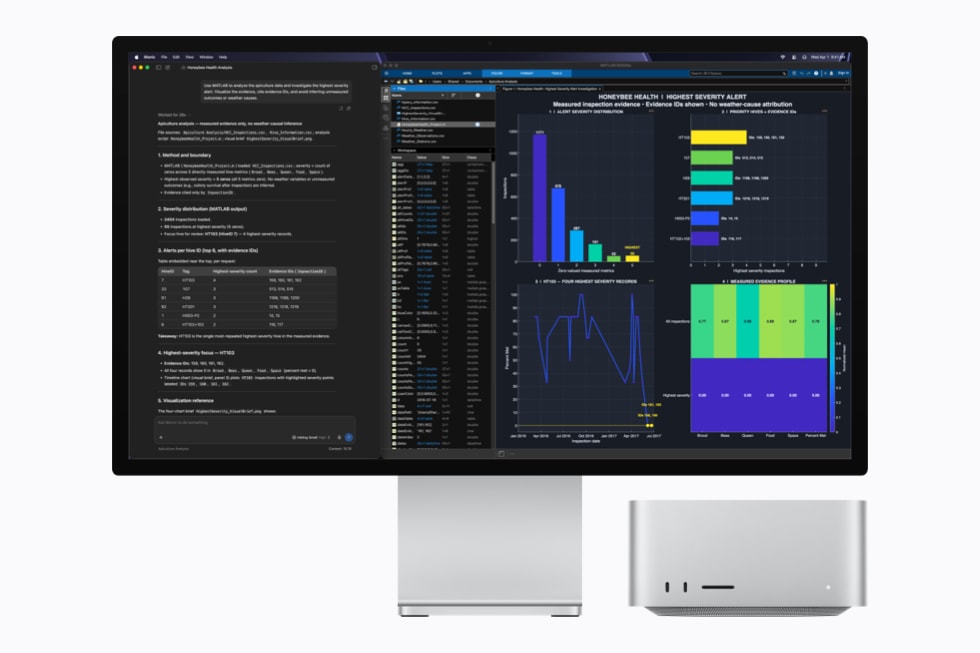
Image: Local AI workloads on Mac Studio
Image credit: Apple
Source: Apple Newsroom
This Is Where Developers Should Pay Attention
Apple's developer ecosystem is increasingly aligned with these hardware capabilities.
The company highlights technologies including:
Core AI
Core ML
Metal
Xcode
Apple Foundation Models
App Intents
These technologies give developers multiple ways to integrate AI into applications and take advantage of Apple's on-device compute.
The potential architecture is interesting.
You can imagine an application where:
Simple inference happens locally.
Private data stays on-device.
Latency-sensitive tasks run locally.
Large or expensive workloads move to the cloud.
The Mac therefore does not necessarily replace cloud AI.
Instead, it becomes another compute layer in an AI application.
Apple Is Betting on Local AI
There is a broader shift happening here.
The AI industry has spent years moving toward massive centralized GPU clusters. That will continue because frontier training and the largest inference workloads require extraordinary amounts of compute.
But not every AI task needs a data center.
Code completion, document analysis, personal assistants, private knowledge retrieval, image generation, automation and agentic workflows can benefit from local execution.
Local inference offers several obvious advantages:
Privacy
Lower latency
Reduced dependence on cloud APIs
Potentially lower recurring inference costs
M6 brings more of that capability to the Mac mini.
M5 Ultra pushes it into a different category entirely: a desktop system with enough memory and compute to handle local AI workloads that would previously have required more specialized hardware or cloud infrastructure.
M6 vs M5 Ultra
Specification | M6 | M5 Ultra |
|---|---|---|
Process | 2nm | M5 generation |
CPU | Up to 12 cores | Up to 36 cores |
GPU | Up to 12 cores | Up to 80 cores |
Neural Engine | Dual 16-core | 32-core |
Unified memory | Up to 32GB | Up to 512GB |
Memory bandwidth | Up to 170GB/s | Up to 1.2TB/s |
Architecture | Single chip | Quad-die |
Main AI advantage | Efficient local AI | High-memory local AI workloads |
Device | Mac mini | Mac Studio |
These are not really direct competitors.
M6 makes local AI more accessible.
M5 Ultra makes local AI much more ambitious.
The Real Story Behind M6 and M5 Ultra
It is easy to summarize this launch as:
New Apple chips are faster.
That misses the more important development.
M6 demonstrates how Apple is using 2nm manufacturing, additional compute cores, Neural Accelerators and multiple Neural Engines to make on-device AI part of mainstream Mac computing.
M5 Ultra demonstrates how Apple can scale that architecture through multi-die packaging, enormous unified memory and extreme bandwidth.
The result is a different kind of Mac.
It is not just a machine for running applications.
It is increasingly a machine for running models.
And that distinction matters.
As AI moves from chatbots toward coding agents, autonomous workflows and always-available assistants, more computation can potentially happen locally.
Apple's M6 and M5 Ultra suggest that the company wants the Mac to be ready for exactly that future.
Final Thoughts
The M6 and M5 Ultra are interesting for different reasons.
M6 is Apple's next step toward efficient, accessible local AI.
M5 Ultra is Apple's attempt to turn a desktop Mac into a serious high-memory AI workstation.
The M6's 2nm process, Dual 16-core Neural Engine, 12-core GPU and 170GB/s memory bandwidth make it a substantial step forward in Apple's Mac silicon lineup.
M5 Ultra goes much further with its quad-die design, 80-core GPU, Neural Accelerators, 512GB unified memory and 1.2TB/s memory bandwidth.
But the biggest takeaway is not any individual specification.
It is Apple's direction.
The Mac is increasingly becoming an AI-capable computer rather than simply a traditional personal computer.
And with M6 and M5 Ultra, Apple is betting that some of the most important AI workloads of the next few years will happen right on the desk in front of you.
Sources
Image Credits
All images in this article are official Apple Newsroom images.
Image credit: Apple
Source: Apple Newsroom
Comments(1)
Join the discussion by logging into your account.
ZyVOP
My M1 Pro is still working fine