
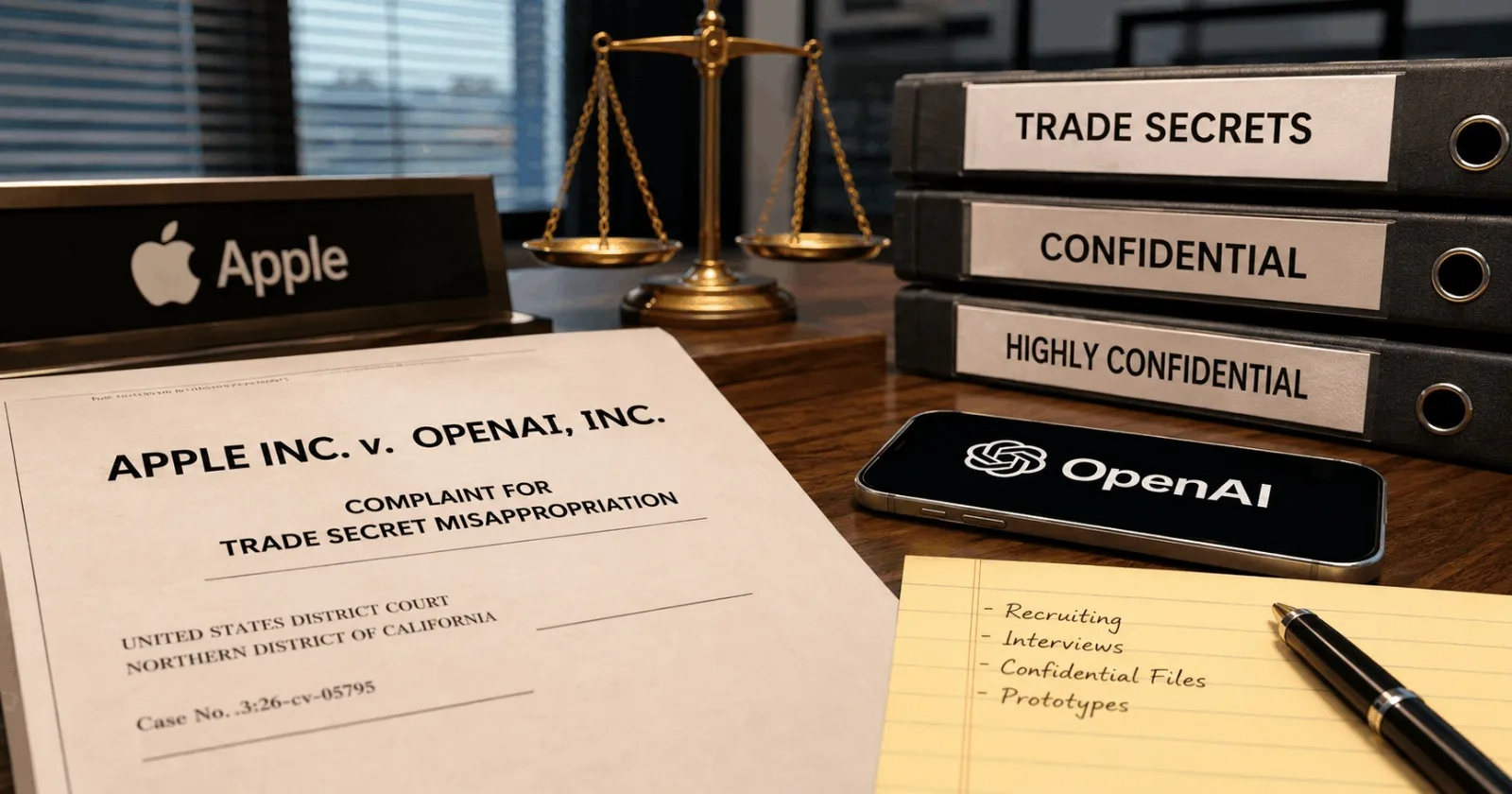
The text message that started it all
A former Apple engineer allegedly found his way back into Apple's internal network months after he was supposed to have returned his work laptop. Instead of reporting the security hole, Apple's lawyers say, he joked about it in a text to a friend still working there, and then quietly started downloading files.
That text message is now sitting inside a federal court filing. It is one small piece of a fight that, as of this week, has escalated to something rarer and more personal: Apple's lawyers sending individual legal letters to about 40 of the roughly 400 former Apple employees who now work at OpenAI, according to the Financial Times. The letters are not lawsuits. They are formal instructions to preserve documents and communications, and requests for one-on-one meetings with Apple's attorneys.
To understand why Apple is doing this to people who left years ago, you need the whole story. It involves a hardware executive who allegedly ran recruiting interviews like intelligence-gathering sessions, a laptop with a secret backdoor, a company that lost the job it now controls, and an IPO worth up to a trillion dollars sitting in the middle of it all.
What actually happened on July 10
On July 10, 2026, Apple filed a 41-page complaint in the U.S. District Court for the Northern District of California. The defendants: OpenAI itself (both its nonprofit and for-profit entities), io Products, and two individuals. Tang Yew Tan spent 24 years at Apple, rising to vice president of product design for the iPhone and Apple Watch, before leaving to become OpenAI's Chief Hardware Officer. Chang Liu spent eight years at Apple as a senior systems electrical engineer before joining OpenAI's hardware team in January 2026.
Apple's core claim is not that hiring these people was wrong. Poaching engineers is legal, and Apple's complaint concedes as much. The claim is what allegedly happened after: a coordinated effort to extract Apple's confidential product designs, manufacturing processes, and supplier relationships, allegedly directed from the top.
Apple says it tried to handle this quietly first. According to the complaint, it sent OpenAI a letter in February 2026 raising its concerns. OpenAI never responded. Five months later, Apple sued.
"...rotten to its core by its illegal reliance on misappropriated trade secrets."
That line is from the complaint itself, and it is one of the tamer ones.
The allegations read like a corporate thriller
The specific claims against Chang Liu are the most vivid. Apple alleges he kept an Apple-issued laptop after leaving the company, and later used it to exploit a previously unknown authentication bug to get back into Apple's network. From there, Apple says, he downloaded dozens of confidential files, including engineering presentations and a manufacturing specification for a circuit board. He allegedly texted his "LOL" discovery to Yu-Ting "Alyssa" Peng, a friend still at Apple who later joined OpenAI too, and mentioned in a separate message that he still had access to a second Apple device he planned to use the same way.
The claims against Tang Tan describe something more systemic. Apple alleges Tan used internal Apple project codenames during OpenAI job interviews to draw out more detail from candidates who still worked at Apple. In some interviews, Apple says he asked candidates to bring "actual parts," CAD files, or prototypes to a kind of unofficial show-and-tell. Apple also alleges OpenAI circulated a checklist, reportedly assembled by Tan, that helped new hires avoid tripping Apple's exit-security procedures.
Apple's complaint extends the pattern to io Products itself, the hardware company OpenAI acquired. It alleges io misled an Apple manufacturing partner into applying a proprietary Apple metal-finishing technique, and separately approached a battery supplier using internal Apple terminology that, in Apple's words, "only Apple-insiders would know to ask."
Apple is explicit that it thinks this is only what it has been able to document so far. Its complaint states plainly that discovery will show the misappropriation occurred on a scale many times larger than what is currently described. That is also, not coincidentally, the legal justification for sending preservation letters to 40 more people who were never named as defendants.
The rivalry nobody outside Apple knew about
Here is the detail that turns this from a standard trade-secrets case into something closer to a grudge match. According to Bloomberg's Mark Gurman, Tan and Apple's incoming CEO, John Ternus, have had a rocky relationship for years. Tan reportedly wanted the top hardware engineering job that Ternus won back in 2021.
Ternus is not a minor figure in this story. He currently runs Apple's hardware engineering division, and effective September 1, 2026, he becomes Apple's CEO, succeeding Tim Cook. Gurman also reports that the vast majority of the roughly 400 former Apple employees now at OpenAI came specifically out of Ternus's division. One executive who worked with Tan described him as someone known for "flying very close to the sun."
Put plainly: the man Apple accuses of running a trade-secrets operation is the same man who, five years ago, lost an internal competition for the job now held by the person about to become Apple's next chief executive. Whatever else this case is about, it is also an old rivalry that never really ended, just relocated to a courtroom.
The most famous name in the case isn't in the case
Jony Ive, the designer behind the iPhone and Apple's most celebrated industrial design era, co-founded io Products alongside Tan. He is not named as a defendant. Apple's complaint refers only to "former Apple leaders" who founded io, carefully avoiding his name.
Analysts do not think that omission means much in practice. Gene Munster of Deepwater Asset Management put it bluntly: Apple is effectively suing Jony Ive, whether his name appears in the filing or not.
This is also not the first time Tan and io's hardware ambitions have run into a trade-secrets accusation. A separate lawsuit, filed by a hardware startup called iyO over a trademark dispute involving the similar-sounding "io" name, was amended in March 2026 to add its own trade-secret claims, alleging a former iyO engineer passed confidential files to Tan. OpenAI disputes that case too. By the time Apple filed its own suit in July, Tan had already been publicly accused of the same basic pattern once before.
Frenemies: the partnership suing itself
Here is what makes this genuinely strange rather than just ugly: Apple and OpenAI are still, technically, partners. Since 2024, ChatGPT has been built into Apple Intelligence and Siri. That arrangement is not ending because of this lawsuit, though it is already fading for another reason: Apple unveiled a revamped, Gemini-powered voice assistant in June, built on Google's AI models instead of OpenAI's, with a wider rollout expected this fall.
The irony gets thicker. Back in August 2025, Elon Musk's xAI and X Corp had filed their own lawsuit accusing Apple and OpenAI of colluding, alleging Apple rigged App Store rankings to favor ChatGPT over Musk's Grok. In that telling, Apple and OpenAI were uncomfortably cozy, not fighting. That case is still working through federal court in Texas, with a trial date set for October 2026. Separately, Musk's own personal lawsuit against OpenAI over its shift away from a nonprofit mission had already been thrown out by a jury on statute-of-limitations grounds just two months before Apple's trade-secrets suit landed. When news of Apple's suit broke, Musk could not resist a jab, posting that "Scam Altman" had struck again, according to reporting from Creative Bloq.
Zoom out and the last year looks almost absurd. Musk sued Apple and OpenAI for allegedly working together too closely. Apple is now suing OpenAI for allegedly working against it. Both descriptions cannot really capture the same relationship, which is probably the point. Big-money tech partnerships are rarely as simple as "friend" or "rival."
OpenAI's defense, so far
OpenAI's public response has been careful and has evolved as the story has grown. Its first statement, issued within a day of the filing, was short: company spokesperson Drew Pusateri said, "We have no interest in other companies' trade secrets." Four days later, as more of the complaint's specific allegations circulated, OpenAI sharpened its position, telling Bloomberg it is "not aware of any evidence that this complaint has merit," while framing the departures at issue as a matter of employees being free to choose where they work.
Neither statement directly addresses the specific allegations, the laptop, the interview checklist, the supplier conversations. That is fairly ordinary in early-stage litigation, where companies tend to avoid confirming or denying details until they are required to answer in court. But it has not stopped commentators from noticing the gap. Longtime Apple blogger Michael Tsai, for one, wrote skeptically that it is hard to believe OpenAI's leadership had no idea what was happening, given how large and public the hiring spree from Apple had been.
We have watched this movie before
Silicon Valley has a genre for exactly this kind of dispute, and the most famous entry is Waymo v. Uber. In 2017, Google's self-driving unit accused a former engineer, Anthony Levandowski, of downloading thousands of confidential files before leaving to found a startup that Uber quickly acquired. That case settled in 2018 for roughly $245 million in Uber equity, four days into what was expected to be a month-long trial. Levandowski later pleaded guilty to a criminal trade-secrets charge, served part of an 18-month sentence, and was pardoned in 2021.
The Washington Post's Gerrit De Vynck called Apple's case against OpenAI the most aggressive trade-secrets fight he has seen since that one. Apple itself has run a smaller version of this play before: it sued chip startup Rivos in 2022 over alleged chip-design theft, a case that settled in 2024. Tesla sued Rivian in 2020 over similar allegations involving battery technology.
The legal bar in all of these cases is the same, and it is worth being precise about it. Under the federal Defend Trade Secrets Act, Apple has to show that the information was genuinely secret, that it took reasonable steps to protect it, that it was acquired or used improperly, and that this caused or is likely to cause real commercial harm. Hiring a rival's engineers is not, by itself, illegal. What is illegal is what those engineers allegedly did with what they knew on the way out the door.
Why the timing makes this worse for OpenAI
This lawsuit is landing at possibly the worst moment for OpenAI's corporate calendar. The company confidentially filed paperwork with the SEC to go public earlier this year, targeting a valuation that could approach $1 trillion, with a listing expected as soon as September 2026, the same month Ternus takes over as Apple's CEO. Discovery in a case like this routinely surfaces internal emails, messages, and depositions that were never meant to be public. For a company trying to present a clean growth story to investors ahead of one of the largest IPOs in history, a court-ordered document dump is close to the worst possible timing, regardless of how the underlying claims are eventually resolved.
That is likely why Apple's preservation letters matter beyond their literal legal function. Sending 40 individual letters to people who were never sued is not just a data-gathering exercise. It is a signal, to OpenAI and to every engineer thinking about leaving Apple next, that Apple intends to make this expensive, thorough, and very hard to make go away quietly.
What happens next
Nothing about this case will move quickly. Trade-secrets litigation of this size typically runs for one to two years before trial, and most cases like it settle rather than reach a jury, exactly as Waymo and Uber did. OpenAI has not filed a formal answer to Apple's complaint yet, and both companies have so far declined to discuss the preservation letters specifically.
What is already clear is the shape of the fight. Apple is betting that a wide net of depositions and internal records will prove a pattern, not just two rogue employees. OpenAI is betting that individual actions, even embarrassing ones, do not add up to the systemic scheme Apple describes. Somewhere underneath both arguments is a far more human story: a passed-over executive, a rival who now runs the company, and a hardware bet that both sides think is worth fighting this hard for.
Everything described in this blog concerns allegations made in an active civil lawsuit. No court has ruled on any of these claims, and none of the named defendants has been found liable for any wrongdoing.
Comments (0)
Join the discussion by logging into your account.