
Hi,
FinderGit 0.44.0 adds a page I wanted for myself: Cleaning.
Tens of gigabytes nobody wrote
Work on a few JavaScript projects, an Xcode app and the odd Go tool, and your disk fills up with folders you never wrote: every project's node_modules, every Next.js .next, Xcode's DerivedData, the download caches of npm, Yarn, Homebrew and Go. They are all rebuildable, since the next install or build makes them again, and they add up. On my own Mac the first scan found about 30 GB.
Cleaning sits under Account in the sidebar. The first time you open it, it scans your root folders, the caches in your home folder and every repository, and eight cards count up as the results arrive: node_modules, build output, Swift & Xcode, package caches, toolchains, Python, Git objects and a few other caches.
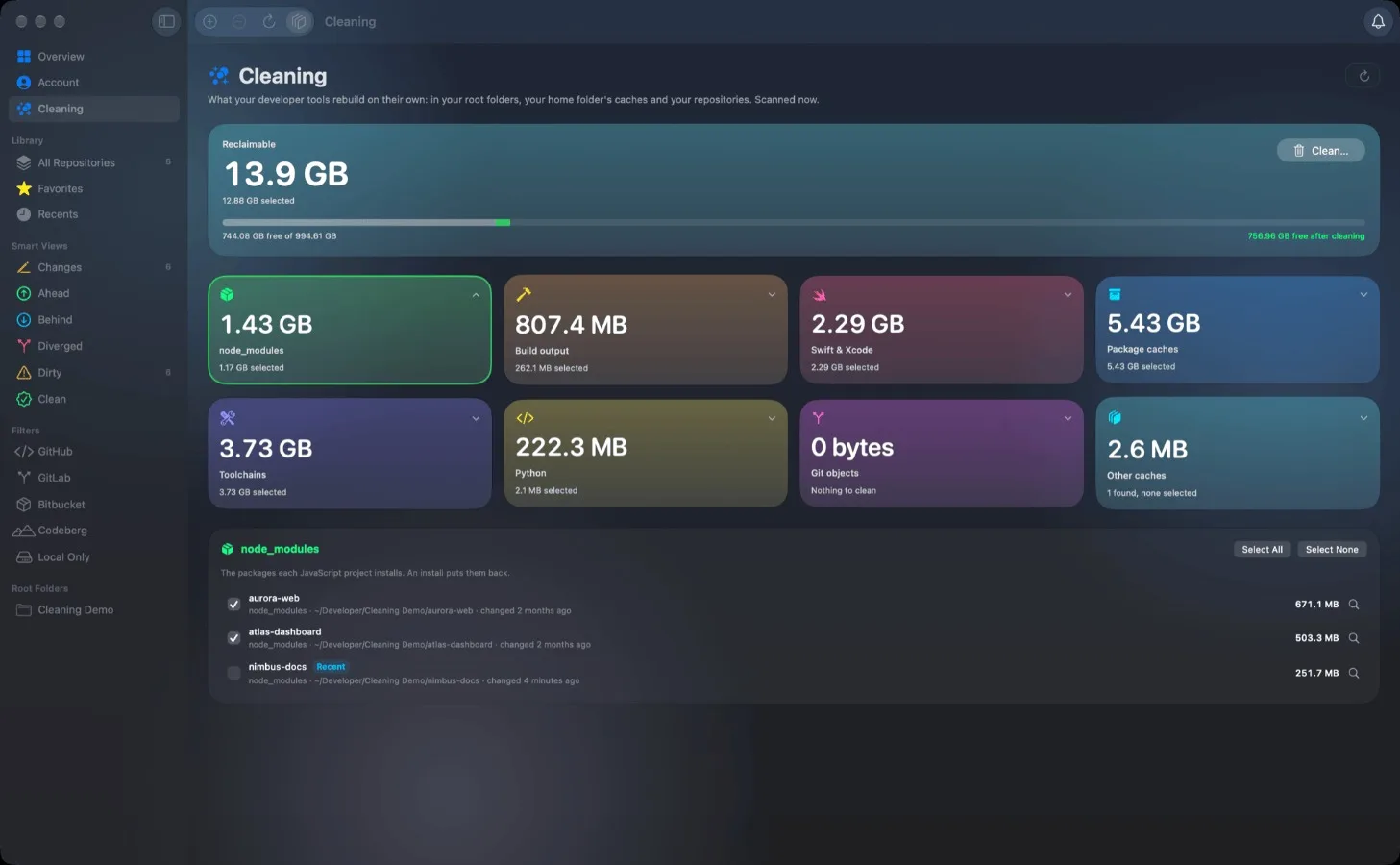
The Cleaning page on a set of demo projects: the two idle ones are ticked, the one changed today is left alone.
Only what you will not miss
Open a card and you see each folder: its project, its size, when it last changed. FinderGit ticks for you only what is safe, not in use and, inside a project, untouched for a month. A folder a dev server or a terminal is working in, one you changed recently, or one that takes longer to get back carries a badge saying why, and the choice is yours.
It is careful about what it calls rebuildable. Inside a repository, a folder is listed only when the repository's own .gitignore ignores it and it sits next to its project file, like a node_modules beside its package.json. Nothing Git tracks, no symbolic links, nothing inside .git. And each folder is checked again right before it goes.
Honest numbers
Each size is what deleting that folder alone gives back. Some package managers fill node_modules from a shared store, so part of what you see on disk is still held elsewhere, and Cleaning does not promise that as free space. The bar under the total shows your disk now and after cleaning.
When you press Clean, it asks once and then works largest first, with a Stop. Folders are deleted rather than moved to the Trash: the space is the point.
FinderGit is free, a universal binary (Apple Silicon + Intel), runs on macOS 15+, and is signed and notarized.
Website: findergit.app
Download: https://findergit.app/download
Comments (2)
Join the discussion by logging into your account.
Igor Ganapolsky
The re-check right before delete is the part that actually makes this safe. A scan can mark a folder idle, and a dev server or an install can open it before Clean runs. Deleting instead of moving to Trash means that gap is not recoverable. The size on a node_modules card is also easy to over-read. pnpm and Yarn keep the bytes in a shared store and only link them into the project. Removing the project folder frees the links, not the store, unless a prune of unreferenced entries runs too. The disk bar is only honest if it counts what the filesystem will actually return. gitignore plus a folder sitting next to package.json is not the same as rebuildable. A gitignored uploads directory, a local patch inside node_modules, or a generated client the lockfile cannot recreate all match that test and do not come back on the next install.