
At a glance
Spec | Value |
|---|---|
Visual generation parameters | 7B (32-layer single-stream DiT) |
Text encoder | Qwen3-VL 8B |
Native resolution | 2048x2048 (2K, 7 aspect-ratio presets) |
Reference images | Up to 10 |
Transparency | Native RGBA, in the base model |
Prompt rewriters | Two 9B checkpoints (T2I and I2I) |
License | Qwen Research License, non-commercial only |
Release date | September 20, 2026 |
Getting a first image out of it
Alibaba's Qwen team open-sourced Qwen-Image-2.1 today. Diffusers already supports it: maintainers merged a QwenImage21Pipeline the same day, per the Qwen-Image-2.1 GitHub README.
Installation is four pip commands: torch 2.4 or newer, transformers 5.17 or newer, the git build of diffusers, and accelerate.
import torch
from diffusers import QwenImage21Pipeline

pipe = QwenImage21Pipeline.from_pretrained(
    "Qwen/Qwen-Image-2.1", torch_dtype=torch.bfloat16
).to("cuda")

image = pipe(
    prompt="A weathered lighthouse at dusk, storm clouds on the horizon",
    num_inference_steps=40,
    generator=torch.Generator("cuda").manual_seed(7),
).images[0]

image.save("lighthouse.png")
Default output is native 2048x2048, with seven aspect-ratio presets from 1:1 up to 16:9 and 9:16, each mapped to a fixed pixel size rather than an upscaled crop.
Editing uses the same pipeline call. Pass an existing image alongside the prompt, and Qwen-Image-2.1 treats it as a condition instead of routing to a separate model.
For anyone without a local GPU worth the download, ComfyUI and ModelScope both list Qwen-Image-2.1 as natively supported from day zero, with prebuilt workflow templates for both text-to-image and editing.
Under the hood: one model, two jobs
Qwen-Image-2.1 is a single-stream diffusion transformer: 32 layers holding 7B parameters in the visual generation component, paired with a Qwen3-VL 8B vision-language model as the text encoder and a 64-channel RGBA autoencoder that compresses images 16x, per the project's README. The RGBA channel count is what lets a single VAE round-trip transparent images without a separate codec.
The attention pattern is block-causal rather than fully bidirectional: text tokens use a standard left-to-right causal mask, while image tokens inside the same block attend to each other bidirectionally. The rule, straight from the repository, is (q_idx >= kv_idx) or same_image_block.
That mixed granularity is also what makes prefix KV cache reuse possible. Once a condition image and its instructions are encoded at the first denoising step, they are cached and reused for every later step instead of recomputed.
flowchart LR
    A[Text prompt] --> B[Qwen3-VL 8B text encoder]
    C[Condition images, up to 10] --> B
    B --> D[32-layer single-stream DiT]
    D -->|prefix KV cache reused across steps| D
    D --> E[64-channel RGBA VAE, 16x compression]
    E --> F[Output image, opaque or transparent]
For editing tasks with several reference images, that caching is the actual efficiency gain, not just a footnote.
Encoding cost for the conditioning context is paid once per generation rather than once per denoising step. That is where compact and efficient stops being a slogan and starts being a measurable speedup.
Native transparency, in one model instead of two
Until this release, transparent image generation lived in a separate checkpoint. Alibaba shipped that capability on its own on December 19, 2025, as Qwen-Image-Layered, a dedicated model for RGBA layer decomposition.
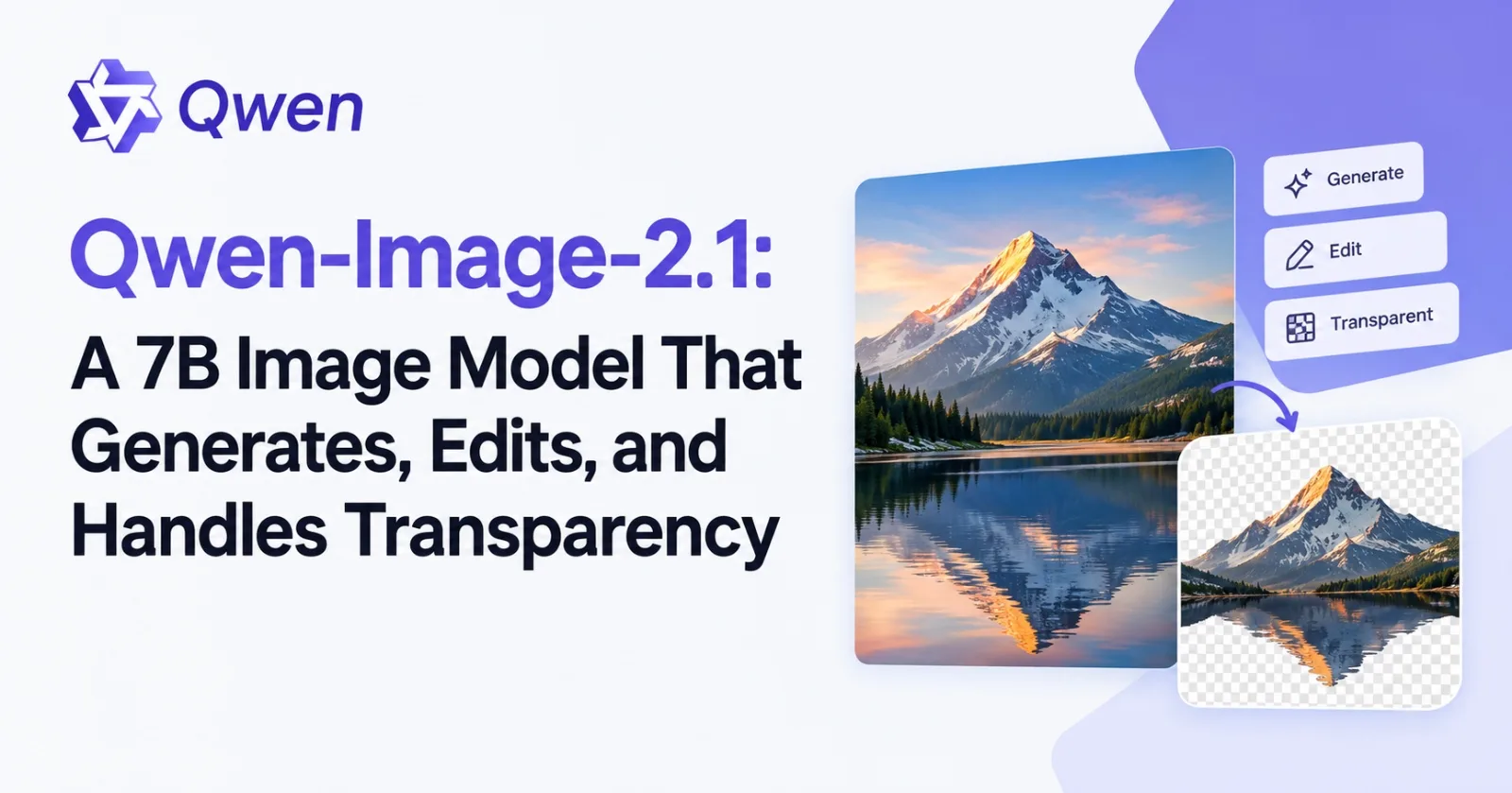
Qwen-Image-2.1 folds that capability into the main model, per the GitHub README. The same weights generate an opaque image or a transparent one depending on the prompt, and can extract a subject from an ordinary photo onto a transparent layer.
Editing extends to transparent layers directly, and to up to 10 reference images at once for multi-subject composition. Local edits are specified by a circle, a painted annotation, or a separate mask, rather than a full prompt rewrite.
Getting reliable RGBA takes specific phrasing: stating outright that the image has an alpha channel and a transparent background, rather than leaving the model to infer it from context.
The prompt rewriters most people will skip
Two checkpoints ship alongside the image model that are easy to miss: Qwen-Image-2.1-PE-T2I and Qwen-Image-2.1-PE-I2I, both fine-tuned Qwen3.5-VL 9B models, per the GitHub README. One expands short text-to-image prompts, the other rewrites editing instructions before the diffusion model sees them.
Skipping them still works, but the repository frames them as the recommended path. They share one codebase, distinguished only by a --task flag.
The I2I rewriter's system prompt is worth reading directly, because it makes an unusually specific call on language, per OrcaRouter's read of the shipped system prompt.
The prose describing an edit follows the language of the user's instruction, but the text rendered inside the output image follows a separate priority order entirely: an explicitly named language wins first, matching whatever text already appears in the source image wins second, and only with neither present does the rewriter fall back to the instruction's own language rather than defaulting to English.
For anyone generating localized packaging or signage, that split between description language and rendered-text language is the difference between a usable asset and one that needs a second pass.
What it costs to run and where it already fits
Component | Size | Role |
|---|---|---|
Qwen/Qwen-Image-2.1 | about 33 GB total (DiT roughly 14 GB, text encoder roughly 17.5 GB, plus VAE) | Base model: generation and editing |
Qwen-Image-2.1-PE-T2I | about 18.8 GB | Prompt rewriter for text-to-image |
Qwen-Image-2.1-PE-I2I | about 18.8 GB | Prompt rewriter for image editing |
Sizes per OrcaRouter's independent measurement; architecture figures per the GitHub README.
The text encoder, not the diffusion transformer, is the bulk of that download. On constrained GPUs, the standard escape hatch is pipe.enable_model_cpu_offload(), which the repository documents as the memory-saving path rather than a true fix.
Framework support landed broadly on release day: Diffusers, ComfyUI, vLLM-Omni with prefix KV caching and FP8 quantization, SGLang-Diffusion, and LightX2V all list Qwen-Image-2.1 support dated September 20, 2026, and AMD Radeon GPUs and eight other chip platforms are covered through ROCm and the FlagOS stack, per the GitHub README.
SGLang's pull request actually landed three days before the weights did. That means the serving path was validated against real checkpoints rather than written from the model card afterward, as OrcaRouter notes.
The catch: a research license and no independent numbers yet
The sharp edge: this is a non-commercial research license. Commercial use requires a separate agreement with Alibaba, and no third party had independently verified the vendor's benchmark claims as of release day.
Qwen-Image-2.1 ships under the Qwen Research License Agreement, which grants rights for non-commercial purposes only; commercial use requires a separate license requested directly from Alibaba, per the GitHub README.
That is a real change from the original Qwen-Image line, which shipped under Apache 2.0. Anyone porting an existing pipeline over needs to re-read the license file rather than assume continuity, as OrcaRouter points out.
No third party had reproduced Alibaba's own benchmark numbers as of release day. The vendor's Qwen-Image-Bench comparison chart should be read as a vendor claim until someone outside Alibaba runs it independently, per OrcaRouter's assessment.
The closest thing to independent signal is a single early-access tester's report: roughly 10 to 15 seconds per text-to-image generation and 18 to 23 seconds per edit, plus a specific failure mode: multi-reference consistency degrading from about three input images onward, with hairstyle details like a side ponytail collapsing toward center at profile angles, per OrcaRouter.
That is one reviewer on a pre-release interface, useful as a data point but not a benchmark.
Where this leaves things
Qwen-Image-2.1 is worth pulling down today for evaluation. The architecture choices are well-documented, and day-zero framework support means the tooling around it is not a guessing game.
Native transparency plus 10-reference editing genuinely close gaps that used to require separate models.
It is not yet worth shipping in a commercial product. The license does not currently allow it without a separate agreement, and every quality claim so far traces back to Alibaba's own material.
Whether a commercial license follows is the open question worth tracking, particularly given Alibaba is running Qwen-Image 3.0 as a closed, hosted alternative in parallel, as OrcaRouter frames it.
Bottom line: worth downloading today for evaluation. Not yet worth shipping in a commercial product.
Comments (0)
Join the discussion by logging into your account.