
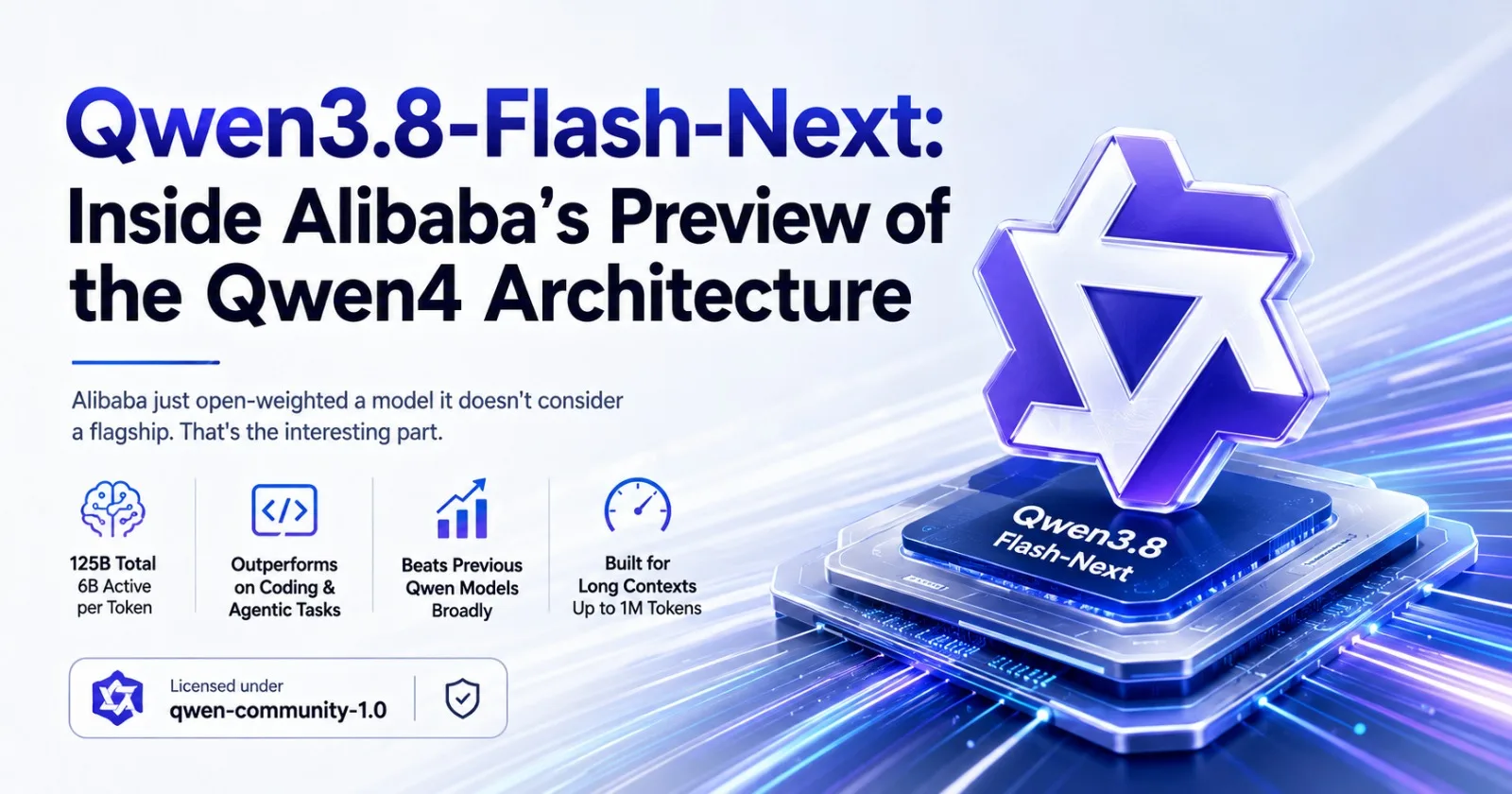
Alibaba just open-weighted a model it doesn't consider a flagship. That's the interesting part.
On August 26, 2026, the Qwen team released Qwen3.8-Flash-Next — a working preview of the architecture meant to underpin Qwen4. It's the same move they made with Qwen3-Next, which went on to power every Qwen release from 3.5 through 3.8. This time it shipped with full benchmark tables, some real deployment headaches, and a live argument on Hacker News about whether the thing overthinks.
The gist:
125B parameters, only 6B active per token — 180B on disk once you count the extras
Beats the previous open Qwen models on most coding and agentic benchmarks
Still loses to Claude and DeepSeek on a couple of the hardest reasoning tests
Real weights are out now, but llama.cpp and default vLLM configs haven't caught up yet
Here's the detail behind each of those points, checked against Alibaba's own model card and technical report, plus independent reporting.
The numbers that matter
125B parameters in the main MoE backbone, only 6B activated per token
A 51B-parameter N-gram embedding table (explained below), plus a 4B multi-token-prediction module — 180B parameters on disk in total
48 layers, hidden dimension 2560, arranged as 12 repeating blocks of three Gated DeltaNet layers followed by one Qwen Sparse Attention layer
512 experts in the MoE layer, with 10 routed plus 1 shared expert active at a time
262,144-token native context, extendable to 1,000,000 tokens via YaRN
Released under the qwen-community-1.0 license — not Apache 2.0, so check the terms before assuming it's as permissive as earlier Qwen releases
A production-ready sibling, Qwen3.8-Flash, is coming to the QwenCloud API separately. Same architecture, more built-in tooling, 1M-token context by default. Pricing is quoted at $0.16 per million input tokens and $0.47 per million output tokens.
Four architecture changes worth knowing
Alibaba frames the release around four systematic changes: attention, residuals, embeddings, and training.
Hybrid attention: GDN + QSA
Three of every four layers use Gated DeltaNet, a linear-attention mechanism that compresses conversation history into a fixed-size running state instead of keeping it all around.
The fourth layer runs Qwen Sparse Attention (QSA), a new mechanism that picks out the important parts of a long context at a coarse "micro-block" level rather than scoring every token. Each layer does this independently rather than sharing one index model-wide. Qwen's own shorthand: one layer type handles memory, the other handles retrieval.
Gated Residual
Between layers, the residual stream splits into four parallel branches, each with its own gate controlling how much information passes through. It's extra routing capacity that doesn't cost anything extra at inference time.
N-gram Embedding
Instead of embedding only single tokens, a 20-million-entry table of common bigrams and trigrams sits at layer 2 — a built-in phrase dictionary. Because it's a lookup table rather than something needing constant GPU compute, it can live in ordinary system RAM (NVIDIA hardware only, for now). That's 51B parameters of added capacity without needing 51B parameters of GPU memory.
A retuned training recipe
Muon and AdamW are applied to different categories of weights. The team also skipped the usual batch-size warmup, jumping straight to the target batch size using refitted scaling laws. Fewer optimizer steps, larger learning rates, no apparent loss of stability. Alibaba credits this — plus the architecture changes — for training the model at roughly 1/9th the cost of Qwen3.7-Plus.
What the benchmarks actually show
Qwen's own comparison table puts Flash-Next ahead of Qwen3.8-27B (a 27B dense model) and Qwen3.7-Plus (397B total, 17B active) on most coding and agentic metrics:
Benchmark | Qwen3.8-Flash-Next | Qwen3.8-27B | Qwen3.7-Plus | DeepSeek-V4-Flash-0731 | Claude-Opus-4.6 (Max) |
|---|---|---|---|---|---|
SWE-bench Pro | 62.5 | 61.7 | 55.8 | 56.0 | 53.4 |
DeepSWE 1.1 | 58.7 | 42.2 | 16.5 | 54.4 | — |
CoWorkBench (agentic office work) | 73.9 | 70.7 | 65.1 | 45.1 | 68.2 |
AndroidWorld (mobile use) | 84.5 | 81.9 | 81.0 | — | 62.0 |
NL2Repo-Bench | 48.1 | 42.3 | 41.1 | 54.2 | 47.6 |
HLE (multidisciplinary reasoning) | 35.9 | 30.8 | 34.7 | 33.8 | 40.0 |
Where it doesn't win
DeepSeek's V4-Flash-0731 still wins on repo-level code generation. Claude Opus 4.6 (Max) leads on Humanity's Last Exam. The gap between a 6B-active model and the largest closed models on raw frontier reasoning hasn't closed — MarkTechPost's independent write-up flagged the same two results as the clearest counterexamples.
Where Flash-Next does look strong is agentic and coding work, measured against models closer to its own weight class.
The speed claims
Alibaba says QSA delivers up to 7.6× faster prefill and 4.9× faster decoding at a 1M-token context. Under a 90%-prefix-cache-hit workload — typical agentic traffic — it claims 8.6× the prefill throughput of Qwen3.7-Plus.
Worth flagging: SGLang's and vLLM's own recipe pages cite different multipliers (10.2× and 6.6×) for what looks like the same comparison. These are vendor- and integrator-reported numbers, not anything independently reproduced yet.
It thinks by default — and people have noticed
Easy to miss in a spec sheet: Flash-Next reasons before it answers. It generates a visible thinking trace by default, adjustable via a reasoning_effort setting (xhigh, medium, or low). It also preserves that reasoning across conversation turns unless told otherwise.
That last detail probably explains part of the prefix-caching throughput numbers — a preserved reasoning trace is exactly the kind of context that gets reused turn to turn in agentic settings.
It's also the subject of the liveliest thread on the model's Hacker News launch post. Commenters are half-jokingly debating whether it overthinks relative to its predecessor. That echoes an earlier, more concrete complaint: one business user found Qwen3.8-27B (and GLM 5.2) burned through a lot of input tokens on repeated reasoning turns, compared with Claude and GPT models on the same workloads. Nobody in the thread had hard numbers for Flash-Next yet. Open question, not a settled one.
Good luck running it today
Mainline llama.cpp doesn't support the new architecture yet — a fix was in progress on launch day. vLLM and SGLang need model-specific recipes, not default configs. On an 8×H200 node, Alibaba's own guidance calls for a particular parallelism setup, because the standard configuration isn't compatible with the checkpoint's quantization layout. The FP8 checkpoint alone runs about 173 GiB.
The flip side is why the local-LLM crowd is excited anyway. Only 6B parameters activate per token, so quantized builds fit on consumer hardware. One Hacker News user reported a roughly 73GB version already running via Unsloth Desktop — small enough for a single high-end Mac Studio or an AMD "Strix Halo" mini-PC. That's hardware that couldn't realistically serve a dense model this capable.
Where it sits in the market
Alibaba's actual flagship, Qwen3.8-Max, is a far bigger model — reportedly 2.4 trillion parameters. The Decoder describes it as competing directly with Claude Opus 4.8, Gemini 3.1 Pro, and OpenAI's GPT-5.6 line, and reports that Flash-Next performs just below that flagship at roughly a twelfth of the cost.
Zoomed out, this release lands in the middle of a genuine price war. OpenAI has reportedly cut prices sharply on part of its GPT-5.6 lineup. Moonshot's Kimi K3 is competing at over 2.8 trillion parameters. DeepSeek's own low-active-parameter "Flash" model is already priced aggressively.
Hacker News commenters didn't even agree on how Flash-Next's $0.16/$0.47 pricing stacks up against DeepSeek's current rates — DeepSeek's pricing reportedly shifts with demand. Treat any specific head-to-head number here as a snapshot, not a fixed comparison.
Bottom line
Alibaba isn't claiming this is the best model available this week. It's explicit that this is a public rehearsal for Qwen4.
Judged on those terms, it's a substantive one. Real weights, a real technical report, four architectural changes you can inspect rather than take on faith. It beats its own previous generation broadly, loses to bigger closed models exactly where you'd expect a 6B-active model to lose, and is already causing minor headaches for anyone trying to run it today.
If the Qwen3-Next precedent holds, expect these same four ideas to reappear, refined, in whatever ships as Qwen4.
Sources: Qwen/Alibaba's official Hugging Face model card and technical report citation; MarkTechPost; The Decoder; Unite.AI; AIBusiness; the Hacker News discussion on the launch post.
Comments(0)
Join the discussion by logging into your account.
No comments yet. Be the first to comment!