
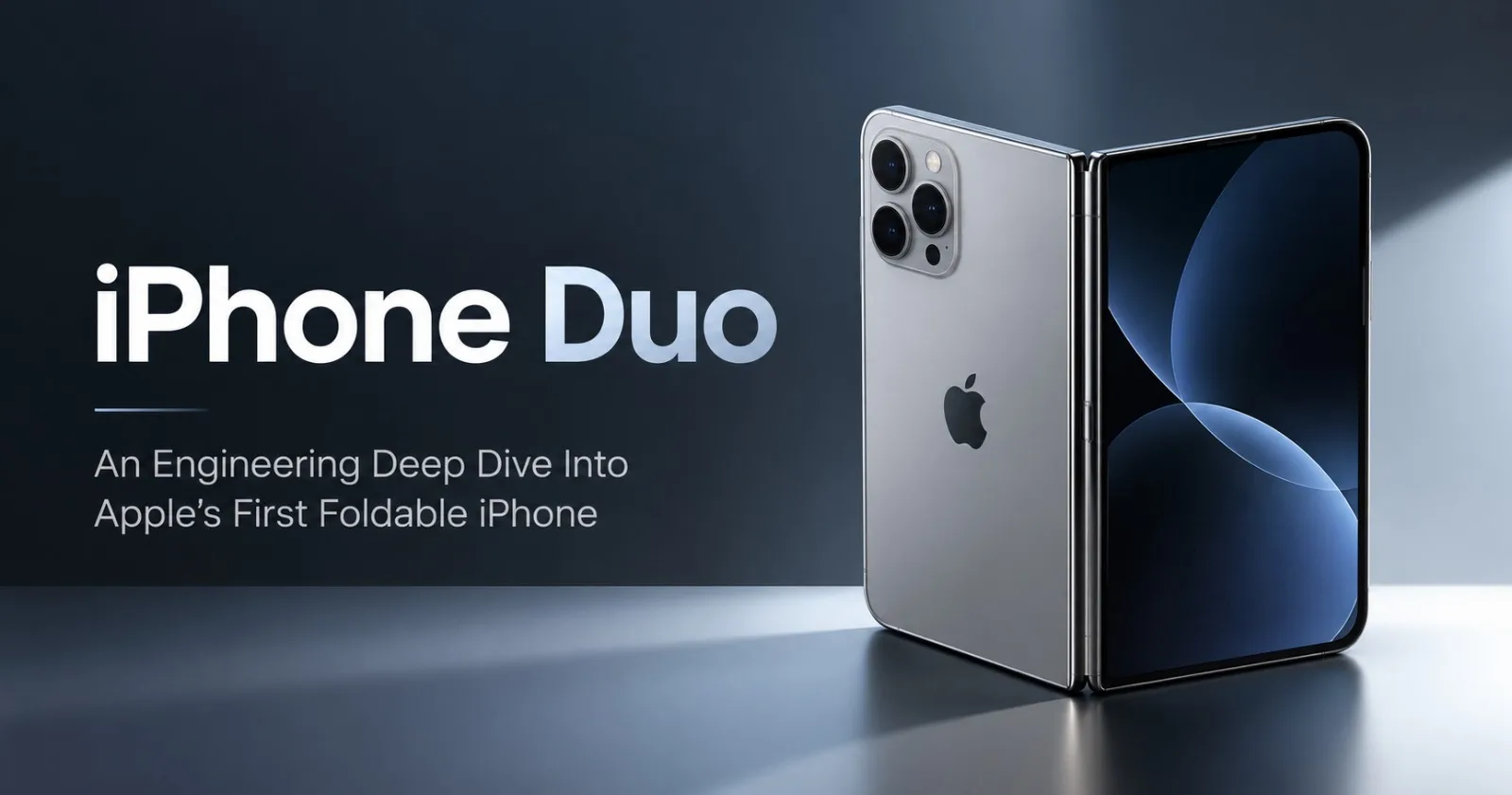
Published September 10, 2026
Apple unveiled its first foldable iPhone on Wednesday, September 9, 2026, at its "Surprise and Shine" event at Apple Park. The device is called the iPhone Duo.
The event also introduced the iPhone 18 Pro and Pro Max, Apple Watch Series 12, and Apple Watch Ultra 4. It was notable for a second reason: it was the first keynote delivered by John Ternus as Apple's CEO, following a leadership transition from Tim Cook earlier this month.
Pre-orders open October 16 at 5 a.m. Pacific. The device ships October 23 in more than 70 countries and regions, with a further 28 following on October 30. Pricing starts at $1,999 for 256GB and runs to $3,199 for 2TB, in two finishes — Star White and Night Sky.
This piece is a technical breakdown of how the Duo is built: display stack, hinge mechanics, internal architecture, thermal design, and software — based on Apple's own tech-specs page, its September 9 press materials, and the first wave of hands-on reports.
TL;DR
Apple's foldable problem was never "does it fold" — it was "does it fold without any visible compromise": no crease, no throttling, no weight penalty you'd notice in daily carry.
The hinge is fully sealed to an IP68 rating (dust and water resistant to 6 meters for 30 minutes) — stronger than Samsung's competing Galaxy Z Fold 8, which is rated IP48. The inner display uses a nano-texture matte finish, borrowed from Apple's Mac and iPad line, to diffuse light across the fold line rather than relying purely on hinge geometry to hide it. Early hands-on reports are split on whether the crease is actually invisible or just less visible.
Weight and thickness are confirmed directly on Apple's own tech-specs page: 254g whether open or closed, 5.2mm thick open and 11.3mm closed.
Sustained thermal throttling is not resolved at all: no independent benchmarks exist yet, because reviewers don't have units in hand ahead of the October 23 release.
1. Why Apple Was Late, On Purpose
Apple's smartwatch, wireless earbuds, and tablet all followed existing product categories rather than opening them — and the same pattern held here. Apple let Samsung, Huawei, Honor, Oppo, and others spend years discovering foldable failure modes — crease depth, hinge dust ingress, panel delamination, battery aging asymmetry, under-display camera quality — before entering the category itself.
There's a small bit of symmetry in the timing: the iPhone Duo announcement landed just three days after the seventh anniversary of Samsung's original Galaxy Fold going on sale. That phone launched first in South Korea on September 6, 2019, followed by Europe on September 18 and the US on September 27.
2. Display Architecture
2.1 The Stack
The inner 7.6-inch display — which Apple describes as roughly 50% larger in area than the iPhone 18 Pro Max's display — is built from multiple layers of custom polymer, the OLED panel itself, more than one glass layer, and a titanium backing plate.
These layers are bonded with a flexible adhesive loose enough to let them slide against each other slightly during a fold, rather than stretching and stressing as a single rigid unit.
The 5.4-inch outer display, by comparison, covers more than 90% of the screen area of a standard iPhone 18 Pro.
graph TD
    A["Nano-Texture Cover Layer — matte glass finish, diffuses light across the fold line"] --> B["Touch Sensor — On-Cell"]
    B --> C["LTPO OLED Emissive Layer"]
    C --> D["Thin-Film Encapsulation (TFE)"]
    D --> E["Flexible Adhesive — allows layer-on-layer slip during fold"]
    E --> F["Custom Polymer + Glass Layers"]
    F --> G["Titanium Backing Plate, slotted at the fold axis"]
The nano-texture layer is the newest element of the stack: the same treatment already used on high-end Mac and iPad displays, applied here for the first time to a folding OLED. Apple's own materials describe it as reducing glare and "minimizing crease visibility" — the word minimizes, rather than eliminates, is worth noting on its own.
2.2 The Crease Problem
A crease at the fold line is a mechanical inevitability on any foldable OLED, not a manufacturing defect — the question is only ever how reduced it is, not whether it's eliminated. Early reporting on the Duo's real-world visibility is genuinely mixed.
Some hands-on accounts describe the crease as effectively gone — visible under a fingernail if you go looking, but not visually detectable — credited to the nano-texture's light-diffusing effect. Other early hands-on photos and videos from the same event show a crease that's visible at certain angles.
Nobody's had the device for more than a few hours, and lighting conditions at a demo table aren't the same as everyday use. Real judgment on this will need a few weeks of ordinary use, not a hands-on session.
3. Hinge Mechanics
The hinge assembly is titanium, built from more than 100 individual components, with a 3D-printed titanium cover and internal support ribs reinforcing the structure, all under the outer titanium panel. It holds the device open smoothly at any angle, with a damped, resistant feel rather than snapping loosely between positions.
The more notable part: it's sealed well enough for an IP68 rating covering both dust and liquid ingress to 6 meters for 30 minutes.
The rest of the body uses Ceramic Shield 2 on the front (the outer display) and Ceramic Shield on the back — Apple's standard scratch-resistant glass, not something unique to the foldable.
That's a meaningfully stronger ingress rating than any current foldable on the market, including Samsung's own current-generation Z Fold 8, which is rated IP48 (protected against solid particles larger than 1mm, but not certified dust-tight, with a 1.5m/30min water rating). Hinge dust ingress has historically been one of the failure modes that dogged early Z Fold generations — on this specific axis, Apple's first attempt already beats the eighth-generation competitor.
graph LR
    subgraph HA["Housing Half A"]
        L1["Titanium frame"]
    end
    subgraph HM["Hinge Module — 100+ components"]
        H1["Multi-bar synchronization gear train"]
        H2["3D-printed titanium cover"]
        H3["Internal support ribs"]
        H4["IP68 dust/liquid seal"]
    end
    subgraph HB["Housing Half B"]
        R1["Titanium frame"]
    end

    L1 --> H1
    H1 --> H2
    H2 --> H3
    H3 --> H4
    H4 --> R1
What's still unpublished: a hinge cycle rating. Apple hasn't put a number on it, and there's no independent durability testing yet since units aren't in reviewers' hands.
4. Internal Architecture
iPhone Duo uses Touch ID built into a side button as its primary biometric, with the option to unlock via a paired Apple Watch instead — there's no Face ID anywhere on the device. Apple did add a new FaceTime camera hidden beneath the inner display, but it's for video calling, not authentication.
graph TB
    SoC["A20 Pro SoC — same chip as iPhone 18 Pro / Pro Max"]
    Vapor["Vapor Chamber — thermal management"]
    BatA["Battery Cell A"]
    BatB["Battery Cell B"]
    FPC["Flexible Interconnect — routes power/data across the hinge"]
    Disp["7.6in Inner OLED Panel"]
    CoverDisp["5.4in Cover Display"]
    Cam["Dual 48MP Rear Camera — Main (2x Telephoto crop) + Ultra Wide"]
    Touch["Touch ID — Side Button"]
    Ctrl["Camera Control Button"]

    BatA --> FPC
    BatB --> FPC
    SoC --> Vapor
    SoC --> FPC
    FPC --> Disp
    FPC --> CoverDisp
    SoC --> Cam
    Touch --> SoC
Confirmed internals:
Chip: A20 Pro — a 6-core CPU (2 performance cores, 4 efficiency cores) that Apple says is up to 20% faster than the A19 Pro, a 7-core GPU with Neural Accelerators, a dual 16-core Neural Engine, and hardware-accelerated ray tracing, per Apple's tech-specs page. Notably, this is the same silicon used across the entire iPhone 18 Pro line — not a separately binned part for the foldable.
Modem: Apple's in-house C2, which the company describes as bringing AI-powered improvements to cellular quality and reliability, with mmWave support in the U.S.
RAM: not listed on Apple's tech-specs page, consistent with Apple's usual practice — but independent spec databases (GSMArena, PhoneArena) converge on 12GB.
Camera: a 48MP Fusion Main lens (26mm, f/1.6) with an integrated optical-quality 2x Telephoto crop, paired with a 48MP Fusion Ultra Wide (13mm, f/2.2) — the same ultra-wide sensor used on iPhone 18 Pro. There's no separate telephoto lens element; the 0.5x-to-2x range across the two sensors is what gives Apple's "4x optical zoom range" figure. Digital zoom extends further, though the exact ceiling isn't published. A Camera Control button carries over from the Pro line, and the front-facing FaceTime camera — hidden beneath the inner display when not in use — supports Center Stage.
Battery: a genuine dual-cell system, one cell per side. Apple doesn't publish the combined mAh figure, instead rating it at up to 24 hours of typical use, 31 hours of video playback on the inner display, or 44 hours on the outer display.
Connectivity: eSIM-only worldwide — no physical SIM tray in any market.
Four camera features are exclusive to the Duo and lean on the cover display: Smart Take (fires automatically once everyone in frame is posed), Duo Preview (shows the subject a live preview on the outer screen), Kid Cue (kid-facing animations to help get their attention for a shot), and Duo FaceTime (lets someone nearby join a FaceTime call using the cover display).
The flexible interconnect board crossing the hinge is the least glamorous, most failure-prone part of the whole device — Apple hasn't detailed it, and it's the kind of component nobody notices unless it fails.
5. Thermal Design
Apple includes a dedicated vapor chamber for thermal management. There's no indication of a separately binned, lower-clocked chip — the A20 Pro appears to be identical silicon across the whole September lineup, with the vapor chamber doing the work of keeping it fed under sustained load in a thinner enclosure.
Apple states the combination delivers up to 35% better sustained performance than iPhone 17 Pro, though that's Apple's own comparison, not an independent benchmark.
What's still unconfirmed: actual sustained-load throttling behavior on the Duo specifically. That requires the kind of extended benchmark testing reviewers do with units in hand over days, not a keynote demo or a brief hands-on session — nobody has published independent numbers yet.
6. Software
The device ships with a version of iOS 27 tailored to the foldable form factor — specifically iOS 27.1, a point release ahead of the iOS 27 that ships to standard iPhones on September 14. That gap suggests Apple wanted extra polish time for the foldable-specific build before it reached customers.
On multitasking: the unfolded display supports Split View, with two apps open side by side for the first time on iPhone, plus the ability to open two windows of the same app. Lock Screen controls, the Dock, and navigation elements shift to the side of the display to maximize vertical space for content, and the Dynamic Island is redesigned to sit vertically along the edge of both displays.
iOS also reacts to the physical state of the device — content adapts as it folds, reorients when turned to the side, and switches to the appropriate display when the phone is flipped over.
The cover display runs full apps, not a stripped-down watch-like interface. Hands-on reports describe apps like Netflix continuing seamlessly from the cover display to the inner display mid-session as the phone unfolds — closer to "full iOS, scaled" than to the constrained-cover-UI approach some Android foldables use.
Apple is also releasing developer SDKs for the foldable form factor, with upcoming support for iPhone Duo in Xcode's Device Hub, and says a handful of major apps — Netflix, Zoom, and Slack among them — were already adapted ahead of launch.
7. Confirmed Specs
Metric | Spec |
|---|---|
Folded thickness | 11.3mm |
Unfolded thickness | 5.2mm |
Weight | 254g (same open or closed) |
Hinge cycle rating | Not published |
Crease visibility | Apple's own copy: nano-texture "minimizes" crease visibility — hands-on reports mixed on how visible it still is |
Combined battery capacity | Not published (rated instead as ~24h typical use, 31h inner-display video, 44h outer-display video) |
Sustained throttle vs. peak | Not yet measured — no independent reviews published as of launch day |
Cover display size | 5.4" |
Inner display size | 7.6" |
IP rating | IP68 — dust and water to 6m/30min, stronger than any current competing foldable |
Chip | A20 Pro — same silicon as iPhone 18 Pro / Pro Max |
Biometrics | Touch ID, side button (or Apple Watch unlock) |
Telephoto | No separate lens — 2x optical-quality crop built into the 48MP Main camera |
Starting price | $1,999 (256GB) up to $3,199 (2TB) |
The two most architecturally significant choices here: Apple went with Touch ID over Face ID, and it reused the same A20 Pro silicon across the whole 18 Pro line rather than building a bespoke chip for the foldable — both signal that Apple is treating the Duo as an extension of its existing platform, not a standalone one.
8. The Bear Case
Price and update commitment: at matching 256GB storage, the Duo costs exactly $100 more than Samsung's non-Ultra Galaxy Z Fold 8, which starts at $1,899. Samsung and Google both guarantee seven years of OS and security updates; Apple's own published minimum is five years of security updates — a commitment it only made in 2024, partly in response to UK regulation — though in practice major iOS updates have typically run closer to six years.
Crease vs. marketing bar: Apple's own hands-on demo leaned hard on the nano-texture story, and CEO John Ternus's keynote didn't address crease depth directly. Apple's press materials do address it, though only glancingly — the official copy describes the nano-texture finish as something that "minimizes crease visibility," which is itself a tell: Apple's own wording concedes there's a crease to minimize, not one that's been eliminated.
Third-party app scaling: SDKs and launch-day partners (Netflix, Zoom, Slack) are already adapted, which is a proactive start — but that's a small fraction of the App Store, and the iPad's experience suggests broad third-party adaptation, if it happens at all, takes years rather than a launch window.
9. Where Apple's Engineering Edge Shows Up
Vertical integration on the SoC: reusing the A20 Pro across the whole lineup and pairing it with a dedicated vapor chamber is arguably a cleaner use of vertical integration than a bespoke chip would have been.
Cross-product display reuse: the nano-texture treatment from Mac and iPad is the actual crease-mitigation lever here, not hinge geometry alone — a direct, confirmed example of engineering reuse across product lines.
Supply chain patience: entering seven years after Samsung's first foldable let Apple ship IP68 out of the gate, on a spec where the rest of the category is still catching up.
10. Bottom Line
One day of hands-on impressions isn't enough to say whether this is the first foldable where you forget it folds at all — but the early signal leans "mostly" rather than "yes" or "no." The hinge feel, the IP68 sealing, and the cover-to-inner-display software handoff all got specific, favorable call-outs in first impressions.
The crease is real but reduced — by Apple's own admission, not just outside reporting — and reasonable people who spent a few minutes with the same device at the same event have already disagreed about how visible it actually is.
Sustained thermal performance remains completely unmeasured by independent reviewers until they get units ahead of the October 23 release. The fold, again, wasn't really the hard part. What's still genuinely open is whether it holds up under a week of normal carry rather than a keynote demo table.
Sources
Apple Newsroom, Apple unveils iPhone Duo
MacRumors, iPhone Duo: Everything We Know and Apple Announces Foldable 'iPhone Duo'
TechCrunch, Apple unveils its first foldable, the iPhone Duo
NPR, Fold the phone: Apple's new CEO unveils a foldable iPhone
CNN Business, Apple event: CEO John Ternus reveals foldable iPhone Duo
TechAeris, Apple iPhone Duo Debuts as Apple's First Foldable iPhone
Digital Trends, Apple's September 2026 event roundup
TechCabal, iPhone Duo: Price, release date, specs, and features
Tom's Guide, iPhone Duo is official
9to5Google, iPhone Duo hands-on videos reveal Android foldable pain points
Cult of Mac, Looks like iPhone Duo avoided the curse of the crease
TechRadar, iPhone Duo hands on
Gizmodo, iPhone Duo Hands-On: The Inner Screen Looks Like Real Paper
Comments (0)
Login to post a comment.