
Picture two colleagues on the same team, using the same AI tool, on the same Tuesday afternoon. Both need to turn a long customer-feedback report into something useful for tomorrow's meeting.
The first types "Summarize this" and pastes the result straight into a slide. The second tells the tool who the audience is and what decision the meeting has to make, asks for the three themes that matter most with a supporting quote for each, and then checks two of those quotes against the original before presenting.
Same tool, same ten minutes, very different outcomes. One walks in with a generic summary that may contain a mistake. The other walks in with something sharp and verified.
That gap, not access to AI, is what will separate people in the year ahead. Almost everyone has the tools now. What varies is the skill.
Why "before 2027"? Honestly, the date is arbitrary. Nothing magical happens on January 1. But year-end is a useful deadline for practical reasons. Many teams set goals, budgets, and review criteria in January, so arriving already fluent puts you ahead of the planning instead of scrambling behind it. The last weeks of the year are also often quieter, which gives you room to practice on real work without much pressure. Six weeks is enough to build a genuine foundation if you take one skill per week.
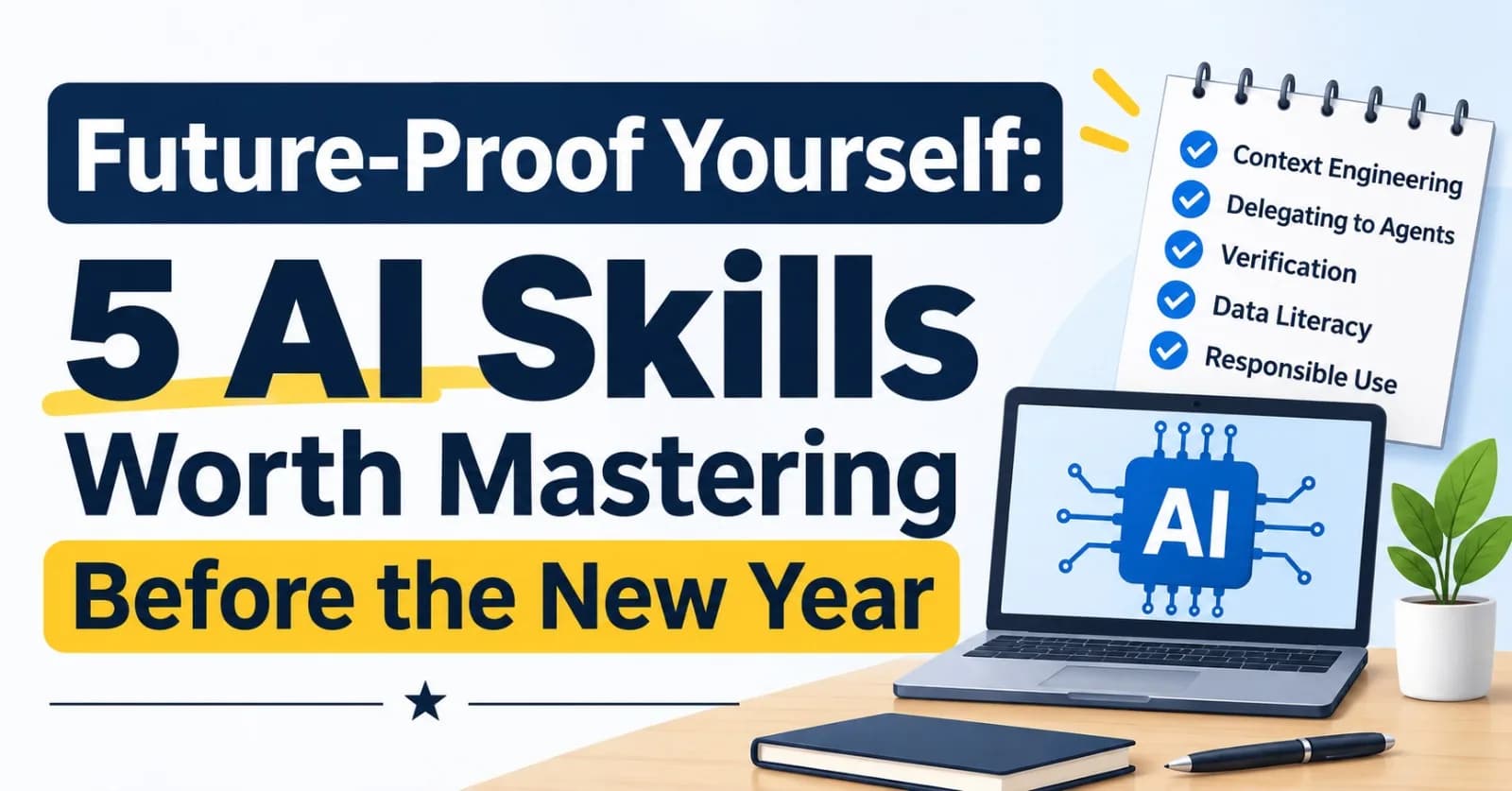
Here are the five to focus on.
1. Context Engineering (Prompting, Grown Up)
Early "prompt engineering" was about clever phrasing and magic words. That era has largely passed. Today's models understand plain language well, so what matters is giving them the right context. Think of it as briefing a smart new colleague who knows nothing about your situation.
A weak request: "Write a product update email."
A strong request: "Write a product update email for our existing customers, who are mostly small-business owners and not very technical. Here are the three features we shipped (pasted below). Keep it under 150 words, warm but not salesy, and end with one clear call to action. Here's a past email whose tone I liked."
The second version isn't longer for the sake of it. Every added sentence removes a guess the model would otherwise have to make. A simple four-part brief covers most situations:
Goal: what you are actually trying to achieve
Context: who it's for, what's already happened, and any source material
Constraints: length, tone, things to avoid
Format: how you want the answer delivered
How to practice: Take your last three AI prompts and rewrite them using the four parts above. Compare the results. You will see the gap immediately.
2. Delegating to AI Agents
Chatbots answer questions. Agents do things: they research across multiple sources, browse websites, edit files, run code, and string together many steps with little hand-holding. As these tools become part of everyday work, the valuable skill is not operating them but delegating to them well.
Say you want a weekly competitor roundup. A vague handoff sounds like "keep an eye on our competitors." A good one looks more like this:
Every Friday, check the pricing and product pages of these four competitors and tell me what changed. "Done" means a one-page summary with a link to each change. Read-only: don't contact anyone or edit anything. Before you write the summary, send me a list of what you plan to check so I can correct course.
That short paragraph contains the four habits of good delegation: a definition of done, a clear scope, a guardrail, and a checkpoint. It's the same way you'd brief a new colleague, and for the same reason: it prevents expensive surprises later.
How to practice: Pick one recurring task, such as a weekly status report, and hand it to an AI tool end to end. Note where it went off track, then refine your instructions. Two or three rounds is usually enough to build a reliable workflow.
3. Verification and Critical Review
AI writes with confidence, whether or not it is right. Suppose an AI-drafted market summary says a competitor's revenue grew 14% last quarter. It sounds plausible, it's cleanly formatted, and nobody questions it. But when you open the cited report, the figure belongs to a different quarter, or the source doesn't say it at all. The mistake stayed invisible until someone looked.
As AI output becomes more fluent, the human skill of checking it becomes more valuable, not less. A few habits make it routine:
Ask for sources, then open them. A citation you haven't checked is just decoration.
Verify numbers, names, dates, and quotes. These are where mistakes hide.
Spot-check, then scale up. If three random items are wrong, don't trust the other forty.
Ask the AI to critique its own answer. "What might be wrong or missing here?" often surfaces real problems, but it supplements checking real sources rather than replacing it.
Test anything executable. Run the code, recalculate the formula, try the link.
A useful rule of thumb: the higher the stakes, the more you verify. A brainstorm for a party playlist needs no fact-checking. A client proposal, or anything involving medical, legal, or financial information, does.
4. Data Literacy
AI is only as useful as the information and questions you give it. Imagine you ask an AI tool why sales dropped in March, and it confidently points to the price change you made that month. That's plausible, but a data-literate reader immediately asks what else changed in March. A competitor's promotion? A stock shortage? Fewer working days? The AI found a story that fits the data. Your job is to ask whether it's the only story.
You don't need to become a data scientist. Focus on the fundamentals:
Structure your information. Clean, labeled tables beat messy copy-pasted text.
Know the common traps. Correlation is not causation, small samples mislead, and averages can hide a lot.
Ask better questions. "Why did sales drop in March, and what else changed that month?" beats "Analyze this data."
Notice what's missing. Ask what data would change the answer, not just what the data you already have says.
How to practice: Take a spreadsheet you know well, such as expenses, project tracking, or sales, and ask an AI tool to find patterns. Then check two of its claims by hand. You'll train both your questioning and your skepticism.
5. Responsible Use and Good Judgment
The fifth skill is less technical and arguably the most important: knowing when, where, and how to use AI safely.
Consider an assistant you've given access to your inbox so it can summarize and triage messages. One email, from a sender you've never heard of, contains hidden text with instructions aimed at the assistant, such as forwarding recent invoices somewhere else. This is called prompt injection. Well-built tools try to defend against it, but no defense is perfect, so the safe habit is to limit what an assistant can do without asking you first, especially sending, deleting, or sharing.
A few other areas deserve the same care:
Privacy: Don't paste confidential customer, employee, or company data into tools that aren't approved for it. Know your organization's policy.
Bias and fairness: AI can reflect biases in its training data. Be especially careful when it informs decisions about people, such as hiring or lending.
Transparency: Be honest with colleagues, clients, and teachers about when AI helped. Trust is hard to rebuild.
Knowing when not to use it: Some work, like a sensitive conversation, a creative project that is meant to be yours, or a task where you're trying to learn, is better done without AI.
People with good judgment about AI will be trusted with more of it. That is a real career advantage.
Your Six-Week Plan
You don't need a course or a certification. You need deliberate practice on real work, not toy exercises.
Week | Focus | Mini-goal |
|---|---|---|
1 | Context engineering | Rewrite your 5 most-used prompts with the four-part brief |
2 | Delegating to agents | Fully hand off one recurring task |
3 | Verification | Fact-check one full AI-generated piece and log the errors you find |
4 | Data literacy | Analyze one real dataset with AI, then verify two claims |
5 | Responsible use | Write a one-page personal "AI rules" checklist |
6 | Put it together | Build one end-to-end workflow that uses all five skills |
The Bottom Line
Go back to our two colleagues. Neither was smarter than the other, and neither had a better tool. The second one simply had a few habits: brief clearly, delegate with guardrails, check the output, question the data, and stay alert to risk.
Tools will keep changing. New models, new apps, and new buzzwords will arrive every few months. These habits will carry over to all of them.
So pick one skill, start this week, and walk into 2027 as someone who doesn't just use AI but knows how to make it work for them.
Which of these five do you want to build first? Share this with a friend who's been meaning to get started.
Comments(0)
Join the discussion by logging into your account.
No comments yet. Be the first to comment!