
+1 (775) 557-4848
If nobody's on the line, it rings inside a phone booth on the playa. Someone walking past might pick it up.
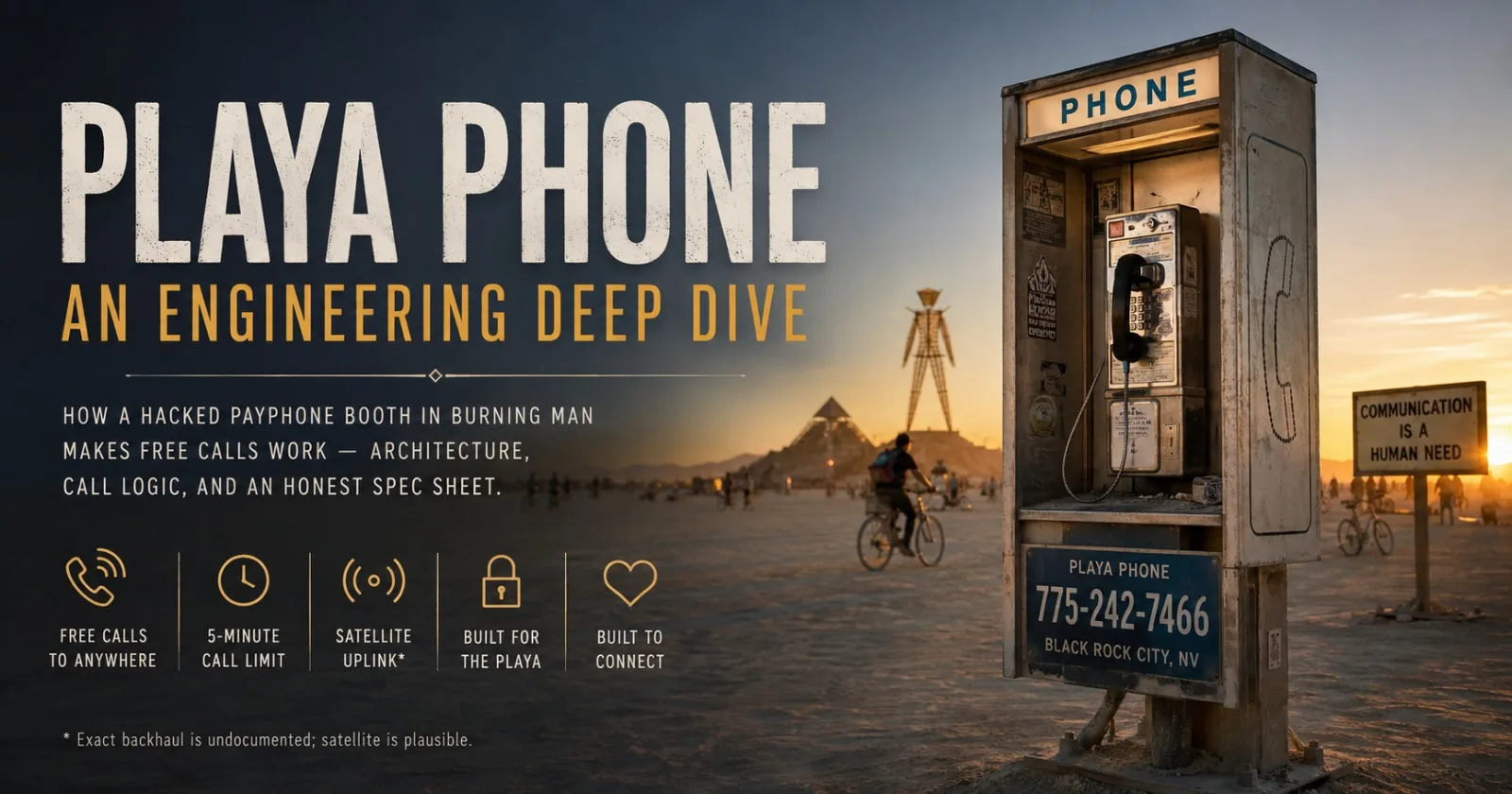
Every August, a temporary city of tens of thousands of people rises out of a dry lakebed in northern Nevada, and about a week later it's gone without a trace. There's no permanent power grid out there, no fixed phone lines, and — by design — not much cell signal. Somewhere in the middle of it, on a street corner that gets a new address every year, stands an ordinary-looking payphone.
The coin slot doesn't do anything anymore — there's no coin mechanism behind it. Dial +1 (775) 557-4848, and if nobody's using the booth, it rings. Someone walking past might pick it up.
This isn't a product in any normal sense. Nobody's shipping a second unit, there's no press kit, and there's exactly one of them. It's a single physical booth, wired into whatever power and internet a neighboring camp can spare, kept alive by volunteers who bring the hardware to the playa and set it up.
And yet it's a genuinely working piece of telecom infrastructure: free outbound calls, capped at five minutes, to almost anywhere in the world, plus inbound calls from total strangers hoping to talk to whoever happens to be walking by. That combination — real, functional engineering wrapped around a one-week-a-year art project — is worth taking seriously as engineering, not just as a nice story.
The booth dates to 2013, when Bay Area engineer Aaron Hopkins wanted a way to call his kid back home without breaking the event's informal etiquette against wandering around on a cellphone. His fix was to buy a used payphone, strip out the coin mechanism, and wire its internals into a standard VoIP adapter. Hopkins has kept it running most years since. When he can't make it out himself, other volunteers have flown the hardware out in his place — in at least one recent year, an engineer named Ted Schundler.
The response has always been bigger than a niche art project would suggest. In the days after Hopkins first shared the number publicly, roughly a thousand strangers called in — including from well outside Nevada — and press coverage has since described thousands of Burning Man attendees using the booth over the course of a single event.
How a payphone gets a dial tone in the desert
Strip away the nostalgia and the booth is a short, unglamorous signal chain. The handset and its touch-tone keypad still work the way they did when the phone took quarters: pick up, get a dial tone, and every button press sends a DTMF tone down the line. The important change is what the line connects to. Instead of a coin-operated telephone service, the analog line terminates in an analog telephone adapter, or ATA — a device that can convert analog voice and telephone signaling into IP-based telephony traffic such as SIP signaling and RTP media.
From there, it's networking, not traditional telephony. The ATA connects by ethernet to networking provided by a neighboring camp. That local setup supplies the booth's network connection and power.
For internet backhaul, the booth's setup changed over time. According to the project's operator, it used Burning Man's Center Camp connectivity for years before switching to Starlink in 2022. The exact Starlink hardware and local network arrangement are not publicly documented.
Confirmed vs. inferred
Confirmed or directly described: the physical payphone, the removed coin mechanism, the VoIP/ATA architecture, the public phone number, the five-minute outbound limit, the one-call-at-a-time behavior described by the project, and the use of Starlink for internet connectivity since 2022.
Engineering inference: the exact ATA model, the exact SIP/VoIP provider, the exact local network arrangement, and where the call timer and ring behavior are enforced. Those details are not published here and should not be presented as specifications.
flowchart TD
    A["Booth handset & touch-tone board<br/>DTMF keypresses + analog audio"]
    --> B["Analog telephone adapter (ATA)<br/>converts analog telephony to IP voice"]
    --> C["Ethernet connection<br/>to host camp network"]
    --> D["Starlink internet backhaul<br/>used since 2022"]
    --> E[Public internet]
    --> F["SIP / VoIP service<br/>routing and call handling"]
    --> G[Public telephone network]
    --> H[Destination phone]
Fig. 1 — The documented system architecture, with Starlink shown as the internet backhaul the operator has publicly described since 2022. The exact local hardware and VoIP provider remain undocumented.
Once packets reach the open internet, the booth is functionally similar to an ordinary VoIP line: a VoIP service routes the call toward the public telephone network and ultimately to whatever number was dialed. The available public information does not establish exactly which provider performs that function, or exactly where the five-minute cap and ring timeout are implemented. Those are best treated as implementation details rather than confirmed specifications.
What happens when you dial
The interesting engineering isn't the hardware. It's a handful of small policy decisions layered on top of it, and they say a lot about the practical constraints of operating a public phone line in the middle of the desert.
Calling out is capped at five minutes. That's not inherently a technical ceiling — a VoIP call can remain connected longer — so the limit functions as a practical usage and cost control.
By the operator's own account, the project does not use ads or analytics to monetize the phone, and the recurring cost of the service is borne by the operator. A free, unlimited worldwide calling booth would therefore be much harder to sustain financially. Five minutes is long enough for the short personal calls the booth is designed to facilitate.
flowchart TD
    A[Booth idle\ndial tone ready]
    --> B[Caller dials a number]
    --> C[VoIP service places the call]
    --> D{Does the other end answer?}
    D -- No --> E[Call attempt ends\nbooth returns to idle]
    D -- Yes --> F[Connected\nfive-minute limit begins]
    F --> G[Timer reaches 0:00]
    G --> H[Call ends automatically]
Fig. 2 — Outbound call flow. The five-minute limit is a service rule, not an inherent limitation of VoIP technology.
Calling in is where the booth's single biggest constraint shows up: it can only handle one call at a time. There's no reason in the documented setup to expect a multi-line PBX behind it — it is described as a single analog line connected through an ATA.
If the line is already occupied, another caller can encounter a busy condition. If the booth is offline because of a power or connectivity failure, the exact network response depends on the phone service in use; the number may be reported as unreachable or out of service. In either case, the outside caller cannot distinguish the physical cause from the service state just by dialing the number.
flowchart TD
    A[Someone dials the booth number]
    --> B{Is the line already in use?}
    B -- Yes --> C[Busy / unavailable condition]
    B -- No --> D{Is the booth online?}
    D -- No --> E[Caller receives the provider's\nunreachable / out-of-service response]
    D -- Yes --> F[Phone rings at the booth]
    F --> G{Does someone answer?}
    G -- No --> H[Call attempt ends\nbooth returns to idle]
    G -- Yes --> I[Connected\nconversation begins]
Fig. 3 — Inbound call flow. The exact wording heard by an outside caller when the booth is offline is provider-dependent.
Single point of failure, on purpose
None of this is redundant. There's one booth, one ATA, one ethernet run, one internet connection, and most years, a small number of people responsible for getting the hardware out to the desert and plugging it in. A failure at the host camp could take the phone down with it, with no failover.
In a conventional telecom deployment, that would be a real design flaw. Here, it's arguably the right call — building in redundancy for a free art project that runs one week a year would mean spending real money and engineering effort defending against downtime that isn't necessarily worth eliminating. Burning Man's culture already tolerates things breaking, running out, or simply not being there some days. A phone booth that occasionally goes quiet fits right in.
Spec sheet
None of the usual smartphone-review numbers apply here — there's no chipset to run a benchmark suite against, and "camera" isn't a category. Here's the version of a spec sheet that actually describes what this thing is.
Parameter | Value |
|---|---|
Concurrent calls | 1 (single analog line / service path) |
Outbound call length | 5 min, then cut automatically |
Rings before giving up | Reported as 6; exact timeout implementation not documented |
Cost to caller | $0 |
Cost to operator | Real service charges, paid personally |
Data collected | The operator says there are no ads or analytics; carrier-level operational records are not documented here |
Core "compute" | One analog telephone adapter |
Network uplink | Starlink (in use since 2022) |
Power source | Shared with a host camp, via the deployed network/power arrangement |
First deployed | 2013 |
Known operators | At least 2 people have been involved in operating/deploying it |
Typical failure mode | Power or internet/connectivity loss at the host camp |
Redundancy | None documented |
Table note: Starlink is publicly described as the internet backhaul since 2022; other implementation details such as the exact ATA model and VoIP provider remain unknown.
Why this works
Judged as a piece of engineering, Playa Phone is almost aggressively right-sized. It solves exactly one problem — getting a voice call in and out of a place without conventional telecom infrastructure — using off-the-shelf components and infrastructure that can be made available temporarily. Nobody needs a custom smartphone-class computer in the booth.
The cleverness is in the integration and the restraint, not in any single component.
The privacy stance is the part worth holding up as a model for products with far bigger budgets. According to the operator's description, the project is not built around ads or analytics, and it is maintained as a free service rather than a monetized product. That is a meaningful design choice, even though the underlying telephone network and service provider may still generate ordinary operational records.
The honest criticisms are about durability, not the basic concept. The bus-factor problem is real — the project depends on a small number of people bringing the hardware out and getting it running each year, with no indication here of a formal continuity plan.
And a single, unredundant line means the booth's availability is only as good as its physical connection, power and internet service. But those are the right costs to pay for what the booth is actually for.
It was never trying to be reliable infrastructure. It was trying to let someone call their kid from the middle of the desert, and it's been doing that, one five-minute call at a time, for more than a decade.
Sources: Playa Phone's own site (playaphone.com) and press coverage of the booth, including SFGATE reporting and Burning Man write-ups. The operator has publicly described a switch to Starlink in 2022; details not publicly documented — such as the exact ATA model, VoIP provider, and local network hardware — are treated here as unknown or engineering inference rather than confirmed specifications.
Comments(0)
Join the discussion by logging into your account.
No comments yet. Be the first to comment!